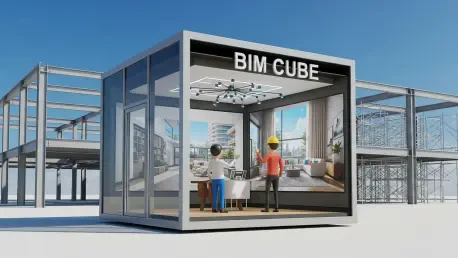

The architectural, engineering, and construction (AEC) industry has long grappled with the challenge of translating complex digital blueprints into tangible, real-world structures without costly errors and misinterpretations. This gap between the digital model and the physical job site often leads to communication breakdowns, budget overruns, and project delays. Addressing this critical issue, Collaborative Ultimate Building Environment (CUBE) has introduced an innovative solution known as the BIM CUBE. This mobile, self-contained room creates a shared, immersive digital environment where entire teams can collaboratively review and interact with project models at a near one-to-one human scale. By stepping inside the CUBE, stakeholders can visualize and refine designs together before a single foundation is poured, fundamentally altering the traditional workflow and aiming to enhance both the quality of service and the final construction outcome by bridging the digital-physical divide in a truly collaborative fashion.
Redefining Collaborative Design
A New Paradigm in Immersive Technology
The BIM CUBE represents a significant leap forward from previous visualization technologies that often isolated users rather than bringing them together for a unified experience. Unlike virtual reality (VR) headsets or stereoscopic glasses, which immerse individuals in a solitary digital world, the CUBE offers a glasses-free, shared environment. This distinction is crucial for the AEC industry, where teamwork and face-to-face communication are paramount. Within its expansive pop-up space, sizable groups of architects, engineers, clients, and contractors can stand side-by-side, naturally interacting with each other and the digital model projected around them. This creates a more intuitive and effective review process, as team members can point to specific design elements, discuss potential clashes, and make decisions collectively without the encumbrance of head-mounted displays. The ability to experience the design on a human scale fosters a deeper understanding of spatial relationships and project scope, allowing for more insightful feedback and a more cohesive and efficient path to a final, approved design.
Adapting to Modern Workplace Challenges
The inherent flexibility and design of the BIM CUBE proved its value in unexpected ways, particularly as workplaces adapted to new health and safety protocols. During the recent pandemic, the CUBE’s spacious interior provided a unique solution for maintaining essential collaboration while adhering to social distancing guidelines. Its large footprint allowed teams to gather and work together effectively within a single, controlled environment, a task that was otherwise challenging in conventional office settings or on crowded job sites. This adaptability underscores the CUBE’s role not just as a technological tool but as a versatile platform capable of meeting the evolving demands of the modern construction industry. By enabling teams to maintain project momentum through in-person, immersive reviews in a safe manner, the system demonstrated its resilience and practicality. This capacity to support continued, high-quality collaboration, regardless of external constraints, positions it as a forward-thinking solution for ensuring project continuity and fostering teamwork in any circumstance.
The Technology Behind the Experience
Seamless Integration and Calibration
A key element enabling the BIM CUBE’s immersive experience is its strategic technological partnership with Scalable Display Technologies, whose software streamlines the complex process of creating a single, cohesive interactive surface. The system utilizes multiple projectors to cast images onto its expansive 40-foot by 10-foot walls, and Scalable’s software is engineered to perfectly align and blend these individual projections. This is achieved through a remarkably user-friendly, single-button calibration system that automatically corrects for geometry and intensity, effectively eliminating the dark spots or misalignments that could otherwise disrupt the visual continuity. The result is a flawless digital canvas where complex models and data can be displayed without any visual seams. This technological foundation is what allows users to become fully immersed in the digital environment, trusting that the information presented is accurate and perfectly rendered. The simplicity and reliability of the calibration process ensure that the focus remains on collaboration and design, not on technical troubleshooting.
Dynamic Workflow and Real-Time Interaction
The sophisticated integration of hardware and software within the BIM CUBE facilitates a highly dynamic and efficient workflow that transforms how project teams interact with digital assets. Users can simultaneously display a detailed 3D design on one wall while projecting a corresponding BIM model on another, allowing for direct, side-by-side comparisons that are crucial for identifying design discrepancies or potential construction issues. Furthermore, the system allows for the overlay of these models onto 360-degree images captured from the actual job site, providing an unparalleled level of context and accuracy. This capability enables teams to spot clashes or misalignments between the digital plan and physical reality early in the process. Any modifications or adjustments made to the design within this environment are reflected in real-time, allowing for immediate feedback and iterative problem-solving on a large, collaborative scale. This dynamic interaction accelerates the decision-making process and significantly reduces the likelihood of costly rework during the construction phase.
A Glimpse into Tomorrow’s Job Site
The introduction of the BIM CUBE signaled a pivotal shift in how the AEC industry approached project visualization and collaborative review. It moved beyond the limitations of individual-focused technologies and established a new standard for shared, immersive experiences that mirrored the teamwork essential to construction. The system’s ability to create a glasses-free, human-scale digital environment allowed diverse teams to engage with designs in a more natural and intuitive way. This technology not only enhanced communication but also streamlined complex decision-making processes by presenting data and models in a unified, easily digestible format. Its successful implementation demonstrated that complex design issues could be identified and resolved in a virtual space long before they manifested as costly problems on a physical job site, ultimately proving its value as a tool for de-risking projects and improving overall efficiency and final quality.