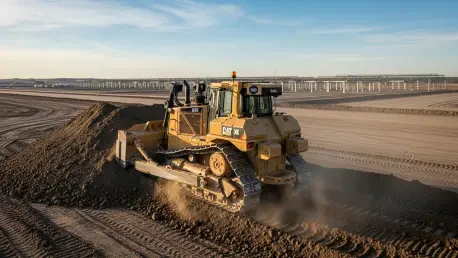

The grand unveiling of the Caterpillar D8 XE at the ConExpo 2026 trade show in Las Vegas signifies a monumental shift in how heavy industrial equipment operates within the modern construction landscape. Launched as a cornerstone of the company’s centennial celebration, this dozer arrived on the scene wearing a distinctive Centennial Grey finish, signaling a departure from the traditional yellow while highlighting a century of engineering evolution. This machine represents the first time electric-drive technology has been successfully integrated into the high-horsepower medium dozer category, building upon the foundations laid by its smaller predecessor, the D6 XE. Far from being a simple update to an existing model, the D8 XE is a ground-up re-engineering effort designed to meet the rigorous demands of road construction, large-scale mining, and complex site preparation. By focusing on mechanical efficiency and environmental responsibility, this machine sets a new standard for how heavy-duty tasks are handled in an era where fuel costs and carbon footprints are critical operational variables.
Revolutionary Transition: Electric Drive Systems
The defining characteristic of this new generation of machinery is the sophisticated electric-drive powertrain that completely replaces the conventional torque converter and multi-speed transmission systems. At the heart of this architecture lies a powerful Caterpillar C15 engine, which functions as the primary power source for a fully-sealed, liquid-cooled electric generator. This generator converts mechanical energy into electrical power, which is then managed by an advanced inverter before being sent to an electric motor located within the propulsion module. This motor provides the necessary torque to the final drives, allowing the tracks to move with a level of precision that mechanical systems simply cannot replicate. By removing the traditional gearbox, the machine eliminates the parasitic power losses associated with gear changes and hydraulic friction, ensuring that a higher percentage of the engine’s output is dedicated strictly to moving material across the job site.
Beyond the mechanical elegance of the electric drive, the performance benefits manifest as tangible gains in daily productivity and long-term fuel economy. Operators utilizing the D8 XE can achieve up to a ten percent reduction in fuel consumption, a figure that becomes particularly significant during medium-load applications where traditional diesel engines often operate outside their peak efficiency curves. This efficiency does not come at the expense of power; in fact, the constant power delivery to the ground results in a six percent increase in material moved per hour. Because the electric motor provides high torque at all speeds, the dozer can push heavy loads faster than its predecessors, especially in scenarios that would typically require shifting between second and third gears in a standard machine. This seamless acceleration allows for a smoother operation, reducing the physical strain on the drivetrain and allowing the operator to maintain a consistent rhythm throughout the workday.
Advanced Design: Thermal Management and Serviceability
To protect the highly sensitive electronic components that enable this electric-drive functionality, the engineering team developed a specialized dual-circuit cooling system. One circuit is dedicated to managing the engine coolant at standard operating temperatures, usually ranging between one hundred eighty and two hundred degrees Fahrenheit. Meanwhile, a secondary, much cooler circuit is employed to maintain the power electronics and the inverter within a narrow window of one hundred twenty-five to one hundred thirty degrees Fahrenheit. This precise thermal regulation is vital for ensuring the longevity of the electrical architecture, preventing the premature degradation of components that must survive thousands of hours in some of the most extreme environments on earth. By separating these cooling paths, the machine can work at full capacity in high-ambient temperatures without risking a thermal shutdown or reduced performance, which is a common concern with high-voltage industrial equipment.
Serviceability was another primary pillar during the development phase, resulting in a modular design that minimizes the time the machine spends in the shop. The electric propulsion module is engineered to be removed and replaced with a level of ease similar to a traditional power-shift transmission, featuring a rail system that allows the entire unit to slide out once the axle shafts and electronic connections are detached. This modularity enables technicians to perform bench-top rebuilding in a controlled environment while the machine returns to the field with a replacement unit. Furthermore, the D8 XE maintains a high degree of parts commonality with the standard D8 model, which means that fleet owners and regional dealers do not need to invest in entirely new inventories of wear parts. This strategic commonality ensures that the transition to electric-drive technology does not create an undue burden on the existing logistical chains that support large-scale construction fleets.
Integrated Technology: Hardware and Automated Systems
The physical hardware of the D8 XE has undergone significant upgrades to match its high-tech powertrain, most notably within the Heavy Duty Track system. These tracks now feature larger bushings and standardized links designed to ensure that the entire undercarriage wears at a more uniform rate, extending the interval between major overhauls. Perhaps the most innovative addition is the integration of track wear sensors embedded directly within the links, which provide real-time data regarding the remaining life of the components. This allows fleet managers to transition from a reactive maintenance model to a predictive one, scheduling repairs before a failure occurs and avoiding the cascading costs of unplanned downtime. The ripper assembly has also been refined, with a new heavy-duty single-shank design that is weighted to provide better penetration in hard rock, complemented by an integrated toe point for recovery operations in difficult terrain.
In the operator’s cabin, the machine utilizes a standardized interface that is consistent across the D5 through D8 models, featuring a ten-inch touchscreen and a comprehensive vision system. The “Cat Assist” suite provides several semi-autonomous features, such as steer assist and stable blade, which automate minor adjustments to maintain smooth surfaces and straight passes with minimal manual input. For more complex tasks, the “Auto Rip” technology manages engine torque and track slip automatically, effectively allowing a less experienced operator to achieve the same efficiency as a seasoned veteran. Safety is further bolstered by “Cat Detect” and “Motion Inhibit” systems, which use the four-camera 360-degree vision array to identify personnel or obstacles in the machine’s path. These systems can prevent the machine from moving if a hazard is detected, providing an essential layer of protection in the busy and often chaotic environment of a large-scale construction site.
Operational Excellence: Industry Versatility and Future Implementation
Caterpillar has tailored the D8 XE to excel in specialized environments through the development of dedicated packages, such as the Waste Handling configuration. This version includes specialized guarding for the fuel and hydraulic tanks, along with thermal shielding for the engine compartment to mitigate the fire risks associated with landfill debris. Enhanced air filtration for both the engine intake and the operator’s cabin ensures that the machine can operate in dusty or contaminated environments without compromising internal components or operator health. These adaptations demonstrate the platform’s versatility, proving that the electric-drive system is robust enough to handle the most abrasive and hazardous applications found in the industrial sector. With a net power of three hundred sixty-nine horsepower and an operating weight that can reach ninety-three thousand pounds, the dozer is positioned as a primary tool for global infrastructure development.
The strategic deployment of the D8 XE provided a comprehensive solution for companies looking to modernize their fleets while navigating the complexities of modern energy requirements. By choosing this electric-drive platform, organizations successfully reduced their reliance on traditional mechanical transmissions, which simplified their long-term maintenance schedules and lowered total cost of ownership. The rollout across North America, Europe, and Australia established a new benchmark for how heavy equipment could be integrated into data-driven job sites. Fleet managers were encouraged to utilize the embedded sensor data to optimize their replacement cycles, ensuring that every machine operated at its peak performance level throughout its life. As the industry moved toward more sustainable practices, the D8 XE stood as a testament to the fact that environmental efficiency and raw mechanical power could coexist in a single, high-performance package that redefined the expectations for the next century of heavy machinery.