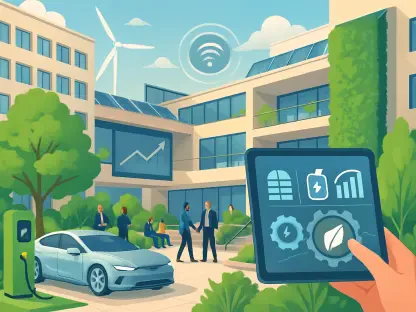

The physical spaces where we work are undergoing a radical re-evaluation, transforming from passive structures into dynamic engines of organizational success. In an age where the very purpose of the corporate office is being questioned, a building must do more than simply house employees; it must actively contribute to the bottom line, enhance employee well-being, and fortify operational resilience. The convergence of information technology and operational technology has unlocked the potential for facilities to become strategic assets, a concept powerfully demonstrated by the technological overhaul of professional sports arenas. These high-stakes environments, which must seamlessly manage immense crowds, complex climate loads, and dense network traffic, offer a compelling blueprint for how any enterprise can leverage its real estate to achieve a significant competitive advantage. This evolution reframes the headquarters not as a cost to be minimized, but as a high-performing tool that works just as hard as the people within it.
The Strategic Imperative of Integrated Operations
For decades, the management of large-scale facilities has been fundamentally inefficient, hampered by the segregation of critical building systems. Functions such as HVAC, physical security, and access control have traditionally operated in isolated silos, each with its own monitoring platform and data stream. This fragmentation forces facility managers into a state of perpetual “dashboard fatigue,” where they must constantly switch between disparate systems to gain a fragmented understanding of the building’s status. This approach creates significant data latency, preventing operators from seeing the bigger picture or correlating seemingly unrelated events in real time. For instance, an unauthorized access attempt might coincide with an unusual energy spike in the same zone, but without an integrated system, connecting these dots requires a slow and manual process of cross-referencing information, delaying response times and hindering proactive management.
The antidote to this operational inefficiency is the deployment of a unified digital architecture that consolidates all building data into a “single pane of glass.” This centralized command center breaks down the walls between siloed systems, aggregating data streams from every corner of the facility into one cohesive and intuitive interface. Platforms engineered for this purpose allow operators to visualize and correlate diverse events on a single screen, eliminating the inefficient “swivel-chair” effect of jumping between monitors. When a security alert is triggered, an operator can instantly view associated camera feeds, check access logs for that area, and assess the status of climate and lighting controls simultaneously. This integrated view empowers staff to make faster, more informed decisions, transforming facility management from a reactive, problem-solving function into a proactive, strategic operation that enhances both security and efficiency across the entire campus.
Reshaping Financial and Environmental Performance
This deep integration of building technologies does more than streamline operations; it fundamentally reshapes a facility’s financial profile by turning a major cost center into a tangible, value-generating asset. The most profound shift occurs in energy management, where artificial intelligence moves the paradigm from being reactive to predictive. An AI-driven performance management platform continuously analyzes a torrent of real-time data, including live occupancy levels, external weather conditions, and upcoming event schedules, to autonomously modulate building controls with precision. Instead of running HVAC and lighting systems on fixed schedules, the platform can dynamically adjust them to meet actual demand, such as pre-cooling an auditorium before a large meeting or dimming lights in unoccupied zones. For a Chief Financial Officer, this capability is revolutionary, converting historically fixed and substantial utility expenses into a variable cost that directly mirrors the building’s real-time usage, unlocking significant bottom-line savings.
Beyond direct cost reduction, this intelligent infrastructure plays a crucial role in enhancing operational resilience and helping organizations meet ambitious Environmental, Social, and Governance (ESG) targets. The same energy optimization that cuts costs also drastically reduces a building’s carbon footprint, providing quantifiable data for sustainability reporting. Furthermore, modern building automation extends to critical safety and maintenance functions, directly impacting business continuity. For example, a smart fire detection system with self-testing capabilities automates routine compliance checks that would otherwise require significant manual labor. This not only lowers maintenance costs but also minimizes potential system downtime and ensures that the organization’s most valuable capital assets are continuously protected. This demonstrates that smart building technology is no longer just about “keeping the lights on”; it is a fundamental strategy for de-risking operations and safeguarding the physical heart of the enterprise.
The Human-Centric Building as a Performance Multiplier
Arguably the most forward-thinking application of smart building technology lies in its ability to directly enhance the performance and well-being of the people inside. In a high-stakes environment like a professional sports facility, this means meticulously controlling variables such as air quality, lighting, and ambient temperature to create an elite training atmosphere that can provide a crucial competitive edge for athletes. This concept serves as a powerful proxy for the corporate world, where the “employees” are highly skilled knowledge workers and the “frictionless office” is becoming a primary tool for attracting and retaining top talent. In a landscape where employees increasingly need a compelling reason to commute, a building that actively contributes to their comfort, focus, and health becomes a significant differentiator, justifying its existence and reinforcing its value as a hub for collaboration and innovation.
This human-centric approach reframes the investment in smart building technology, connecting it directly to the optimization of an organization’s most valuable asset: its human capital. The central proposition is compelling: if precisely controlled environmental conditions can yield a marginal but meaningful improvement in an athlete’s physical performance, the potential return on investment from applying similar principles to enhance the cognitive performance of software engineers, financial analysts, or researchers could be immense. An environment with optimal CO2 levels, circadian-rhythm-aligned lighting, and personalized climate control can demonstrably improve concentration, creativity, and overall productivity. In this model, the building sheds its passive role and becomes an active participant in achieving business objectives, working in concert with its occupants to foster an environment where innovation and peak performance can thrive.
A Blueprint for the Future Enterprise
The strategic convergence of information and operational technologies ultimately provided a clear blueprint for transforming corporate real estate. The initiative demonstrated that a technologically stagnant building was not merely an operational drain but a significant competitive liability in the modern business landscape. By integrating disparate systems into a single, intelligent ecosystem, the project proved it was possible to unlock a new tier of organizational value. The insights gained showed how a physical facility could be reimagined as an intelligent, resilient, and high-performing asset. This transformation yielded a powerful model that drove not only financial success and sustainability goals but also directly supported elite employee performance, setting a new standard for what an enterprise should expect from its physical spaces.