
The dream of a fully automated smart home often collides with the architectural realities of an existing building, where the prospect of chasing wires through plaster and concrete is a non-starter. For years, this has created a fundamental dilemma for homeowners and installers alike: accept the unparalleled stability of a wired system at the cost of disruptive and expensive installation, or opt for the convenience of wireless technology and its associated risks of signal interference, dropped commands, and security vulnerabilities. This persistent trade-off has traditionally limited the scope of ambitious smart home projects, particularly in retrofits where preserving the building’s integrity is paramount. However, a new generation of wireless protocols is challenging this long-held assumption, promising to deliver the robust, dependable performance of a hardwired connection without the need for a single new cable, potentially unlocking sophisticated automation for a vast number of properties previously deemed unsuitable.
The Core Principles of a Resilient Wireless Network
Fortifying Communication with Redundancy and Security
At the heart of any reliable communication system is the certainty that a sent message is successfully received, a principle that becomes even more critical in a wireless environment susceptible to interference. Modern KNX RF systems address this challenge head-on through a multi-layered strategy designed to guarantee data integrity. The primary mechanism is a “Fast Acknowledge” protocol, where every transmitted command requires a confirmation from the receiving device. If this acknowledgment is not received within a fraction of a second, the system automatically initiates a new transmission. This closed-loop communication ensures that a command to lower the blinds or dim the lights is never lost in the ether. This resilience is further enhanced by utilizing multiple wireless channels in parallel. Devices can independently and intelligently switch to a clear frequency if they detect interference from other networks, ensuring stable operation even in buildings saturated with wireless signals. To protect this robust communication from external threats, the entire system is fortified by KNX Secure, which encrypts all data packets to prevent unauthorized access and manipulation.
Maximizing Efficiency and Longevity
While reliability is crucial, the long-term practicality of a wireless system is heavily dependent on its energy consumption and maintenance requirements. A key innovation addressing this is the implementation of a “Slow Low Energy” mode, which dramatically reduces the power draw of battery-operated devices during idle periods. This intelligent power management allows components to function for extended durations without user intervention, significantly lowering the total cost of ownership. For instance, an RF Multi servo controlling a radiator can operate for up to two typical heating seasons on a standard pair of AA batteries. This exceptional battery life transforms what could be a frequent maintenance task into a minor, biannual check, making the system far more convenient for the end-user. This focus on hyper-efficiency not only enhances user experience but also aligns with the growing demand for sustainable building technologies, where minimizing energy consumption across all integrated systems is a primary goal for both new constructions and modernizations.
Expanding Functionality Through Seamless Integration
Unifying Wired and Wireless Components
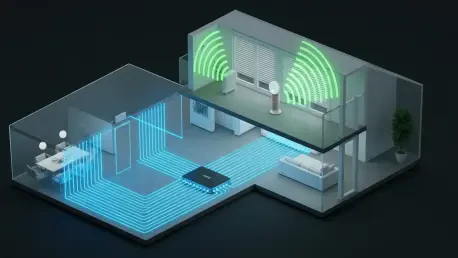
The true power of a modern wireless solution lies in its ability to seamlessly extend an existing, proven infrastructure rather than completely replacing it. This integration is made possible by a dedicated media coupler, such as the Gira RF Multi/TP, which acts as a sophisticated bridge between the wireless KNX RF components and the wired KNX TP network. This single device translates signals in both directions, allowing wireless sensors and actuators to communicate flawlessly with their hardwired counterparts. In larger or structurally complex buildings with thick walls or multiple floors, the coupler can also be configured as a repeater, amplifying the wireless signal to ensure comprehensive coverage throughout the entire property. This capability is transformative for modernization projects, as it empowers installers to add advanced smart functionality to previously inaccessible areas without the need for invasive and costly construction. By eliminating the necessity of opening walls to run new cables, this approach dramatically accelerates installation timelines and preserves the building’s original aesthetic.
A New Paradigm in Smart Home Modernization
The arrival of a comprehensive wireless ecosystem that refused to compromise on stability marked a turning point for the smart building sector. It effectively resolved the long-standing conflict between the flexibility desired for retrofits and the unwavering dependability required of a true KNX installation. The availability of a complete portfolio of compatible devices provided installers with the tools they needed for any scenario. Wireless radiator servos enabled sophisticated, automated climate control for enhanced energy management. Innovative operating top units allowed existing wired inserts for lighting and blind control to be converted into fully functional wireless actuators, crucially maintaining a consistent design aesthetic across the entire property. Furthermore, a dedicated wireless data interface streamlined the entire process of programming, diagnostics, and maintenance through the ETS software. This holistic approach proved that a reliable, secure, and energy-efficient smart home was no longer the exclusive domain of new builds; it became an attainable reality for any building, regardless of its age or structural constraints.