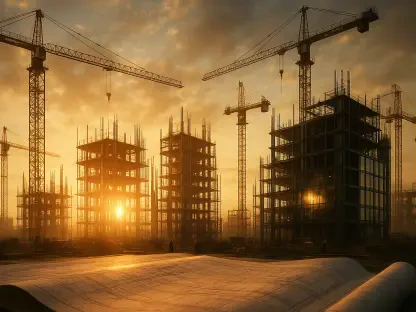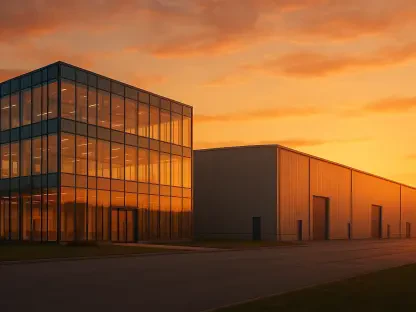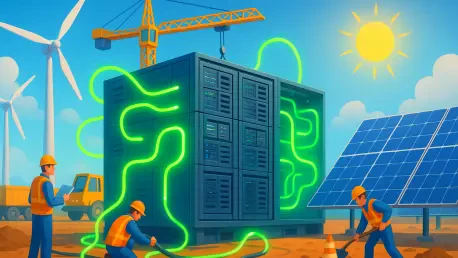

Leading construction firms are increasingly adopting energy-computing integration models to power massive data centers directly with green wind and solar energy sources. This fundamental shift marks a departure from the traditional reliance on the standard power grid, as the sheer energy density required for artificial intelligence necessitates localized, high-capacity sustainable solutions. The global technological landscape is no longer just a software-driven ecosystem; it has become a race for physical capacity, where the ability to build and power specialized facilities determines the pace of innovation. As industry leaders emphasize that AI is becoming a foundational utility akin to water or electricity, the construction sector finds itself at the heart of this industrial metamorphosis. This convergence is not a future projection but a current reality in 2026, where the demand for a robust physical shell to house high-performance digital processes is driving a significant surge in industrial contracts.
The quantitative expansion of this sector is reflected in the financial performance of major engineering firms, which have reported record-breaking orders for computing power hubs and specialized data centers. With year-on-year growth for intelligent computing infrastructure exceeding 300% in some regions, it is evident that a new industrial cycle has begun. This transformation offers a vital lifeline for a sector that has historically grappled with cyclical downturns in residential and commercial real estate. By aligning with the needs of the technology giants, construction companies are evolving from simple builders into critical partners in the digital economy. The intersection of engineering expertise and high-tech requirements is creating a sophisticated marketplace where technical capability and speed of delivery are the primary drivers of success.
The Magnitude of the Computing Power Boom
Quantitative Growth: The Surge in Market Projections
The demand for intelligent computing centers has accelerated at an unprecedented rate, making them the fastest-growing segment in the industrial real estate market. In 2026, the scale of intelligent computing is reaching a pivotal threshold, with global capacity forecasted to hit 1271.4 EFLOPS by the end of the year. This growth is underpinned by a compound annual growth rate that has consistently remained above 50%, reflecting the massive investment poured into training and inference infrastructure by technology conglomerates. The financial implications are equally significant, as the market for internet data centers is projected to expand significantly from 2026 to 2028, potentially exceeding 620 billion yuan in specific regional markets. For construction enterprises, this represents a stable and high-value project pipeline that offsets the volatility seen in traditional building sectors.
Beyond the raw numbers, the surge in computing infrastructure represents a fundamental change in how capital is allocated within the construction industry. Large-scale data centers require substantial upfront investment, often reaching hundreds of billions for a single gigawatt-scale facility. This level of spending is reshaping the priorities of contractors, who are now dedicating specialized divisions to handle the unique technical requirements of these projects. The focus has moved from mass-market residential developments to bespoke, high-specification industrial facilities that can support the heat and power loads of modern GPUs. Consequently, firms that have established themselves in this niche are enjoying healthier margins and more predictable revenue streams than their competitors who remain focused on traditional civil works.
Physical Expansion: Navigating Current Project Landscapes
The current landscape of project development is characterized by hundreds of active construction sites dedicated to intelligent computing. While a significant portion of these facilities is already operational, there are currently over 200 massive projects under construction globally that represent the cutting edge of industrial engineering. These projects are multifaceted, involving not just civil construction but also complex park development, the expansion of high-capacity power grids, and the installation of sophisticated electromechanical systems. The sheer complexity of building a modern AI data center means that timelines are tight and the margin for error is minimal. Each facility must be engineered to provide 24/7 reliability, which requires specialized fire protection, advanced HVAC systems, and redundant power supplies.
The geographic distribution of these projects is also shifting, as developers seek locations with access to cheap, renewable energy and reliable cooling resources. This has led to an infrastructure boom in regions that were previously overlooked by industrial builders, creating new local economies centered around data center parks. Construction firms are responding by deploying modular construction techniques that allow them to assemble data halls in a fraction of the time required for traditional builds. This agility is essential in a market where technology companies are in a race to deploy capacity before their competitors. The result is a highly dynamic construction environment where the ability to manage complex logistics and specialized labor is the key differentiator between successful firms and those struggling to keep pace.
Shifting Labor Dynamics and Corporate Transitions
Talent Migration: Bridging Engineering and Technology
A significant indicator of the current industrial pivot is the dramatic shift in labor demand and recruitment patterns across the construction and technology sectors. In 2026, major internet and cloud providers are aggressively recruiting professionals with traditional civil engineering, HVAC, and electrical engineering backgrounds to build out their physical infrastructure. This “DeepSeek” phenomenon highlights a growing recognition that the digital world cannot exist without a high-performance physical shell. Specialists who once worked on residential high-rises are now finding lucrative opportunities within the R&D arms of technology giants, where they design the next generation of liquid-cooled server rooms and energy-efficient power distribution systems. This cross-border talent migration is effectively blurring the lines between traditional engineering and high-tech innovation.
The influx of construction expertise into the tech sector has also changed the career trajectories for recent graduates. Civil engineering and energy systems students, who previously faced a cooling job market in property development, now see their skills as highly sought after by the world’s most valuable companies. These professionals are tasked with solving critical physical bottlenecks, such as heat dissipation and power density, which are currently the primary constraints on AI development. This shift has forced construction firms to offer more competitive packages and clearer career paths to retain their top talent. As a result, the industry is seeing a professionalization of its workforce, with a renewed focus on specialized technical certifications that bridge the gap between building science and computer science.
Enterprise Evolution: The Pivot to Specialized Models
The industry’s elite construction firms are leading a strategic charge by pivoting their business models from residential projects to landmark AI infrastructure developments. For example, some regional leaders have successfully secured contracts for massive artificial intelligence computing centers, effectively decoupling their financial health from the fluctuations of the broader property market. This transition is not just about changing the types of buildings they construct; it is about changing their entire operational philosophy. These firms are now acting as technology infrastructure partners, working closely with telecommunications and cloud providers from the design phase. By integrating AI and digital twins into their own construction processes, they are improving efficiency and transparency for their high-profile clients.
This evolution is also visible in the changing profile of project owners within the construction sector. In 2026, the primary drivers of large-scale construction activity are no longer traditional property developers but global technology conglomerates and telecommunications carriers. These clients have vastly different requirements, prioritizing speed, technical reliability, and energy efficiency over aesthetic design or residential density. Construction firms that have adapted to this shift are securing multi-billion dollar bids that provide long-term stability. Some specialized enterprises have even reported that data center construction now accounts for nearly 100% of their main operations. This total immersion in the technology infrastructure space represents a new era for the industry, where “builder” and “tech partner” are synonymous.
The Stratified Nature of the AI Supply Chain
Dominant Players: The Edge of Top-Tier Contractors
The boom in AI infrastructure does not distribute its rewards equally across the construction industry, as the market has become highly stratified based on technical and financial capacity. The upper tier of the supply chain is dominated by massive general contractors who possess the scale and “power construction genes” required to handle gigawatt-scale projects. These industry titans have the financial backing to manage the intense capital requirements of high-stakes infrastructure and the expertise to oversee every phase of development from initial design to final commissioning. By offering comprehensive EPC services, they provide a one-stop solution for technology giants who want to minimize the number of interfaces and risks involved in complex builds.
These top-tier firms also benefit from their established relationships with government bodies and power grid operators, which are crucial for securing the massive energy allocations that data centers require. In the current 2026 landscape, the ability to guarantee power access has become a more valuable asset than the ability to provide cheap labor. Consequently, the largest firms are consolidating their market share, leaving little room for mid-sized contractors who lack specialized energy expertise. These leaders are also investing heavily in their own R&D, developing proprietary cooling and power-saving technologies that they can bundle with their construction services. This strategy creates a significant barrier to entry, ensuring that the most profitable projects remain in the hands of a few dominant players.
Technical Specialization: Middle-Tier Growth Opportunities
The middle tier of the construction supply chain is finding its niche by focusing on the specialized technical components that make a data center functional. In the current market, the majority of the capital expenditure for a computing power center is not spent on the building’s shell but on its internal systems, such as liquid cooling, cleanroom environments, and advanced fire protection. Firms that specialize in these electromechanical links are seeing substantial returns because their technical expertise is in high demand and short supply. For these subcontractors, the shift from traditional HVAC to specialized data center cooling represents a massive increase in the value of their services. Their work is critical to the operational success of the facility, making them indispensable partners for general contractors.
Conversely, the bottom tier of the supply chain, which consists of firms handling basic civil work like site preparation and structural shells, faces a much more challenging environment. These tasks are highly commoditized and subject to intense price competition, as they do not require the specialized knowledge that commands a premium. For these players, the AI era is less transformative, as they are competing for a relatively small portion of the total project budget. Without a pivot toward electrical or energy systems, these firms risk being left behind in a market that increasingly values “smart” construction over “bulk” construction. The stratification of the market underscores the importance of technical capability in capturing the true value of the current infrastructure cycle.
Operational Risks and Strategic Challenges
Industry Pressure: Managing Big Tech Demands
Working with major technology enterprises introduces a unique set of operational challenges that differ significantly from the norms of traditional property development. In 2026, “Big Tech” clients demand extreme levels of customization and incredibly fast delivery cycles to keep up with the rapid evolution of AI hardware. A project that takes three years to complete might find its infrastructure obsolete by the time it opens if it cannot adapt to new cooling or power density requirements. This creates intense pressure on construction firms to be flexible and agile, often requiring them to adjust designs mid-build. The result is a high-pressure environment where the ability to manage rapid change is just as important as the ability to pour concrete.
Furthermore, the technology-driven construction cycle operates on a different rhythm than the traditional industry, with a focus on modularity and “just-in-time” delivery. Contractors must coordinate with global supply chains for specialized components like high-capacity transformers and liquid cooling manifolds, which are often in short supply. Any delay in the delivery of these critical items can derail the entire project timeline, leading to significant financial penalties. This requires a level of sophisticated supply chain management that many traditional construction firms have never had to develop. To succeed, these companies are adopting digital procurement platforms and predictive analytics to manage risks and ensure that every component arrives exactly when it is needed.
Financial Viability: Addressing Market Volatility
The capital-intensive nature of AI infrastructure projects creates a high-stakes financial environment where profitability is never guaranteed. Despite the massive order books seen in 2026, some construction firms have reported transitions from profit to loss as they struggle with the upfront costs and low initial margins of these complex builds. The financial strain is compounded by the fact that technology companies may suddenly terminate or scale back contracts if their corporate strategies change or if market conditions shift. This volatility makes it difficult for contractors to plan for the long term, as a major project cancellation can leave them with idle specialized equipment and a bloated workforce.
There are also growing concerns among financial analysts that the current pace of infrastructure investment may be outpacing actual market demand. If the return on investment for AI services begins to stall, cloud vendors may drastically reduce their capital expenditures, leaving construction firms that have pivoted entirely to this sector with significant exposure. To mitigate these risks, the most resilient firms are diversifying their portfolios and seeking project models that involve shared risk with the client. They are also focusing on operational efficiency, using AI-driven project management tools to reduce waste and optimize labor productivity. Balancing the immense opportunities of the computing boom with the inherent financial risks remains the primary strategic challenge for the modern construction executive.
Strategic Evolution: Navigating the Industrial Shift
The shift toward AI-centric infrastructure provided a clear roadmap for construction firms that sought to escape the stagnation of residential markets during the recent transition. Companies that successfully integrated power systems and advanced cooling technologies redefined their value proposition within the global economy. By prioritizing technical excellence over simple physical volume, the industry established a new standard for high-performance industrial real estate. This transition ultimately favored those who viewed the data center not merely as a building, but as a complex machine requiring specialized engineering and precise environmental control. The industry proved that its future lay in the ability to bridge the gap between heavy construction and high-technology requirements.
This evolution demonstrated that the most resilient players were those who focused on green energy synergies and rapid deployment capabilities to maintain their competitive edge. Firms that adopted modular construction and energy-computing integration models reduced the time-to-market for their clients while significantly lowering operational costs. The successful integration of renewable energy sources directly into data center design emerged as a critical differentiator for top-tier contractors. Moving forward, the industry utilized these lessons to expand into other high-tech sectors, such as semiconductor manufacturing and aerospace testing facilities. The transformation of the construction sector into a tech-integrated service industry ensured its relevance in a world where physical infrastructure remains the backbone of digital progress.