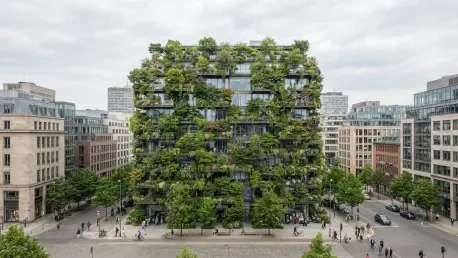

As insurance premiums and mortgages increasingly reflect climate risk, the private sector is independently moving toward resilient and restorative design standards. This shift is not merely a response to environmental ethics but a calculated reaction to the escalating costs of inaction and the degradation of natural resources that once supported urban stability. Architects find themselves at a critical junction where the old metrics of efficiency no longer suffice to protect long-term property values or community well-being. The traditional model of sustainable design, which long sought to do less harm by reducing energy consumption and waste, is being surpassed by a more ambitious framework known as regenerative design. This new approach views every structure as a potential source of ecological and social improvement rather than a parasitic entity that merely siphons resources. By focusing on active healing, the profession is moving toward a standard where the built environment generates positive impacts for local ecosystems.
From Resistance to Strategic Advocacy
Navigating Political and Linguistic Barriers
Historical challenges provide a stark reminder that the adoption of high-performance design is rarely a straightforward technical progression. In the early 2010s, green building initiatives faced intense political friction in several American states, culminating in events like the 2013 decision in Mississippi to effectively ban the LEED rating system for state-funded projects. This legislative move was driven by disputes over timber certification, yet it highlighted a broader disconnect between the architectural community’s goals and the legislative realities of local governments. This incident forced practitioners to reconsider their methods of persuasion and to recognize that the political arena is just as influential as the drafting table. Without the ability to navigate these complex regulatory environments, even the most innovative and scientifically sound designs risk being sidelined by ideological opposition. Architects realized they had to become fluent in the language of policy to ensure their work reached implementation.
Aligning Design with Economic Performance
To bypass these ideological roadblocks, forward-thinking designers transitioned from abstract environmental rhetoric to a pragmatic focus on tangible stakeholder benefits. By reframing sustainability as a matter of energy independence and economic performance, architects managed to gain support from even the most skeptical decision-makers. They began highlighting how well-ventilated schools directly correlated with improved student test scores and how moisture-resistant construction lowered insurance premiums in hurricane-prone zones. This tactical shift emphasized that exceeding minimum building codes was not a luxury but a prudent financial strategy that protected taxpayers and business owners from future utility spikes and repair costs. This evolution in communication proved that when the profession aligns its goals with the values of the broader community, it can advance restorative standards regardless of the political climate. The focus shifted from green aesthetics to the undeniable logic of superior performance.
Building Consensus through Resilience
The physical reality of increasing disaster frequency has forced a nonpartisan dialogue focused on resilience, particularly in regions like the Gulf Coast. In these areas, the concept of resilience serves as a powerful bridge, allowing architects to implement advanced design strategies that might otherwise be dismissed as environmental theory. By focusing on the structural integrity of buildings and their ability to remain operational during grid failures, designers successfully argue for higher standards that prioritize human safety and economic stability. This approach treats the building as a defensive asset, one that protects the owner’s investment while reducing the burden on municipal emergency services. As market actors prioritize risk mitigation, the architectural profession has the opportunity to lead by providing technical solutions that ensure long-term viability. This transition toward resilience-based design provides a clear pathway for integrating regenerative principles into the mainstream market, turning necessity into a catalyst for innovation.
The Paradigm Shift Toward Healing
Moving Beyond the Ceiling of Sustainability
The industry is currently witnessing the emergence of a new performance ceiling where net-zero achievements are becoming the standard rather than the exception. Sustainability has historically been defined by mitigation, essentially asking how developers can limit the damage their projects inflict on the surrounding environment. However, the AIA Strategic Council now argues that this neutral stance is insufficient for the scale of current ecological challenges. Regenerative design fundamentally alters this inquiry by asking what a building can contribute back to its site and the wider community. It represents a transition from a linear, extractive model to a circular, life-affirming one where buildings act as functional components of the local biosphere. By aiming for systemic healing across air, water, and soil, architects are beginning to treat the built environment as a restorative force capable of cleaning urban runoff, sequestering carbon, and cooling the urban heat island effect through integrated biological systems.
Technical Integration of Restorative Systems
Technical execution in this new era involves sophisticated modeling that integrates building operations with surrounding natural cycles to create a symbiotic relationship. Instead of isolated systems, regenerative projects utilize living facades that improve local biodiversity and thermal chimneys that minimize mechanical cooling through passive airflow. These buildings are designed to produce a surplus of renewable energy that can be shared with the local grid, effectively turning properties into distributed power plants. Furthermore, advanced water management systems on-site are now capable of filtering graywater to a standard that exceeds municipal requirements, returning clean water to local aquifers. This shift requires architects to collaborate more closely with ecologists and biologists, ensuring that every design decision supports the health of both human inhabitants and local flora and fauna. The goal is no longer a footprint of zero, but a footprint that actively enriches the landscape, providing a measurable net gain.
Proactive Authority in the Design Sector
The profession is facing a pivotal moment where it must assert its authority over the definition of the regenerative movement or risk being sidelined by external actors. As building science becomes more complex, a vacuum of leadership has appeared, inviting specialized consultants and software providers to dictate the standards and metrics of success. If architects remain passive, they may find themselves following templates and compliance checklists generated by third-party entities rather than leading the creative vision. Reclaiming this authority requires a commitment to research and the proactive development of internal standards that prioritize ecological and community health. By integrating advanced carbon accounting and biodiversity tracking into the design process, firms can establish themselves as the primary experts in high-performance architecture. This effort involves more than just selecting sustainable materials; it requires a holistic understanding of how human environments interact with global systems.
Strategies for Restorative Market Leadership
The transition toward a regenerative model ultimately repositions the architect from a service provider to a vital strategist in the fight for systemic resilience. As professional standards evolve, practitioners prioritize the integration of restorative technologies that transform buildings into active participants in ecological repair. Successful firms move beyond the traditional boundaries of the studio to influence policy and finance, ensuring that every project contributes meaningfully to its local context. This journey requires a significant investment in data-driven design and a willingness to challenge the status quo of building codes. By mastering the intersection of biology, economics, and engineering, the industry establishes a new baseline for what a built environment should achieve. Moving forward, the most effective strategy for the profession involves fostering collaborative networks with interdisciplinary experts to refine these standards. This proactive stance allows architects to safeguard the future of the built environment.