
The global construction industry is currently grappling with a profound identity crisis as the traditional reliance on high-carbon materials clashes with an increasingly urgent mandate for environmental stewardship and human health. For decades, the sector has operated under a rigid dichotomy where “standard” building practices and “green” initiatives are viewed as distinct, often opposing, philosophies. This separation has created a market where sustainability is treated as a premium add-on rather than a fundamental requirement of sound engineering. However, as resource scarcity intensifies and the biological impact of synthetic building environments becomes clearer, this artificial divide is beginning to dissolve. The core challenge for modern developers is no longer simply to build for durability, but to redefine the very essence of construction to include ecological harmony as a non-negotiable metric of success. By moving away from the narrow focus on structural mass and toward an integrated model of efficiency, the industry can finally bridge the gap between human shelter and planetary health.
The Material Conflict: Durability Versus Ecological Responsibility
Traditional construction methodologies have long centered on the use of heavy, consolidated materials such as reinforced concrete, structural steel, and fired brick to ensure maximum longevity and safety. These materials are favored by engineers for their predictable performance, exceptional fire resistance, and ability to provide significant acoustic and seismic insulation through sheer physical mass. Despite these functional advantages, the environmental cost of extracting and processing these resources is immense, contributing to a massive carbon footprint that often lingers long after the building is completed. The production of cement alone remains one of the primary drivers of industrial emissions, creating a legacy of “embodied carbon” that traditional methods struggle to mitigate without radical changes to the underlying chemistry of the materials themselves. This reliance on carbon-intensive skeletons reflects a historical priority where the strength of the container was valued far above the sustainability of its constituent parts.
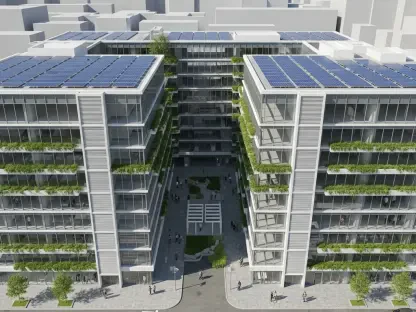
In direct contrast, the green building movement prioritizes a holistic life cycle approach that favors renewable, low-impact materials such as mass timber, hempcrete, and raw clay. These substances are selected not only for their structural capabilities but also for their ability to sequester carbon and minimize the energy required for their manufacture and transport. By utilizing biophilic design principles, green construction seeks to create a symbiotic relationship between the built environment and the natural landscape, ensuring that structures enhance rather than deplete their surroundings. This methodology shifts the focus from the initial cost of construction to the long-term operational efficiency and health of the occupants. The transition toward these natural alternatives represents a fundamental rethinking of what constitutes a “high-performance” building, suggesting that true quality is measured by a structure’s ability to support life across its entire existence, from the first stone laid to its eventual decommissioning.
Evaluating Health and Ethical Materiality
The most critical distinction between these two schools of thought lies in their treatment of human biological health and the ethical implications of material waste. Conventional construction often treats a building as a static, functional box designed to meet specific zoning and safety codes, frequently overlooking the off-gassing of volatile organic compounds from synthetic glues, paints, and insulation. This approach often results in “dead” waste—materials that cannot be easily recycled or biodegraded, eventually filling landfills with toxic debris that persists for centuries. Green building challenges this paradigm by advocating for a circular economy where every component is chosen for its safety and its ability to return to the earth. By focusing on “breathable” wall systems and non-toxic finishes, this methodology ensures that the indoor air quality supports the respiratory health of inhabitants, treating the building as a protective skin rather than just a rigid shell of inert matter.
Furthermore, the current linguistic habit of using prefixes like “bio,” “eco,” or “green” suggests that sustainable practices are an optional specialty rather than the baseline for professional excellence. This terminology creates a dangerous loophole where “standard” construction is implicitly permitted to be ecologically destructive or biologically harmful simply because it does not carry a specific label. If the industry is to evolve, it must reach a point where building correctly—using materials that are safe for both the installer and the end-user—is the only recognized way to build. The goal is to move beyond the niche status of sustainability, ensuring that the principles of ethical materiality are woven into the fabric of building codes and insurance standards. This shift requires a cultural transformation within the trades, moving away from a “disposable” mindset and toward a stewardship model where the health of the ecosystem is viewed as a prerequisite for any new development.
Redefining the Building as a Living Organism
To achieve a truly modern standard, the industry must stop viewing buildings as static commodities and start treating them as complex organisms that interact dynamically with their environment and occupants. This requires a pivot in priority from short-term financial gains and rapid assembly toward more sophisticated parameters, such as hydrothermal performance and the elimination of synthetic emissions. A building designed as a living organism utilizes passive heating and cooling strategies, high-performance envelopes, and natural ventilation to regulate its internal climate without excessive mechanical intervention. This approach views the structure as a reactive system that manages moisture, filters air, and harvests energy, much like a biological entity. By integrating these features into the core architectural design, developers can create spaces that are not only energy-efficient but also deeply conducive to the psychological and physical well-being of the people who utilize them every day.
Moreover, the longevity of a structure must be re-evaluated through the lens of maintenance, adaptability, and eventual disassembly. Unlike traditional buildings that are often demolished with heavy machinery when they outlive their initial purpose, the next generation of construction emphasizes “design for disassembly.” This involves using mechanical fasteners instead of permanent adhesives and modular components that can be easily replaced, upgraded, or harvested for use in other projects. By planning for the end of a building’s life at the very beginning of the design phase, the industry can drastically reduce the volume of construction and demolition waste that currently plagues urban development. This forward-thinking strategy ensures that resources remain within the economic loop, transforming the building into a temporary bank of materials rather than a future pile of rubble. This shift towards modularity and repairability represents the ultimate maturation of the construction sector’s environmental responsibility.
Integrating Technical Strength with Ecological Intelligence
The final evolution of the sector depends on the total unification of traditional structural integrity with modern ecological intelligence. There should no longer be a perceived trade-off between a building that is “strong” and one that is “green,” as current technological advancements in engineered wood and low-carbon concrete demonstrate that these goals are perfectly compatible. Professional builders must adopt a unified standard of construction that guarantees both physical safety and biological integrity as a single, cohesive package. This integration requires a commitment to continuous education across the workforce, from architects to site laborers, ensuring that everyone understands how sustainable materials behave under various stressors. By embracing this technical and social responsibility, the construction industry can shed its reputation as a major environmental polluter and instead become a vital partner in restoring the health of the planet while providing dignified, high-quality housing for a growing population.
Looking ahead, the most successful firms will be those that treat environmental regulations not as hurdles to be cleared, but as opportunities to innovate and lead the market. The path forward involves moving away from the “minimum viable product” mindset and toward a “maximum benefit” philosophy that considers the social and ecological impact of every project. This includes investing in local supply chains to reduce transport emissions and supporting the development of bio-based material science. As the industry moves from 2026 toward the end of the decade, the focus must remain on creating resilient urban environments that can withstand climatic shifts while offering a sanctuary for human health. The transition is already underway, and those who fail to integrate these principles will likely find themselves obsolete in a world that increasingly demands accountability, transparency, and a deep respect for the natural systems that sustain all life. The future of building is not just about the structures themselves, but about the quality of the legacy they leave behind.