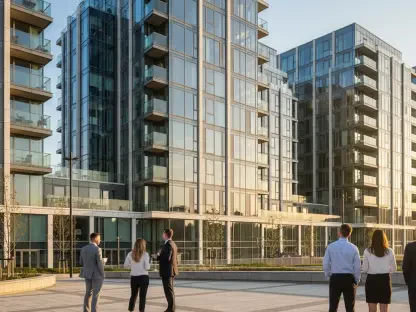

Standing as a testament to architectural ingenuity, the Renewable Energy/STEM Center at Suffolk County Community College demonstrates that a building can perform as a dynamic instructor rather than a static container for desks. This 26,000-square-foot facility serves as a functional machine, producing as much energy as it consumes while pulling back the curtain on the complex mechanics of sustainability. By moving beyond traditional four-walled instruction, the center creates a sensory experience where students do not just read about thermodynamics; they stand inside a living example of the discipline.
From Blueprint to Breakthrough: When the Classroom Becomes the Lesson
Traditional educational structures often hide their mechanical hearts behind drywall and ceiling tiles, but this hub celebrates its inner workings. The architecture is the curriculum, inviting learners to witness how structural decisions influence environmental outcomes. This transparency transforms every hallway into a potential lecture hall, shifting the focus from passive listening to active discovery.
As the college’s first net-zero building, the facility proves that ambitious climate goals are compatible with high-intensity academic use. It challenges the conventional boundaries of school design by treating the physical envelope as a teaching tool. Consequently, the transition from theoretical study to practical observation occurs the moment a student enters the lobby, making the invisible forces of energy visible and tangible.
The Sustainability Triangle: Addressing the Modern Educational Crisis
Decarbonization efforts have historically faced a gap between academic theory and the practical skills required to manage a green economy. This facility bridges that divide by anchoring itself in the “sustainability triangle,” a framework that balances environmental health, economic viability, and social equity. Located in Brentwood, the center provides local students with high-tech resources that were once exclusive to elite private institutions.
By achieving LEED Gold certification, the college addresses regional climate goals while democratizing access to specialized training. This social equity component ensures that the shift toward renewable energy includes a diverse workforce. The building serves as a vital response to the modern workforce crisis, preparing a new generation to lead the energy transition with confidence and technical proficiency.
Anatomy of a Living Laboratory: Technical Mastery in Action
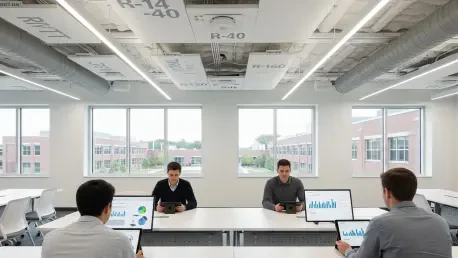
Technical excellence is woven into the very bones of the structure, utilizing Passivhaus engineering to achieve extreme thermal efficiency. R-40 insulation and high-performance glazing work in tandem to minimize energy loss, while a roof of photovoltaic panels paired with geothermal wells secures energy autonomy. These systems are not merely background utilities; they are the primary subjects of study for those enrolled in the college’s technical programs.
Inside, an intelligent climate control system utilizes Variable Refrigerant Flow technology to demonstrate precise energy management. Strategic roof geometry and daylight sensors further illustrate the intersection of physics and architecture by optimizing natural light. Students monitor real-time data from these systems, gaining a granular understanding of how various components interact to maintain a net-zero balance throughout the changing seasons.
Validation Through Design: The AECOM and LEED Gold Standard
The collaboration with the architectural firm AECOM ensured that every square foot of the Michael J. Grant Campus landmark met rigorous performance standards. Achieving LEED Gold certification was not an end goal but a validation of the facility’s role as a high-performance workspace. The design incorporates insulating berms and a central demonstration garden, blending professional-grade engineering with accessible public education spaces.
This dual-purpose approach proves that sustainable design can meet demanding academic needs without compromising on aesthetics or functionality. By integrating nature and technology, the designers created a space that inspires pride in the local community. The facility stands as a benchmark for public infrastructure, showing that government-funded projects can compete with private innovation in the quest for a carbon-neutral future.
Bridging the Gap: Strategies for Implementing Sustainable Pedagogy
To fully leverage the potential of a net-zero hub, the college adopted a framework that integrates the facility into daily student life through active observation. Lectures often migrate into the “living laboratory” where students witness geothermal systems in real-time. This hands-on approach fosters collaborative problem-solving, encouraging engineering and environmental science students to work together on cross-disciplinary projects.
The institution also aligned its curriculum with workforce needs by connecting classroom metrics to career-ready skills in the renewable energy sector. By using the space as a social hub, the college demonstrated the tangible benefits of green technology to the surrounding population. Moving forward, educators sought to replicate this immersive model, ensuring that the next generation of technicians and scientists remained at the forefront of global sustainability efforts.