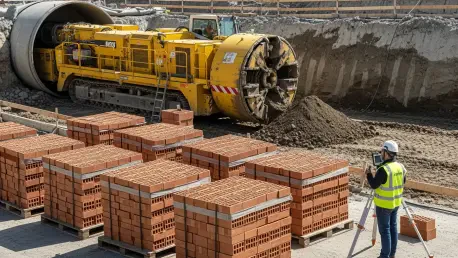

The expansion of Vienna’s subway system, specifically the massive U2xU5 project, is evolving into a landmark experiment for the urban circular economy that challenges traditional notions of construction waste. Through a strategic partnership between the municipal transport agency, Wiener Linien, and the global manufacturing leader Wienerberger, excavated clay from deep tunnel construction is being systematically repurposed rather than discarded in overfilled landfills. This initiative marks a significant shift in how major infrastructure projects approach environmental management, effectively turning a common byproduct of transit expansion into a premium resource for the local building industry. By integrating industrial production directly with urban development, the city is demonstrating that the materials needed to build the future are often hidden right beneath the surface of the existing metropolitan landscape. This circular approach not only addresses the logistical headaches of soil disposal but also creates a self-sustaining loop where the city’s growth literally provides the physical substance for its own architectural evolution.
Industrial Scale and Technical Standards
Converting Raw Earth into Construction Material
The production process behind the so-called “subway bricks” is a full-scale industrial operation that treats excavated clay with the same technical rigor as virgin raw materials sourced from dedicated mines. Once the soil is extracted from the depths of Matzleinsdorfer Platz by the tunnel boring machine “Debohra,” it is transported to specialized processing plants in Hennersdorf and Göllersdorf. At these facilities, the raw earth undergoes a series of mechanical and thermal treatments to ensure that any organic impurities are removed and the mineral composition is optimized for masonry. This high-level refinement allows the resulting bricks to meet the highest industry benchmarks for structural integrity, load-bearing capacity, and long-term durability. By integrating this “waste” material into standard high-volume manufacturing lines, the project proves that sustainable alternatives can perform just as reliably as traditional building supplies without requiring any compromises in safety or engineering quality.
Furthermore, the technical success of this conversion process relies on the specific geological properties of the Viennese soil, which has been prized for brickmaking for centuries. The consistency of the clay extracted from the tunnel boring operations allows for a seamless transition into the existing kilns of Wienerberger’s regional plants. Engineers have conducted extensive testing to confirm that the thermal insulation and soundproofing properties of these recycled bricks are identical to those made from primary clay sources. This scientific validation is crucial for gaining the trust of architects and structural engineers who require predictable material behavior for complex urban developments. Consequently, the project has successfully demystified the use of secondary raw materials in heavy construction, showing that circularity is not just a theoretical goal but a practical reality that can be achieved through rigorous quality control and cross-industry collaboration.
Market Viability and Regional Integration
These bricks are not merely a specialized niche product reserved for symbolic green projects; they are specifically designed for widespread market viability and will soon be available through standard building material retailers across the region. This broad accessibility allows modern developers and private homeowners to continue Vienna’s long-standing architectural tradition of building with local clay, which historically defined iconic landmarks like the Parliament and the Karl Marx-Hof. By ensuring these materials meet all modern technical standards for energy efficiency, the city has successfully bridged the functional gap between heavy civil engineering and high-performance residential architecture. The commercialization of the subway bricks ensures that the environmental benefits of the U2xU5 project extend far beyond the transit network itself, influencing the broader construction market and encouraging other manufacturers to explore similar resource recovery strategies.
The logistical framework supporting this initiative is equally vital to its commercial and environmental success, as it focuses on minimizing the distance between the excavation site and the end user. By utilizing regional processing plants located in Lower Austria, the project maintains a streamlined, efficient supply chain that keeps the city’s foundation within a tight economic cycle. This regional focus supports local employment while simultaneously reducing the overhead costs associated with long-haul transportation of heavy building materials. Moreover, the project creates a new economic model where the costs of tunnel excavation are partially offset by the value of the reclaimed material. This shift in economic perspective transforms a traditional liability—the expense of hauling and dumping soil—into a tangible asset that contributes to the local economy. As these bricks enter the mainstream market, they serve as a physical reminder of how urban infrastructure can be leveraged to create a more resilient and self-reliant building sector.
Environmental Impact and Future Planning
Establishing a Sustainable Urban Blueprint
This initiative serves as a foundational cornerstone of Vienna’s broader strategy to achieve total climate neutrality by 2040 by rethinking the lifecycle of urban infrastructure. By reframing excavated soil as a strategic resource rather than a burden, the city significantly reduces the pressure on local landfills, which are increasingly reaching their capacity limits. This diversion of thousands of tons of material protects natural landscapes from the environmental degradation often associated with new clay mining operations. Furthermore, keeping the entire production and logistics chain within the local region drastically minimizes the carbon footprint associated with the transport of heavy construction materials. This holistic approach ensures that the environmental gains are not just limited to the reduction of waste but are distributed across the entire supply chain, from the moment the earth is moved to the final placement of the finished brick.
Beyond the immediate benefits of waste reduction, the subway brick project adds a vital layer of sustainability to the U2xU5 expansion, which already stands as the largest climate protection project in the city’s history. While the expanded transit network is expected to save approximately 75,000 tons of CO2 annually by providing a viable alternative to private vehicle use, the circular construction approach ensures that the building phase itself is resource-efficient. This dual focus on green operation and green construction sets a new international standard for how metropolitan areas can grow without exhausting their natural resources. By treating the construction site as a source of material rather than just a place of consumption, Vienna is pioneering a model of “urban mining” that can be applied to various other types of infrastructure development. This strategy effectively decouples urban growth from environmental destruction, proving that a modern city can expand its services while simultaneously restoring its ecological balance.
Future Perspectives and Global Scalability
The success of the initial pilot project has already prompted city officials and industrial partners to explore similar clay-to-brick initiatives for upcoming phases of the subway expansion, including the U5 extension to Hernals. By demonstrating that urban excavation can be successfully integrated into industrial supply chains, Vienna provides a replicable roadmap for other global cities facing similar challenges of waste management and resource scarcity. The institutional consensus between municipal leaders and private industry demonstrates that sustainability goals are most effectively met when they are aligned with economic and industrial logic. As more data is gathered from the current phase of production, the city plans to refine the process to include a wider variety of excavated materials, potentially expanding the circular model to include concrete recycling and other mineral waste streams. This ongoing evolution suggests that the subway brick is only the beginning of a much larger shift toward a truly circular urban metabolism.
In looking toward the next decade, the focus must now shift to standardizing these circular practices across all public works and private developments to ensure long-term viability. Future urban planning should prioritize the early identification of reusable materials during the geological survey phase of any major project to maximize recovery rates and minimize logistics costs. There is also a significant opportunity for other metropolitan areas to adopt this “Vienna Model” by fostering deeper cooperation between transit authorities and local manufacturers. Policymakers should consider implementing procurement guidelines that favor materials sourced from local excavation sites, thereby creating a guaranteed market for circular products. By embracing these actionable steps, cities can transform their underground construction challenges into a steady supply of high-quality, low-carbon building materials. The transition toward a circular economy has shown that when public agencies and private manufacturers align their goals, they can literally rebuild the city using its own subterranean foundation, turning ancient soil into modern solutions.