
The quest for urban sustainability is increasingly turning our buildings from passive consumers of energy into active participants in the ecological landscape, and a groundbreaking approach is harnessing the power of one of Earth’s oldest life forms. Researchers are now exploring how microscopic algae, cultivated within the very walls of our structures, can create a new generation of living architecture that breathes, cools, and cleans the air around it. This fusion of biology and construction engineering is not a distant futuristic concept but an emerging reality, particularly promising in regions blessed with abundant sunlight. By integrating sophisticated photobioreactors into building facades, urban planners and architects are on the brink of transforming static skylines into dynamic, green ecosystems. This innovative technology holds the potential to significantly reduce a building’s carbon footprint while simultaneously enhancing its energy efficiency and aesthetic appeal, paving the way for cities that are not just smarter, but truly alive.
The Green Engine of Modern Buildings
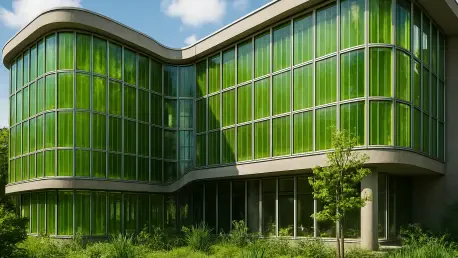
The core of this architectural evolution lies in the integration of photobioreactors, which are essentially transparent panels or tubes filled with a culture of microalgae. When incorporated into a building’s exterior, these systems function as a living skin, absorbing solar radiation and atmospheric carbon dioxide to fuel photosynthesis. The environmental impact is profound; microalgae are remarkably efficient at CO₂ fixation, with studies indicating their carbon capture rates are ten to fifty times higher than those of terrestrial plants. This transforms a building from a significant source of greenhouse gas emissions into an active carbon sink, continuously purifying the air and releasing oxygen. In climates characterized by high solar availability and minimal risk of freezing, the conditions are ideal for year-round cultivation, allowing these bioreactors to operate at peak efficiency. This creates a symbiotic relationship where the building not only shelters its inhabitants but also nurtures a photosynthetic process that actively works to mitigate climate change on a local scale.
Beyond its impressive carbon-capturing capabilities, this algae-based system serves as a highly effective form of passive solar control, directly addressing the challenge of building-related energy consumption. The dense culture of microalgae suspended in water within the facade panels acts as a natural heat shield, absorbing a significant amount of solar energy that would otherwise penetrate the building and increase indoor temperatures. This process dramatically reduces the thermal load, especially in sun-drenched regions where overheating is a primary driver of energy use. By mitigating heat gain, the reliance on conventional air conditioning systems is substantially lessened, leading to considerable savings in both energy costs and electricity consumption. The dynamic nature of the algae also allows it to filter sunlight, reducing glare while still permitting natural light to enter interior spaces. This creates a more comfortable and visually pleasant indoor environment, proving that sustainable design can simultaneously enhance building performance and inhabitant comfort.
Beyond Bricks and Mortar: A Human-Centered Approach
The integration of living algae systems extends its benefits beyond environmental metrics and energy savings, delving into the realm of biophilic design and human well-being. This is particularly relevant in specialized applications, such as modular accommodations for workers in harsh, remote environments. In these settings, integrating photobioreactors can transform otherwise utilitarian structures into visually engaging and futuristic habitats. The vibrant green of the algae and the gentle bubbling within the panels offer a connection to nature, providing a mental escape and reducing the stress associated with isolated or industrial surroundings. This approach acknowledges that sustainable architecture must also be human-centric, creating spaces that are not only efficient but also restorative. The living facade becomes more than a technical component; it evolves into a dynamic piece of art that improves the daily experience of its occupants, fostering a more positive and productive atmosphere in challenging locations.
This forward-thinking approach is also being applied to public urban spaces, where bio-urban designs are blurring the lines between science, art, and infrastructure. Prototypes like the “Urban Algae Tree” demonstrate the potential for this technology to create functional and educational landmarks within the cityscape. Such a structure is conceived to be entirely self-sufficient, designed to provide ample shade, capture and utilize rainwater for its own processes, and remove an estimated 1,000 kilograms of CO₂ from the atmosphere annually. Beyond its practical functions, it serves as a powerful public statement on sustainability, making complex ecological concepts accessible and engaging for everyone. By integrating these living systems into common structures like bus shelters or park pavilions, cities can create interactive experiences that raise public awareness about environmental stewardship. These installations become focal points for community engagement and learning, inspiring a collective move toward greener urban living.
A Vision Realized
Pioneering research in this field has successfully transitioned from theoretical models to tangible prototypes, demonstrating the viability of integrating microalgae into the built environment. The focus has shifted from laboratory experiments to real-world implementation, aiming to deliver measurable environmental and social impacts. This work establishes a clear pathway for architects, engineers, and urban planners to adopt a technology that turns buildings into active contributors to ecological health. The designs have not only proven their capacity for significant carbon capture and energy reduction but have also highlighted the profound benefits of biophilic design on human well-being. Ultimately, the successful development of these algae-based architectural systems provides a compelling blueprint for a future where our cities can breathe, adapt, and thrive in harmony with the natural world.