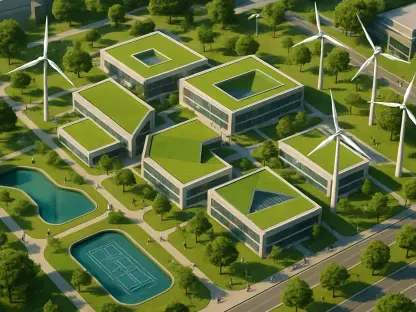

The global construction industry stands at a critical juncture, confronting its profound environmental impact, which includes accounting for 32% of the world’s energy demand and 35% of its carbon dioxide emissions. The very materials that form the backbone of modern infrastructure, particularly cement and steel, are responsible for a substantial 18% of these building-related CO₂ emissions through their production processes alone. As the environmental toll of conventional construction continues to mount, a powerful current of innovation is pushing the industry toward sustainable alternatives. Among the most promising of these is hempcrete, a bio-composite material that offers a compelling pathway to creating buildings that not only reduce their ecological footprint but also actively enhance the health and well-being of the people who inhabit them, marking a potential turning point in the quest for a greener built environment.
A Material of Earth and Innovation
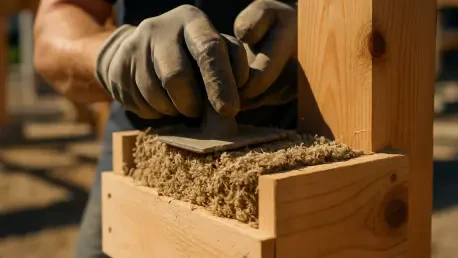
Hempcrete, known more formally as lime-hemp concrete or LHC, is a unique bio-composite defined as a cellulose aggregate concrete. Its composition is a straightforward yet effective mixture of hemp hurds—the woody inner core of the hemp stalk—blended with a lime-based binder and water. The modern resurgence of this material can be traced back to 1980s France, where it was ingeniously employed to improve the thermal performance of historic timber-framed buildings while preserving their structural and aesthetic integrity. This historical application underscores its core identity as a material that pairs a natural, plant-based aggregate with a mineral binder, creating a product that is both ancient in its components and revolutionary in its modern potential. Its simplicity in composition belies a sophisticated performance that addresses many of the shortcomings of its conventional counterparts, offering a sustainable alternative rooted in natural cycles.
The physical characteristics of hempcrete are central to its growing appeal in the sustainable building sector. Possessing a medium density and an exceptionally high air content, the material is markedly lighter than conventional options like brick or standard concrete. This inherent porosity is the source of several of its most significant benefits. It grants hempcrete a high absorption coefficient, making it “breathable” by allowing it to absorb and release moisture vapor from the surrounding air. This dynamic property helps to naturally regulate indoor humidity levels, which in turn prevents common issues such as condensation and the growth of mold, contributing to a far healthier indoor air quality for occupants. Furthermore, this porous structure traps air, providing excellent thermal insulation. This quality is highly valued in the pursuit of creating energy-efficient buildings that require less energy for heating and cooling over their lifespan, directly reducing operational carbon emissions.
Despite its impressive thermal and hygrothermal properties, hempcrete does have a significant limitation: its relatively low compression resistance. Unlike traditional concrete, it is not a structural, load-bearing material and cannot be used to support a building on its own. This characteristic necessitates its use in tandem with a separate structural frame, which is typically constructed from timber or steel and designed to bear the building’s entire load. Within this framework, hempcrete functions as an infill material, forming the primary insulation and walling system. This method of application makes it highly compatible with modern construction techniques, particularly timber framing systems, allowing architects and builders to integrate a high-performance, sustainable material into contemporary residential and commercial designs without compromising structural integrity. Its role is not to replace structural concrete but to offer a superior alternative for the building envelope.
From Concept to Construction Site
The construction industry utilizes hempcrete through three primary application techniques, each tailored to different project scales, designs, and logistical requirements. The first method is cast-in-situ hempcrete, where the material is mixed on-site and then poured or cast into temporary molds or formwork to create monolithic structures for floors, walls, and roofs. A second approach involves the use of pre-fabricated hempcrete blocks. These are manufactured in a controlled off-site environment and then transported to the construction site, where they are used in wall construction in a manner similar to traditional masonry. The blocks are typically designed and arranged to minimize the interruption of the insulating layer, thereby reducing the thermal bridging that can compromise the performance of conventional blockwork. The third and most mechanized technique is spray-applied hempcrete, which functions similarly to the cast-in-situ method but uses specialized equipment to spray the mixture onto a surface or into a frame, enabling a much faster application over large areas and complex shapes.
According to Anna Graaf, White Arkitekter’s Sustainability Director, the successful application of hempcrete hinges on a nuanced understanding of its inherent properties. “Hemp can be used in exterior walls and interior walls,” Graaf explains. “In interior walls, it’s much easier because then you don’t need to consider the matter of moisture as much as in exterior walls and the issue of air tightness as well.” For exterior applications, which expose the material to the elements, employing the correct construction methodology is paramount. While hempcrete is inherently breathable, achieving the necessary levels of air tightness and moisture control within an exterior building envelope requires specific knowledge and careful detailing, much like the advanced building techniques used today. Graaf emphasizes this point, stating, “It’s crucial to know how a material works so you use the right construction methodology.” This underscores that hempcrete is not a simple drop-in replacement but a high-performance material that demands a thoughtful and informed approach to design and construction.
Paving the Way for Widespread Adoption
Despite its numerous environmental and performance benefits, the widespread adoption of hempcrete faces significant hurdles, primarily a lack of standardized practices and a pervasive knowledge gap within the construction industry. This absence of established “know-how” is a critical factor hindering its use on a larger scale. Many large construction contractors, especially in markets like Sweden, are not yet experienced in handling, mixing, and building with hempcrete. This unfamiliarity naturally leads to a preference for its use in smaller buildings, where project complexities are lower and the material is perceived as easier to manage. Graaf notes that in larger, more intricate buildings, a greater level of experience and expertise is required. However, she offers an optimistic perspective on its future trajectory, believing that the market is currently building a solid foundation through these smaller projects, which will cultivate the necessary skills and confidence to eventually scale its use into larger and more ambitious architectural endeavors.
At the forefront of sustainable design, White Arkitekter, an employee-owned Scandinavian firm founded in 1951, is actively demonstrating the potential of materials like hempcrete. The firm has set an ambitious goal to make all of its architectural projects climate-neutral and regenerative by 2030. Their strategy to achieve this involves a holistic approach that includes meticulously selecting materials with a minimal carbon footprint, promoting the recycling and reuse of materials, reducing overall material consumption, and planning for future disassembly. Hemp is a cornerstone of this vision. As Graaf articulates, “Hemp is a relatively new material, although it’s an old one. It’s bio-based with a low carbon impact: a natural material that can be grown quickly and has low energy use during production… it’s regenerative… and it can go back to nature again.” To advance these goals, the firm operates a dedicated research department, the White Research Lab, and collaborates with an external research foundation to develop and showcase sustainable solutions, often featuring new materials in office libraries for clients to experience firsthand.
The Velindre Cancer Centre in Cardiff is a landmark project that masterfully embodies this forward-thinking philosophy. Tasked with creating the UK’s most sustainable hospital, White Arkitekter developed a design that seamlessly integrates social and environmental sustainability. The choice of materials was integral to realizing this vision. The design team selected natural materials with high breathability and a low carbon footprint, such as hempcrete and mineral plasters, while prioritizing locally sourced options whenever possible. This material palette was chosen not only for its outstanding environmental credentials but also for its proven ability to create a calming, healthy, and restorative space that fosters the well-being of both patients and staff. The building’s design follows a circular approach, utilizing materials that are sturdy, reusable, and require minimal maintenance, while the structural and material strategy was optimized to minimize the total amount of material needed for construction. This unwavering commitment to holistic, nature-based solutions ultimately earned the project the prestigious European Healthcare Design Award in 2022.
An Imperative for a Sustainable Future
The intensified focus on materials like hempcrete was driven by the urgent need to address the profound environmental consequences of the global construction industry. Throughout their life cycles, conventional materials like steel and cement were identified as major contributors to pollution, the depletion of finite natural resources, and the acceleration of climate change. In response to this stark reality, interest surged in green building practices and the development of sustainable alternatives. Bio-based composite materials, particularly hempcrete, represented a viable and highly promising path forward. They offered a way to construct buildings that not only minimized their adverse environmental impacts but also significantly enhanced the health and well-being of their occupants, marking a crucial step toward a more responsible and regenerative built environment.