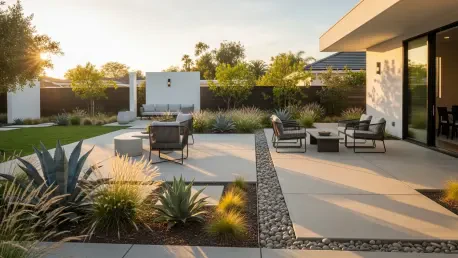

Amidst the pressing environmental realities of a changing climate, California’s iconic landscapes are undergoing a profound transformation, compelling a shift in how outdoor spaces are conceived, designed, and constructed. Landscape architect Ive Haugeland and her boutique studio, Shades of Green, are at the vanguard of this evolution, redefining the discipline from a pursuit of pure aesthetics into a highly technical and functional art form. By masterfully integrating a clean, Scandinavian design sensibility with an unwavering commitment to sustainability, Haugeland is creating outdoor environments that are not only visually stunning but are also resilient, resource-efficient systems engineered to thrive in the state’s unique and demanding context. Her work demonstrates that the gardens of tomorrow must be as hardworking as they are beautiful, setting a new standard for landscape architecture.
A New California Aesthetic
Design-First, Function-Forward
The contemporary Californian landscape is tasked with a dual mandate that extends far beyond simple ornamentation, a challenge that Ive Haugeland’s studio, Shades of Green, addresses with a sophisticated, function-forward approach. These outdoor spaces must now operate as high-performance environmental systems, actively managing critical resources and mitigating ecological risks. This involves the intricate design of elements like bioretention swales for stormwater management, rainwater capture systems for irrigation, and strategic planting schemes to reduce fire risk and combat the urban heat island effect. Simultaneously, these landscapes must meet the demands of modern outdoor living, providing sophisticated, well-appointed areas for relaxation and entertainment. This philosophy, which insists that a landscape must “work as hard as it looks good,” reframes the garden not as a static backdrop but as a dynamic, living system that supports both human well-being and ecological balance in a seamless, integrated design.
While the principles of sustainability and functionality are foundational, Haugeland’s creative process remains firmly rooted in a design-first philosophy, driven by a deep appreciation for the artistry of nature. The core motivation is the love of plants, colors, textures, and forms, and the desire to craft spaces that are emotionally resonant and aesthetically pleasing. However, this artistic vision is supported by the non-negotiable pillars of ecological responsibility and practical usability. The objective is to create environments where people can connect with the beauty of the natural world without compromising on environmental stewardship. This approach ensures that sophisticated, contemporary design is not sacrificed for sustainability but is instead enhanced by it. The result is a harmonious fusion where elegant design solutions emerge directly from functional requirements, proving that a resilient, high-performing landscape can also be an oasis of refined and enduring beauty.
Scandinavian Roots in a Golden State
Ive Haugeland’s Scandinavian heritage imparts a distinct design sensibility to her work, offering a refreshing counterpoint to the more ornate or pseudo-European styles that have often characterized Californian landscapes. This perspective is defined by principles of clarity, restraint, and an intuitive, respectful connection to the natural world. Her designs prioritize clean lines, uncluttered compositions, and a carefully curated palette of materials and plants that emphasize texture, form, and seasonal change. This minimalist approach avoids fleeting trends in favor of a timeless aesthetic that allows the inherent beauty of the landscape and its surrounding architecture to take center stage. By stripping away the superfluous, this Scandinavian viewpoint fosters a sense of tranquility and order, creating spaces that feel both contemporary and deeply rooted in their environment, offering a calm and sophisticated retreat from the complexities of modern life.
The fusion of a Scandinavian aesthetic with the practical demands of the California climate results in landscapes that are both visually cohesive and technically robust. This design language is exceptionally well-suited to sustainable practices, as its emphasis on simplicity and naturalism aligns perfectly with the use of native and climate-adapted plants, permeable surfaces, and subtle water-management features. Rather than imposing a foreign style onto the land, this approach seeks to work in harmony with the local ecology. The restrained color palettes and structural clarity of the designs create a perfect canvas for drought-tolerant flora, showcasing their unique forms and textures. Consequently, the landscapes created by Shades of Green are not just beautiful but are also intelligently designed to mature gracefully over time, requiring fewer resources and adapting seamlessly to the environmental realities of the Golden State.
The Art of Sustainable Practice
Sustainability as a Baseline
Long before sustainability became a mandated buzzword in landscape architecture, Ive Haugeland was pioneering its principles, integrating concepts like green roofs, rain gardens, and permeable paving into her designs when they were still considered niche specializations. This extensive experience positions Shades of Green as a leader in environmentally responsive design, bringing years of practical knowledge and technical expertise to every project. For the studio, sustainability is not an afterthought or an optional upgrade; it is the fundamental baseline from which all design decisions originate. This proactive and deeply ingrained commitment means that clients benefit from a level of foresight that anticipates future regulatory changes and environmental challenges. By treating ecological stewardship as a core tenet, the studio ensures that every landscape is designed from the ground up to be resilient, water-wise, and supportive of local biodiversity.
The studio’s standard practice embodies a holistic approach to sustainability, reflecting a core principle of working in concert with the natural environment rather than attempting to dominate it. This philosophy is evident in the comprehensive suite of integrated systems specified for each project. These often include advanced irrigation technology, soil health management programs, the selection of climate-appropriate and fire-resistant plant species, and the thoughtful grading of the land to capture and utilize every drop of rainfall. This method moves beyond mere water conservation to create landscapes that actively contribute to a healthier ecosystem. By prioritizing solutions that are regenerative and self-sustaining, Shades of Green crafts outdoor spaces that are not only less dependent on finite resources but also become more robust and vibrant as they mature, creating a lasting legacy of environmental responsibility.
The Boutique Studio Advantage
Shades of Green’s decision to operate as an intentionally small, hands-on studio is a key strategic element that distinguishes it within the competitive luxury residential market. This boutique model enables Ive Haugeland and her dedicated team to maintain meticulous control over every facet of a project’s lifecycle. From the first conceptual sketches and the careful selection of materials to the creation of detailed construction documents and vigilant on-site field coordination, the studio’s involvement is comprehensive and deeply personal. This holistic oversight ensures that the original design vision is executed with unwavering precision and consistency, preventing the dilution of ideas that can occur when a project is fragmented across multiple firms. This commitment to quality control at every stage results in a final product that is not only beautifully designed but also impeccably constructed and true to the initial intent.
This integrated, high-touch approach fosters a level of trust and transparent communication with clients that is difficult to achieve in larger, more impersonal firms. Clients are not handed off between departments but work directly with the core team from start to finish, ensuring a clear, unified voice and a seamless process. This continuity is crucial for complex residential projects, where decisions must be made in collaboration with architects, engineers, and contractors. The boutique structure allows for greater agility and responsiveness, enabling the team to address challenges and refine details efficiently. Ultimately, this client-focused model synthesizes design and project management into a single, cohesive service, delivering a more coherent and reliable outcome while building strong, lasting relationships based on shared vision and mutual respect.
Blending Craft with Technology
In the contemporary practice of landscape architecture, the fusion of ecological science and sophisticated design is paramount, a synthesis exemplified by the work of Shades of Green. The studio adeptly leverages modern technology, employing essential tools like Computer-Aided Design (CAD) for precise technical drawings and advanced 3D modeling software for realistic project visualization. These digital tools are indispensable for ensuring accuracy, improving efficiency, and allowing clients to fully comprehend the design intent before construction begins. They facilitate complex analyses of site conditions, from sun and shadow patterns to intricate grading and drainage plans. Furthermore, looking ahead, the potential integration of AI applications promises to further streamline processes and enhance analytical capabilities, ensuring that the studio remains at the forefront of the industry’s technological evolution and continues to deliver technically sound and innovative design solutions.
Despite the firm’s embrace of technological advancements, the philosophy at Shades of Green steadfastly asserts the irreplaceable value of human craft, artistic intuition, and direct personal oversight. Technology is viewed as a powerful tool that serves and enhances the design process rather than driving it. The nuanced selection of a plant combination, the subtle texture of hand-selected stone, and the on-the-ground adjustments made during construction are all elements that transcend digital simulation. It is this human touch—the decades of experience, the deep understanding of materials, and the intuitive feel for a space—that elevates a project from a competent plan to a truly exceptional landscape. This deliberate balance ensures that efficiency never comes at the expense of artistry, resulting in sophisticated, high-quality environments that are not only well-engineered but also imbued with a timeless sense of place and soul.