
With a keen eye on the intersection of design, construction, and technology, Luca Calaraili has become a leading voice in architectural innovation. His work focuses on practical solutions that drive the industry forward, making him the perfect expert to dissect one of the most promising initiatives in housing today: the NSW Housing Pattern Book. We sat down with him to explore how this project is moving from concept to construction, tackling everything from design flexibility and site adaptability to the real-world lessons being learned as the first homes take shape. This conversation unpacks the delicate balance of delivering high-quality, sustainable housing at an accelerated pace and what the early, enthusiastic market response signals for the future of urban development.
The design by Other Architects and NMBW aims to redefine the traditional terrace. What specific features allow for flexibility and customization, and how do these adapt to the needs of different twenty-first-century households? Please share some examples.
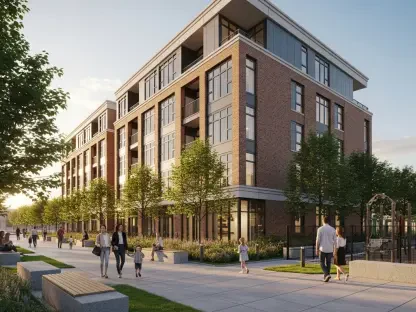
What’s truly exciting about this design is that it breaks the rigid mold of the classic terrace. It’s not just a single, fixed floor plan. The core idea is to create a framework that can be adapted for a wide range of modern living situations—from a young family needing a home office to a multi-generational household requiring separate living zones. This flexibility is built into the pattern itself, allowing for different configurations of rooms, varied dwelling sizes, and unique internal layouts all within a cohesive row. Imagine one unit configured as a spacious four-bedroom home, while its neighbor might be a three-bedroom with a dedicated ground-floor studio. This is about giving people choices and a sense of ownership over their space, moving beyond the one-size-fits-all model that no longer reflects how we live.
The Edmondson Park site is sloped and irregular with multiple street frontages. How did these challenging conditions demonstrate the pattern’s adaptability, and what specific design adjustments were made to accommodate the variety of dwelling sizes within a single row?
That site is the perfect real-world stress test for this concept. You have a slope, an odd shape, streets on three sides, and a rear laneway—it’s the kind of plot that would typically cause major headaches for a standard, cookie-cutter development. But for this pattern, it’s a showcase. These conditions forced the design to prove its adaptability. The architects were able to cleverly step the row of seven terraces down the slope, adjusting floor levels to match the topography naturally. The multiple frontages allowed them to orient different homes to different streets, creating a more dynamic and engaging streetscape. This is how the pattern accommodates a variety of dwelling sizes so seamlessly; the irregular site becomes a justification for variation, not an obstacle.
As the first pattern book project to be constructed, what key lessons are you hoping to learn? Could you walk me through the specific goals for the demonstration home and how Landcom will use it to promote the broader initiative?
This first build is absolutely critical; it’s our proof of concept in brick and mortar. We’re moving from theoretical plans to a tangible outcome, so we’re watching every detail of the construction process to refine the model for future projects. The main goal for the demonstration home, which Landcom will retain when the project is complete in early 2027, is to serve as a physical ambassador for the entire pattern book initiative. It’s one thing to see a drawing, but it’s another to walk through a finished space, to feel the quality of the light, and to understand how the flexible spaces work. Landcom will use this home to show developers, councils, and potential homebuyers what high-quality, architect-designed medium-density housing can look and feel like, demystifying the process and encouraging wider adoption.
The pattern book’s goal is to accelerate high-quality, affordable, and sustainable housing. Beyond pre-approved designs, what practical steps or processes are in place to ensure both speed and quality, and how is this balance managed on the ground?
The pre-approved nature of the designs is the most significant accelerator, as it streamlines a notoriously slow and complex planning system. But the quality is embedded right from the beginning. These aren’t generic, off-the-shelf plans; they are the result of a rigorous design process involving respected firms like Other Architects and NMBW Architecture Studio. The patterns have already been vetted for their architectural merit, sustainability, and livability. On the ground, this means the construction team can focus on execution rather than wrestling with design or compliance issues. The balance is maintained because the creative, high-quality thinking has already been done upfront, allowing the construction phase to be efficient without cutting corners.
With over 21,000 patterns sold in six months and projects approved in various suburbs, what does this early adoption signal about market demand? What are the next crucial steps for the government to support this momentum across the state?
The numbers are staggering and send a clear signal: the market is hungry for this. Selling over 21,000 patterns in just six months shows a pent-up demand for well-designed, accessible housing options that fall somewhere between a traditional house and a high-rise apartment. People want quality and certainty, and the pattern book provides both. To maintain this momentum, the government’s next crucial step is to continue rolling out more demonstration sites, like the ones being finalized with Sydney Olympic Park Authority and Homes NSW. They also need to ensure the planning system is equipped to efficiently process these applications. The goal should be to make building a pattern book home the most straightforward and appealing option for small-scale developers and families right across the state.
What is your forecast for the NSW Housing Pattern Book initiative?
My forecast is incredibly optimistic. I believe we are at the beginning of a fundamental shift in how we approach medium-density housing. The early success at Edmondson Park and the high volume of pattern sales indicate that this initiative has struck a chord. If the government continues to support and expand it, I foresee the pattern book becoming a standard tool for delivering diverse, high-quality, and sustainable homes much faster than our current models allow. It has the potential to not only alleviate housing shortages but also to significantly elevate the architectural quality of our suburbs, creating more vibrant and livable communities for generations to come.