
The historic streets of Clerkenwell are currently undergoing a radical metamorphosis as the fifteenth edition of Clerkenwell Design Week introduces a curatorial expansion known as Design Interventions. This ambitious initiative pushes the boundaries of traditional interior design by relocating large-scale installations from the relative seclusion of indoor showrooms directly into the public squares and thoroughfares of the EC1 district. By repurposing historic churchyards, forgotten subterranean chambers, and lush public greens, the festival effectively converts the everyday urban environment into an experimental gallery that investigates material innovation and sensory perception. This shift represents a deliberate move to make high-concept design accessible to the general public, fostering a unique dialogue between the architectural heritage of London and the cutting-edge creative movements of the present day. These installations do not merely exist as passive objects; they act as catalysts for communal engagement, forcing pedestrians to pause and reconsider their relationship with the physical spaces they navigate daily.
Redefining Social Interaction Through Material Innovation
Challenging Visual Assumptions in Public Spaces
The “Fountain of Technicolour Beads” located on Clerkenwell Green serves as a profound investigation into the nuances of human perception, specifically addressing Color Vision Deficiency. Created by One Bite Design, this terrazzo installation utilizes a sophisticated palette that challenges the fundamental assumption that visual reality is a universal experience shared equally by all observers. As visitors move around the structure, the shifting colors and patterns highlight how individuals with different chromatic perceptions interpret the same physical object. This piece moves beyond mere aesthetic appeal, functioning as a psychological tool that encourages empathy and awareness regarding the diversity of sensory experiences. By placing such a complex conceptual work in a bustling public area, the designers force a confrontation with the invisible barriers that define our social interactions. The tactile nature of the terrazzo further invites physical contact, bridging the gap between an intellectual understanding of optical science and the visceral reality of public art.
In a similar vein, “The Crinkle-Crankle Bench” by StudioFolk reimagines the historical concept of boundary walls to create a new form of social infrastructure. This installation utilizes natural stone carved into a sculptural, half-crescent formation that snakes through its environment, providing varied seating options and pockets for conversation. Traditionally, walls are designed to exclude or divide, but this reinterpretation uses the same materials to invite gathering and reflection. The weight and permanence of the stone contrast with the fluidity of the serpentine shape, suggesting that modern urban furniture can be both monumental and welcoming. This intervention demonstrates how traditional masonry techniques can be updated to meet the needs of a contemporary workforce that increasingly seeks “third spaces” for informal meetings and mental respite. By integrating functional seating into a piece of fine sculpture, the project blurs the line between public utility and artistic expression, turning a simple stroll through the district into a moment of unexpected communal connectivity and rest.
Harmonizing Modern Design With Historic Masonry
The dialogue between the contemporary and the ancient reaches its peak with the “Confluence” installation, situated within the imposing architecture of St Bartholomew the Great. Fung+Bedford have employed their signature origami-inspired folded geometries to create a structure that stands in stark contrast to the 900-year-old masonry surrounding it. While the medieval stone represents an era of permanence and rigid structural integrity, the folded white forms of the installation evoke a sense of lightness and modern fragility. This juxtaposition does not clash; instead, it highlights the enduring relevance of geometric precision across different centuries. The installation serves as a bridge, connecting the craftsmanship of the Middle Ages with the digital-era precision of modern paper-folding techniques. Visitors are encouraged to walk through and around these ethereal shapes, experiencing how light and shadow interact with both the new installation and the ancient arches, thereby creating a multi-layered sensory experience that honors the past while firmly embracing the future of spatial design.
The temporary nature of these installations is further explored through “The Pulse of Becoming,” a living work created by graduates Musab Umair, Amruta Ramesh Pullawar, and Sharath Binu John. This piece utilizes crescent-shaped shells embedded with thousands of chia seeds, which are designed to sprout and grow over the course of the festival. This biological progression transforms the structure from a static architectural object into a living, breathing organism that changes daily. By situating this organic growth against the backdrop of Clerkenwell’s luxury interior showrooms, the designers highlight themes of renewal and the inevitable cycles of life that persist even within a high-tech urban environment. It serves as a reminder that the built environment is not a finished product but an evolving entity that must coexist with natural processes. The visual transition from clean, white shells to lush, green surfaces provides a time-lapse experience of nature reclaiming the urban fabric, prompting discussions about the sustainability of temporary event structures and the potential for integrating living systems into permanent city planning.
Technological Frontiers in Spatial Mediums
Integrating Artificial Intelligence and Three-Dimensional Fabrication
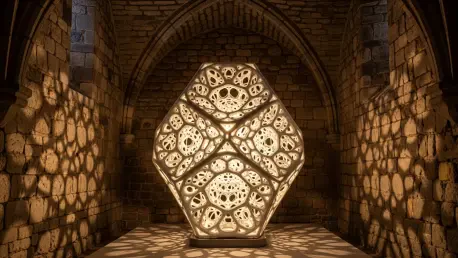
Technological advancement remains a primary pillar of the event, particularly evident in the “Light” exhibition housed within the historic House of Detention. The “Loom Light” sculpture, a collaborative effort involving MIMStudios, AI Build, and SEAM Design, represents a significant leap forward in the integration of 3D printing and artificial intelligence. This work utilizes complex algorithms to dictate the structural form, resulting in a shape that would be nearly impossible to achieve through traditional manufacturing methods. The use of robotic fabrication allows for a level of intricacy that mimics biological patterns, while the integrated lighting elements transform the sculpture into a spatial medium rather than a simple light fixture. This installation underscores a broader industry trend where lighting is no longer treated as a functional afterthought but as a primary architectural component that defines the volume and mood of a space. The subterranean setting of the prison cells provides an atmospheric backdrop that emphasizes the glow and precision of the 3D-printed lattices, merging the dark history of the site with the bright possibilities of current technology.
Building on the concept of lighting as a transformative force, the exhibition demonstrates how Op Art principles can be applied to digital manufacturing. The “Loom Light” does not just emit illumination; it manipulates it through its skeletal structure to create moiré patterns and shifting shadows that change as the viewer moves. This interactive quality is a direct result of the synergy between generative design software and advanced hardware, showcasing how designers are now using AI to explore aesthetic territories that were previously unreachable. For the design industry, this represents a shift toward “smart” materials and structures that can be customized for specific environmental conditions or aesthetic desires. The collaboration between these diverse firms—ranging from lighting specialists to AI developers—highlights the necessity of interdisciplinary approaches in contemporary urban design. By moving beyond silos, these creators are producing works that are at once structurally sound, technologically sophisticated, and visually arresting, setting a new standard for how light and form can be synchronized to enhance the human experience within the city.
Synthesizing Urban Rhythm and Immersive Experiences
The decentralization of the festival throughout the EC1 district fosters a unified narrative of innovation that transcends the boundaries of a typical trade show. By weaving high-concept design into the physical and social rhythms of the city, the event ensures that innovation is not just seen but felt by those who inhabit these spaces. This strategy prioritizes accessibility, removing the metaphorical “velvet rope” of the design world and inviting everyone from professional architects to casual passersby to participate in the experience. The result is an urban landscape that feels more vibrant and responsive, where historic preservation is balanced by the injection of modern creativity. These interventions serve as a blueprint for how cities can utilize temporary festivals to test new ideas for public space usage, material sustainability, and community interaction. As the festival progresses, the collective impact of these diverse works creates a sense of place that is both rooted in Clerkenwell’s industrial past and oriented toward a future of collaborative, tech-driven urbanism.
In evaluating the long-term implications of these design interventions, it is clear that the integration of site-specific art into public infrastructure offers a viable path for revitalizing aging urban districts. The success of the current program suggests that designers should continue to advocate for the use of “living” materials and AI-assisted fabrication to create more adaptive and inclusive environments. Future urban planning could benefit significantly from adopting the experimental mindset seen in these installations, particularly regarding how public seating and lighting can be used to improve mental well-being and social cohesion. Stakeholders in city development must consider how temporary activations can lead to permanent improvements in material standards and communal spaces. Moving forward, the focus should remain on developing interdisciplinary partnerships that bridge the gap between historic conservation and technological progress, ensuring that the urban landscape remains a dynamic canvas for innovation. The lessons learned from this year’s installations provided a robust foundation for a new era of responsive, human-centric city design that had transitioned from theory into tangible reality.