
A design philosophy centered on deep respect for the natural environment has earned a Philippine-based firm top honors, suggesting a profound shift in how we approach the creation of built spaces. Plontur Group’s Luana Farms project in Calaca, Batangas, recently secured the “Leisure-Led Development” award at the prestigious World Architecture Festival (WAF) 2025, not for a bold architectural statement, but for its quiet deference to the landscape. This victory brings international attention to a methodology that challenges the long-held practice of imposing human will upon the earth. Instead of seeing land as a blank slate to be conquered and reshaped, this approach treats it as a primary collaborator, a source of intelligence that can guide development toward a more sustainable and authentic outcome. The success of Luana Farms serves as a powerful testament to the idea that the most innovative designs may not come from a drafting table, but from listening intently to what the land itself has to say.
A Dialogue with the Earth
The core principle that guided the creation of Luana Farms is encapsulated in the phrase “letting the land lead,” a concept championed by Erick Yambao, Plontur’s Founder and Principal Designer. This methodology positions the land itself as a form of “design intelligence,” fundamentally rejecting the conventional approach where a preconceived architectural vision is imposed upon a site, often requiring extensive clearing and grading. Instead, the design team embarked on a process of deep observation and response, allowing the inherent characteristics of the terrain to dictate the masterplan. The existing topography, ecological systems, and natural contours were not seen as obstacles to be overcome but as directives to be followed. This patient, interpretive process ensures that the resulting development feels as though it has emerged organically from its surroundings, fostering a sense of place that is both authentic and deeply connected to its environment.
This philosophy translated into a masterplan where every decision was a reaction to the site’s natural state. The circulation paths follow the gentle slopes of the land, the organization of spaces respects existing ecological corridors, and the orientation of buildings is determined by natural light and wind patterns. By working in harmony with the landscape, the designers avoided the destructive “cut-and-fill” methods that dominate modern construction. This approach is not simply about preservation; it is an active collaboration with nature that seeks to amplify the inherent beauty and logic of the site. The result is an environment where the built and natural worlds are not in conflict but are part of a single, cohesive system. This profound respect for the land’s integrity demonstrates that architecture can be a force for enhancing the environment, rather than diminishing it, creating spaces that are both beautiful and ecologically responsible.
Cultivating a New Model of Development
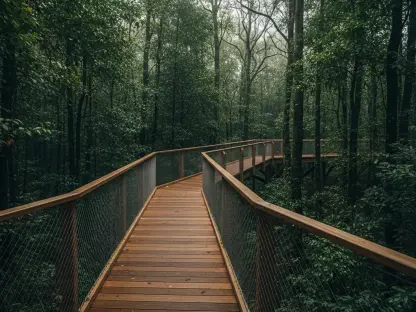
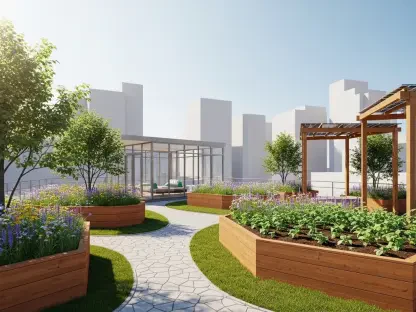
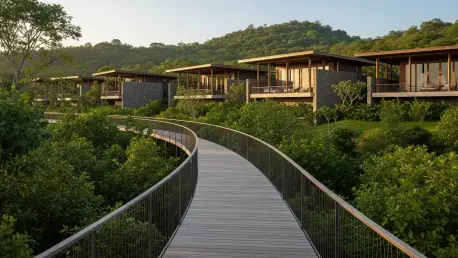
At Luana Farms, the abstract philosophy of nature-led design materializes in a series of tangible, innovative features that redefine community living. To preserve the delicate ground-level ecosystems, human movement is facilitated by elevated walkways that weave through restored natural areas, allowing residents to experience the environment without disrupting it. Residential and community spaces are not isolated from their surroundings but are seamlessly integrated with “productive landscapes,” where active farming is not just tolerated but celebrated as a central part of the community’s identity. This ensures that agricultural heritage is sustained rather than erased by development. Open landscapes are treated as primary, essential areas, not as residual afterthoughts between buildings. Architectural structures are designed to emerge gently from the terrain, while traditional hard boundaries like gates and walls are replaced with softer “thresholds,” reinforcing a sense of being invited into the space by nature itself.
The project’s success establishes it as a critical counterpoint to prevailing development trends, particularly within the rapidly urbanizing context of the Philippines. The standard approach of overwriting the natural landscape is here replaced by a method of restraint and amplification. By choosing to work with what the land already offers, Plontur demonstrates a powerful model where ecology, agricultural productivity, and residential life can not only coexist but mutually reinforce one another. This harmonious integration challenges the false dichotomy that often pits development against conservation. Luana Farms stands as a globally relevant case study, offering a blueprint for sustainable development that can be adapted to diverse contexts. It proves that a leisure-led development can be economically viable while being ecologically sensitive and socially enriching, setting a new benchmark for the industry worldwide.
A Victory for an Entire Community
The international acclaim received by Plontur Group at the WAF 2025 is more than a singular achievement; it represents a major milestone for the entire Philippine design community. This prestigious award affirms the capability of local practitioners to contribute meaningfully to the global discourse on architecture and sustainable development. It signals the maturation of a design culture within the country that values interdisciplinary collaboration, innovative thinking, and a deep connection to context. The victory elevates the profile of Philippine design on the world stage, demonstrating that solutions rooted in local conditions and philosophies can have a universal and transformative impact. This recognition moves beyond celebrating a single project to validating a national creative industry that is increasingly poised to lead conversations on the future of the built environment.
The Ascendance of Landscape-Led Design
Perhaps the most profound implication of the Luana Farms project was how it fundamentally redefined the relationship between disciplines. In countless developments, landscape architecture is relegated to a secondary, often decorative, role—a finishing touch applied after the primary architectural and engineering decisions have been made. At Luana Farms, this established hierarchy was completely inverted. Here, landscape architecture was not a supporting player but the primary, driving force that shaped the entire project from its inception. The lay of the land, its ecological systems, and its productive potential were the first considerations, and all architectural interventions were designed to respond to and serve this landscape-led vision. This project powerfully demonstrated that the landscape can, and perhaps should, lead architecture, not merely frame it. The award has brought a critical but often overlooked discipline into the spotlight, championing its central role in creating more sustainable, resilient, and deeply integrated built environments for the future.