
The iconic, canopied landscapes of the Berkeley Hills, where sculptural oaks arch over homes and vines of wisteria spill across property lines, have long defined the area’s charm and contributed to its high property values. This deeply ingrained aesthetic, a multi-layered tapestry of lush vegetation snuggled against homes, is now facing an existential challenge driven by the escalating threat of wildfires. After years of record-breaking fire seasons across California, new regulations are set to upend nearly two centuries of landscaping tradition. The city of Berkeley will soon mandate that residents in high-risk areas clear a five-foot, ember-resistant buffer around their homes, a concept known as “Zone 0.” This requirement is forcing a fundamental reimagining of what a Berkeley Hills yard should look like, pushing homeowners to become reluctant pioneers in a new era of landscape design where resilience and safety must coexist with beauty. They are now at the forefront, creating a new paradigm that addresses the stark realities of climate change and redefines the relationship between home, garden, and the wildland interface.
1. A Clash of Aesthetics and Imperatives
The prevailing design of planting shrubbery directly against a home’s foundation is not a recent trend but a deeply rooted ideal promoted in the 19th century by Andrew Jackson Downing, often called the father of American landscape architecture. In his influential 1842 book, Cottage Residences, Downing advocated for naturalistic styles that blended structures seamlessly into the surrounding environment, a response to anxieties about rapid urbanization. This philosophy encouraged layering plants, from ground cover to shrubs to gracefully arching trees, creating a picturesque effect that became the standard for residential landscaping across the United States. However, what was once considered a mark of beauty is now identified by fire experts as a critical vulnerability. This layering creates a “fire ladder,” where embers igniting low-lying plants can quickly spread flames upward to larger vegetation and ultimately to the house itself. Many homeowners now face the difficult decision of removing mature, beloved plants, grappling not only with the significant expense but also a deep sentimental attachment to gardens that have been cultivated for generations, making the transition a difficult and emotionally charged process.
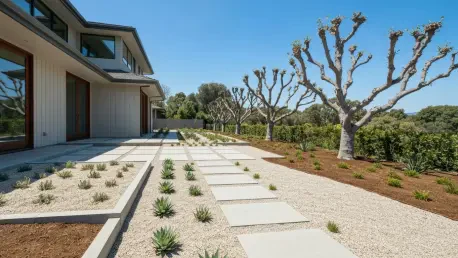
In response to this heightened risk, Berkeley’s new regulations are establishing a mandatory five-foot, non-combustible zone immediately surrounding homes. This “Zone 0” is designed to be an ember-resistant buffer, a critical defense against the wind-blown embers that are responsible for igniting the vast majority of homes during a wildfire. The primary goal is to prevent a single home ignition from becoming a catastrophic, structure-to-structure urban conflagration that spreads into downhill neighborhoods. This local initiative mirrors a statewide push, with similar rules expected to be finalized by the state and enforced starting in 2029. Consequently, residents of the Berkeley Hills are becoming de facto early adopters of a new landscaping philosophy. They are being asked to swap out traditional foundation plantings and flammable mulches for hardscapes like gravel, stone, and concrete. This shift requires not just a physical transformation of their properties but also a mental one, moving away from a long-held aesthetic to embrace a look that prioritizes survivability in an increasingly fire-prone California.
2. Navigating the Financial and Practical Realities
The transition to a fire-safe landscape presents a significant financial challenge for many homeowners, with costs that can vary dramatically. While the Berkeley Fire Department offers an average cost estimate of approximately $2,900 per parcel for creating defensible space within a 100-foot radius, this figure often fails to capture the full scope of the work, particularly the cost of replacing vegetation and installing new features. For instance, the seemingly simple task of removing existing plants and replacing flammable bark mulch with gravel can approach $10,000. Larger projects escalate costs exponentially; one homeowner received estimates ranging from $15,000 to $28,000 just for removing some vegetation and pruning a single large tree. The priciest undertakings often involve replacing wooden fences and gates with non-combustible alternatives. A pair of gates made from Knotwood, an aluminum product with a wood-like finish, can cost between $5,000 and $10,000. While residents acknowledge the necessity of these measures, recognizing that the cost of prevention is far less than the cost of rebuilding after a fire, the upfront expense remains a substantial hurdle for many in the community.
In the face of these high costs, homeowners are adopting a wide range of strategies, creating a spectrum of approaches from intensive do-it-yourself projects to large-scale professional renovations. On one end is homeowner David Hallsted, who is methodically working through a 50-item checklist with his son, dedicating several hours a day to the task. His approach is defined by thrift and hands-on labor: sourcing discounted flagstone, learning to lay bricks himself, replacing wooden features with fire-resistant Hardie Board, and collaborating with neighbors on shared property line issues. At the other end of the spectrum, residents like Robin and Susan Beauchamp undertook a comprehensive, six-figure redesign of their property with a professional landscape design firm. Guided by the principles of the national Firewise program, they removed all flammable foundation plantings, replacing a lawn with decomposed granite and drought-resistant plants well before the city’s mandate. While their total project was extensive, they estimated that the specific work needed to achieve Zone 0 compliance constituted about $6,000 to $8,000 of the total cost, illustrating that fire safety can be integrated into broader aesthetic goals, albeit at a significant price point.
3. Resources and Strategies for Homeowners
Recognizing the financial strain on residents, the city and community organizations have established several programs designed to mitigate the costs of creating defensible space. For the do-it-yourself-inclined, the Berkeley Fire Department’s Home Hardening Mesh Program provides free metal screens for vents and metal guards for gutters, which are crucial for preventing ember intrusion. Once vegetation is cleared, whether by homeowners or contractors, the Berkeley Chipper Program offers a valuable service by hauling away the debris for free, saving residents significant disposal fees. For those who need more direct financial support, the fire department has secured a $1 million grant from Cal Fire to fund its Resident Assistance Program (RAP). This program is specifically aimed at helping low-income, elderly, and physically or medically disabled residents with compliance work, though it does not cover major projects like tree removal or hardscaping. These initiatives provide crucial support, enabling more residents to participate in community-wide fire safety efforts without bearing the full financial burden themselves.
Beyond city-led initiatives, homeowners have several other avenues for sourcing affordable labor and expert guidance. A creative solution involves tapping into the local academic community by hiring undergraduate or graduate students from UC Berkeley’s landscape architecture department. These students can assist with redesigns, develop budgets, and bring fresh energy to a project, often for free or at a significantly reduced fee. For those seeking professional help, the Berkeley Fire Department maintains a list of vetted defensible space and home hardening contractors, giving residents a starting point for finding reliable professionals. Another cost-effective option is to hire workers through organized day laborer programs, such as the one run by the Multicultural Institute, which ensures fair wages while connecting homeowners with the manual labor needed for clearing brush and other tasks. Exploring these varied resources allows residents to tailor their approach to their specific budget and needs, making the daunting task of landscape transformation more manageable and accessible to a broader segment of the community.
4. The Evolving Landscape of Fire-Safe Design
The city’s EMBER (Ember Resilience) initiative, while comprehensive, includes important nuances that homeowners should understand. The proposal, which will initially apply to over 850 homes in the highest-risk zones, does not require a complete removal of all structures and plants near a house. Existing decks, for instance, will not have to be removed. Similarly, trees can remain within the buffer zone, provided their branches are properly pruned to maintain clearance from the roof and other parts of the structure. The rules for fencing are also specific: fences that run parallel to a home within the five-foot zone are not affected, but the first five feet of any fence or gate that attaches directly to the house must be replaced with non-combustible materials. In response to homeowner concerns about the financial and aesthetic impact of these changes, the city has delayed enforcement of the new rules until at least May 2026, granting residents a grace period and exempting those who are working in good faith toward compliance from citations. This flexibility is intended to facilitate a smoother transition as the community adapts to the new standards.
The new regulations have triggered a significant response from local industries, with contractors specializing in landscaping and construction seeing a surge in demand. Brush clearing companies have experienced an explosion in business since the EMBER initiative was first proposed, with the majority of daily calls now related to creating Zone 0 clearance. These crews focus on removing highly flammable vegetation like scotch broom, coyote bush, dried weeds, and eucalyptus litter. Similarly, fencing contractors have seen a notable increase in projects replacing traditional wood fences with non-combustible alternatives. Leading this trend are materials from Australian companies like Knotwood, which manufactures aluminum fencing with a realistic wood finish. These products, developed in a country with its own strict wildfire regulations, are becoming a popular choice, though they come at a premium, costing significantly more per linear foot than wood. This market shift demonstrates how regulatory changes are not only reshaping private properties but also driving innovation and creating new economic opportunities in the home improvement and safety sectors.
Forging a Resilient Future
The transformation of Berkeley Hills’ landscapes marked a pivotal moment in the community’s history. Through a challenging but necessary process, residents, city officials, and local businesses collaborated to redefine the very concept of a beautiful yard. What began as a response to a looming threat evolved into a proactive movement, proving that fire safety and aesthetic appeal were not mutually exclusive but could be thoughtfully integrated. Homeowners who initially mourned the loss of their traditional gardens discovered new forms of beauty in the clean lines of hardscapes, the vibrant colors of drought-resistant native plants, and the peace of mind that came with a more defensible home. This collective effort did more than just harden individual properties against wildfire; it fostered a deeper sense of shared responsibility and community resilience. The new aesthetic that emerged from this period became a powerful visual statement, a testament to a community that chose to adapt, innovate, and create a safer, more sustainable future in the face of environmental change, setting a powerful precedent for other fire-prone regions across the state and beyond.