
The Pier Pavilion at Barangaroo, a new architectural work by Besley and Spresser, serves as a compelling case study in the complex and often conflicted nature of modern public space, existing within the contentious redevelopment of a prominent Sydney waterfront site where an ambitious vision for public land has been steadily compromised by powerful commercial interests. This architectural piece thus provides a lens through which to examine the tensions between civic amenity and private enterprise in shaping the 21st-century city. From its unique funding model to its dual-purpose design, the pavilion materializes the inherent compromises and negotiations that define contemporary urbanism. It stands not merely as a structure but as a physical manifestation of a broader debate about who our cities are for and how the public realm is valued, created, and ultimately controlled in an era of large-scale, privately driven development. The project’s success or failure carries implications far beyond its immediate location, offering a tangible lesson in the delicate balance required to create meaningful civic spaces.
A Compromised Shoreline The Context of Barangaroo
From Public Vision to Commercial Reality
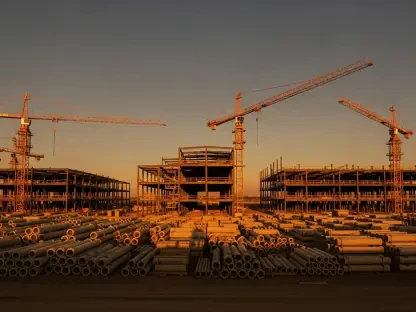
Barangaroo’s evolution from a natural shoreline to a desolate, fenced-off industrial port and now a gleaming western extension of the city’s business district is a story of profound transformation. Central to this narrative has been the persistent struggle over the character and extent of its public realm. The original 2006 masterplan, which won an international design competition, envisioned the waterfront as a generous expanse of open public land, a green edge for the city. However, over the subsequent years, this civic-minded vision has been significantly eroded by commercial imperatives. A prime example is the construction of a towering casino on land that was initially designated as public parkland, a move that permanently altered the skyline and privatized a key portion of the headland. Furthermore, the commercial towers in the southern precinct have been developed with such density that little genuine open space remains at their feet, while the site’s middle section continues to languish as an unresolved construction zone. This history has framed Barangaroo as a site of conflict, a battleground where the promise of public amenity has consistently been challenged by the powerful momentum of private development.
The Pavilion as a Point of Tension
Amid this complex backdrop, the narrative is not entirely one of loss for the public. Recent additions, including a popular harbor swimming pool, upgraded event facilities, and a crucial new Metro station, have delivered tangible community benefits and improved accessibility. It is within this dualistic context of both compromise and progress that the Pier Pavilion emerges as a particularly instructive project. The pavilion itself is a perfect embodiment of Barangaroo’s core tensions. While it functions as a public space, its conception by Infrastructure NSW was a strategic maneuver to balance community needs against commercial objectives. Its funding model is especially revealing: the structure was financed entirely through contributions from private developers. Its intended use is also hybrid, designed primarily for passive public enjoyment and relaxation but also slated to host periodic private, closed events. This functional duality directly probes the boundaries of what can be considered truly “public,” raising fundamental questions about access, ownership, and the nature of civic space when it is forged by private interests.
Designing for Permanence and People
A New Model for Urban Pavilions
The Pier Pavilion joins a global trend of architect-designed pavilions, yet it distinguishes itself in crucial ways from famous temporary commissions like London’s Serpentine Pavilion or Melbourne’s MPavilion. Unlike these counterparts, which often function as aesthetic follies situated within the controlled environments of parks or gardens, the Barangaroo project was conceived from the outset as a permanent structure. It needed to be fully integrated into its dense, active urban environment and remain accessible to the public at all hours. This requirement for permanence and constant accessibility demanded a fundamental shift in design philosophy. The focus moved away from expressing a singular architect’s aesthetic preoccupation and toward creating a durable, robust, and inclusive form that could serve a multitude of stakeholders and withstand the rigors of time and public use. This ethos is best captured by the architects’ own declaration that their winning proposal prioritized “a vision of the public realm, rather than a vision of the building,” signaling a commitment to civic function over architectural objecthood.
A Study in Understated Form
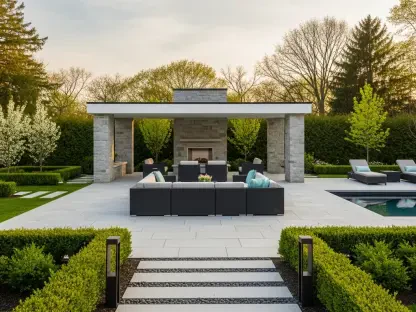
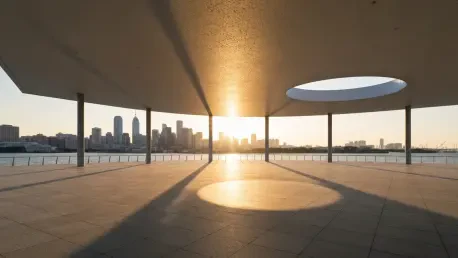
The architectural expression of the pavilion is defined by an understated, well-proportioned, and vaguely neoclassical quality, possessing a profound sense of openness. Its primary gesture is a broad, shallow roof plane with a flush soffit, elevated seven meters above the pier deck. This roof is supported by a perimeter of slender, densely spaced columns set on edge, which follow the gentle, scalloped geometry of the roofline, creating an impression of lightness and permeability. This connection to the surrounding environment is powerfully reinforced by a large, seven-meter-diameter oculus that pierces the roof, opening a direct view to the sky and allowing natural light to flood the space below. The roof itself supports a garden of endemic coastal plants, a living layer that reinforces the pavilion’s connection to the site’s natural history. At its interface with the main promenade, a double line of columns rests on a low plinth, which is cleverly designed to form a wide, welcoming bench that faces both inward toward the pavilion and outward toward the public thoroughfare, seamlessly integrating seating into the architectural form.
Terrazzo Oysters and Indigenous History
Simplicity and seamless integration with the surroundings guided the pavilion’s material palette. The interior is almost entirely open, with the only enclosed element being a long, windowless volume that discreetly contains services, storage, and a café servery behind large pivot doors. The grey granite paving of the floor extends directly from the surrounding promenade, effectively blurring the boundary between the pavilion and the public thoroughfare. All other primary surfaces—the roof edge, soffit, columns, and plinth—are clad in custom-made white terrazzo panels, creating a clean, cohesive, and monolithic appearance. The terrazzo itself is the central element of the design’s narrative. It was a key feature of the competition-winning proposal and was specifically developed over an 18-month period to include recycled Sydney Rock Oyster shells. This material choice was a deliberate and tangible method of connecting the modern structure to Country and the Indigenous history of the shoreline, which was once marked by extensive shell middens. The complex development of this unique material underscores the project’s deep commitment to quality and meaning.
The Technical Craft of Simplicity
The pavilion’s apparent simplicity belies significant technical and structural complexities that were masterfully resolved. Its location on an exposed pier deck subjects the structure to strong winds and potential movement, creating a substantial engineering challenge. A critical design requirement was to maintain the permeable perimeter of slender columns without resorting to obtrusive interstitial bracing, which would have compromised the building’s essential quality of openness. To accommodate the movement caused by wind loads, the engineering solution necessitated an expressed joint between the terrazzo panels. While this technical requirement makes the grid of joints a visible part of the aesthetic, the design team turned it into an opportunity for refinement. The exceptional care taken in the details, such as the carefully chamfered edges where the panels meet, is equally noticeable and speaks to the high level of craftsmanship involved. This meticulous execution transforms a structural necessity into an elegant feature, celebrating the craft of construction and reinforcing the pavilion’s quiet, dignified presence.
A Model of Civic Reconciliation
The Pier Pavilion successfully materialized the inherent complexities and tensions of its site, context, and brief. From its overall form down to the precise resolution of a single joint, the building told a story of balancing competing demands between public access and private influence. The finished structure provided a calm and restful environment, offering a dignified presence amidst a busy and visually competitive urban landscape. It achieved a civic quality robust enough to endure the occasional intrusion of ropes and bollards during private events, suggesting a resilience in its public character. Ultimately, the Pier Pavilion was realized as a successful model of public benefit generated from private interests. It stood as a thoughtful and elegant architectural intervention that helped residents and visitors alike form a better and more nuanced understanding of what “public” could mean in the 21st-century city.