
Luca Calarailli is a seasoned leader in the construction sector, renowned for his ability to marry architectural vision with rigorous engineering standards. With a career defined by large-scale urban transformations, he has become a leading voice in the adoption of advanced construction technologies and sustainable building practices. His recent work on Birmingham’s tallest student accommodation scheme, Crown Place, serves as a testament to his expertise in navigating the complexities of high-density city developments while achieving significant industry milestones.
The following discussion explores the strategic evolution required to deliver 15,000 beds across diverse residential sectors, the implementation of UK-first construction technologies, and the delicate balance between high-end architectural design and community-focused social value.
Achieving a milestone of 15,000 beds involves scaling operations across diverse project types. How has your approach to residential delivery evolved when moving from suburban schemes to 33-story city landmarks, and what specific management shifts were necessary to maintain quality at this volume?
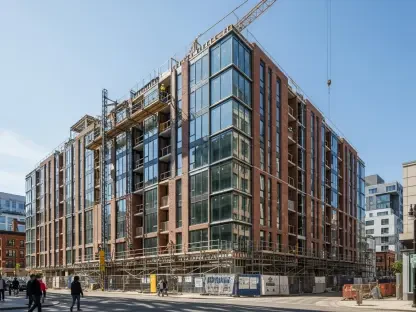
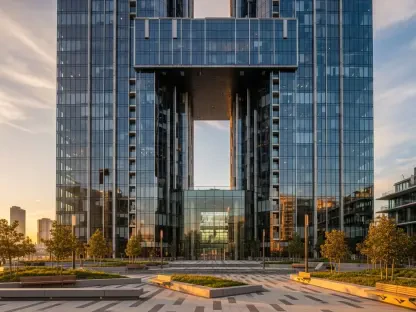
Scaling to 15,000 beds across the multi-room sector required us to move beyond traditional project management into a highly specialized, data-driven delivery model. When you transition from a low-rise suburban scheme to a 33-story skyscraper like Crown Place, the primary shift is in the intensity of the build sequence and the management of vertical logistics. For this £85 million project, we had to maintain rigorous quality control across 814 student beds, which included 572 studios and 128 duplex rooms, all while operating on a highly constrained city-center footprint. We implemented a “floor-by-floor” handover strategy that ensured the 145-week program stayed on track without compromising the finish of the internal amenity spaces. By treating each phase as a micro-project within the larger tower, we were able to replicate high standards across both the 33-story tower and the adjoining 9 and 12-story blocks.
Using a unitized brick facade and remote crane operation represents a significant shift toward advanced automation in high-rise construction. What were the primary safety benefits of operating cranes from ground level, and how did prefabricating thousands of facade panels impact the overall timeline and labor requirements on-site?
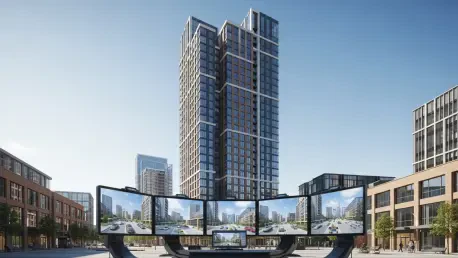
The introduction of the Skyline Cockpit allowed our crane operators to work from a ground-level station rather than climbing hundreds of feet into the air every day, which fundamentally improved site safety and operator well-being. By removing the physical strain of the climb and providing a panoramic digital view, we reduced the risks associated with high-altitude operations and fatigue. Simultaneously, the use of a unitized brick facade system was a game-changer for our timeline, as we were able to install 2,768 prefabricated panels directly onto the structure. This approach eliminated the need for external scaffolding or traditional bricklaying teams working at height, which significantly reduced on-site labor hours and allowed us to achieve a watertight building envelope much faster than conventional methods. The precision of these factory-made panels ensured a consistent aesthetic across the entire Birmingham skyline without the weather-related delays typical of traditional masonry.
High-rise projects located on major arterial routes require precise logistics, such as just-in-time deliveries. Could you walk through the coordination required to prevent city-wide traffic disruption and explain how tools like open-top goods hoists or jump lifts optimized the movement of materials to the upper floors?
Operating on the corner of Lancaster Street, one of Birmingham’s busiest arterial routes, meant we had zero margin for error in our delivery schedule. We utilized a “just-in-time” logistics strategy, where every vehicle was tracked and scheduled to arrive in specific windows to prevent any idling or congestion on city streets. To keep the interior of the building moving as fast as the exterior, we deployed KONE jump lift technology, which allowed us to use the permanent lift shafts for construction purposes earlier than usual, moving operatives and light materials efficiently. For larger components, the open-top goods hoist was essential, as it allowed us to crane materials directly into the hoist at ground level and transport them to the upper floors without manual double-handling. This integrated vertical transportation strategy was the heartbeat of the site, ensuring that the thousands of components needed for 814 beds reached their destination exactly when the fit-out teams were ready.
Integrating BIM-linked robotic setting-out systems and augmented reality tools changes the traditional job site environment. How do these digital overlays improve accuracy compared to manual methods, and what specific training steps are required for project teams to successfully adopt these technologies during a multi-year build?
Digital tools like HP SitePrint and GAMMA AR have moved us away from the era of “measure twice, cut once” and toward a “model once, print everywhere” philosophy. The BIM-linked robotic system allowed us to print complex floor layouts directly onto the concrete slabs with millimeter precision, eliminating the human error often found in manual chalk-lining. By using augmented reality to overlay 3D designs onto the physical as-built environment, our supervisors could “see” through walls to identify potential clashes between HVAC ducts and structural steel before a single pipe was installed. To make this work over a 145-week program, we invested heavily in upskilling our teams through interactive workshops and direct collaboration with tech providers. It wasn’t just about handing someone a tablet; it was about integrating these digital workflows into our daily briefings so that every foreman understood how the model guided their specific tasks.
Large-scale urban developments often face pressure to reduce environmental impact while providing social value to the local community. How did transitioning to battery systems for power affect diesel consumption, and what strategies helped convert temporary student work placements into long-term apprenticeships and professional roles?
Sustainability and social value were treated as core deliverables rather than afterthoughts, starting with our use of the AmpD Enertainer battery system which allowed us to slash diesel consumption by 7,645 liters per week. This move alone significantly reduced our carbon footprint and noise pollution in a dense city environment. On the human side, we focused on creating a “pipeline of talent” rather than just providing temporary jobs, which resulted in over 3,800 weeks of employment for Birmingham residents. We hosted 22 educational engagement events for over 400 students, but the real success lies in the four T Level students who successfully transitioned into full-time apprenticeships with us. By embedding these students within our project team from the early stages, they gained hands-on experience with innovations like robotic setting-out, making them some of the most tech-savvy new entrants in the industry today.
Modern student housing now includes premium features like Sky lounges and extensive communal amenity spaces. How do these design choices influence student well-being, and what challenges arise when balancing these high-end communal areas with the technical demands of high-density studio and cluster layouts?
Today’s students expect a holistic living environment, so we dedicated over 13,000 sq ft to amenity spaces, including a cinema, karaoke rooms, and a Level 33 Sky lounge that offers some of the best views in the city. These spaces are vital for mental well-being, as they provide an escape from the intensive “study-sleep” cycle and foster a sense of community among the 814 residents. The technical challenge lies in the sheer density of services required; fitting the complex plumbing and electrical systems for 572 studios alongside these high-end, open-plan communal areas requires meticulous coordination. We had to ensure that the “back-of-house” infrastructure for the gym and commercial kitchens didn’t encroach on the ceiling heights or acoustic privacy of the residential rooms. It’s a delicate balancing act between the “wow factor” of a sky-high lounge and the functional necessity of a high-density apartment block.
What is your forecast for the student accommodation sector?
I believe the sector is moving toward a “hospitality-first” model where the quality of the living experience and the technological integration of the building are the primary differentiators. We will see an even greater shift toward sustainable, low-carbon construction methods, such as the battery-powered sites and unitized facades we pioneered here, as institutional investors demand higher ESG standards. The demand for Purpose-Built Student Accommodation (PBSA) remains incredibly strong in major university cities, but the “winners” in this market will be those who can deliver high-density schemes that don’t feel crowded, thanks to smart design and expansive communal amenities. As we move past our 15,000-bed milestone, my forecast is that the industry will increasingly rely on remote operations and robotic automation to combat labor shortages and maintain the rapid delivery timelines that this booming sector requires.