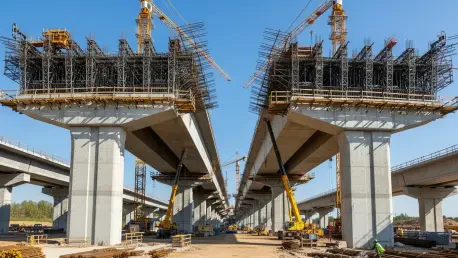

The massive concrete pillars rising above the intersection of Interstate 820 and Interstate 30 symbolize a regional transformation that could come to a sudden halt if federal lawmakers fail to secure a long-term funding solution by the end of September. This specific $267 million interchange expansion is a vital lifeline for thousands of daily commuters traveling between Fort Worth and Aledo, yet it represents only a fraction of the multi-billion-dollar mobility strategy currently at risk. As the Dallas-Fort Worth metroplex continues its trajectory as a national leader in both demographic and industrial expansion, the reliance on a stable Surface Transportation Bill has never been more evident. Without legislative certainty, the momentum that has added nearly 47,100 construction jobs to the local economy since the start of the decade might evaporate. Industry experts from the Associated General Contractors of America warn that high-quality transportation networks are the backbone of corporate efficiency, directly influencing shipping costs and private delivery timelines.
Regional Planning and the Necessity of Federal Support
Long-Range Strategy: Infrastructure Dependency
The scale of growth within the North Texas region necessitates planning that spans decades rather than years, as evidenced by the Regional Transportation Council’s authorization of a comprehensive $217.3 billion long-range plan extending through 2050. This ambitious blueprint is not merely a wish list but a structured response to the logistical demands of a global distribution hub. It encompasses essential highway widening projects, freight enhancements, and public transit initiatives designed to manage the environmental impact of urban sprawl. For a region that outpaces nearly every other American metropolitan area in development metrics, these projects are the prerequisite for future viability. Without the assurance of federal dollars, the transition from a logistics-heavy economy to a fully integrated smart-mobility network remains stalled. Planners emphasize that every highway mile added today is a strategic investment in the supply chain efficiency that defines the region’s competitive advantage.
Municipalities across the DFW area are increasingly synchronizing their local priorities with broader state and regional goals to ensure a seamless transition of infrastructure benefits. A prime example is Fort Worth’s “Moving a Million” plan, which seeks to prepare for a future where the city’s population surpasses the seven-figure mark. This synchronization requires a level of fiscal predictability that local tax bases alone cannot provide. Federal grants and matching funds act as the catalyst for these local initiatives, allowing cities to tackle complex engineering challenges that would otherwise be cost-prohibitive. When federal funding becomes a variable rather than a constant, local planners are forced to adopt a defensive posture, often scaling back the very projects intended to foster long-term growth. The integration of local municipal vision with regional strategy creates a powerful development engine, but it is one that requires the fuel of consistent federal support to maintain its operational speed and efficiency.
The Impact: Federal Funding Cycles
Infrastructure development is a notoriously protracted process that involves exhaustive environmental reviews, complex engineering designs, and the intricate acquisition of right-of-way. These foundational stages frequently occur years before a single shovel hits the dirt, requiring significant upfront capital that is often tied to federal reimbursement schedules. Because the lead time for a major interchange or a new transit corridor is so extensive, any lapse in federal certainty can disrupt the entire project pipeline. Contractors and engineers rely on a multi-year horizon to allocate resources, manage personnel, and schedule the specialized heavy machinery required for large-scale works. If the funding window is perceived as unstable, the risk profile for these projects shifts dramatically. This uncertainty leads to a “wait-and-see” approach among regional authorities, effectively freezing the progress of essential improvements that are already years in the making.
The dependency on federal funding cycles also creates a ripple effect throughout the entire supply chain of the construction industry. Manufacturers of steel, concrete, and asphalt must align their production schedules with the anticipated demand from public works projects, many of which are contingent on federal authorizations. When a funding gap occurs, the resulting work stoppage or delay creates inefficiencies that drive up the final price tag for taxpayers. Moreover, the North Central Texas Council of Governments notes that federal funds often bridge the gap between regional aspirations and the reality of local budgets. Without a reliable federal partner, the region faces the prospect of a fractured infrastructure network, where high-capacity corridors abruptly end at municipal boundaries due to funding shortfalls. This fragmentation would severely undermine the DFW area’s status as a premier logistics hub, where seamless movement across county lines is a requirement for modern commerce.
Economic Risks of Legislative Uncertainty
Financial Pressures: Failure of Short-Term Fixes
Should Congress fail to pass a comprehensive long-term bill, the immediate effects might appear subtle to the average driver, but the underlying consequences for the regional economy are projected to be severe. Delays in bid solicitations inevitably lead to higher project costs due to the compounding effects of inflation on raw materials and labor. Furthermore, uncertainty regarding federal reimbursements can destabilize the bond markets that public entities utilize to finance these large-scale works. When investors perceive a higher risk in the federal funding stream, the cost of borrowing increases, further draining the budgets of state and local transportation departments. This creates a cycle where less infrastructure is built for more money, a scenario that North Texas can ill afford given its rapid pace of expansion. The fiscal health of the region’s transportation agencies is inextricably linked to the reliability of the national surface transportation framework.
While Congress has historically utilized temporary extensions to avoid a total funding vacuum, these “stop-gap” measures are fundamentally insufficient for the “megaprojects” that North Texas requires. Short-term funding windows prevent state transportation departments from making the multi-year commitments necessary for complex interchanges or freight corridor upgrades that might take a decade to complete. A three-month or six-month extension provides no security for a contractor who must hire hundreds of specialized workers or invest in million-dollar equipment. These temporary fixes often lead to a “start-stop” cycle of construction that is inefficient and costly. Experts argue that the complexity of modern engineering requires a legislative environment that favors stability over political brinkmanship. Without a multi-year commitment, the region’s ability to execute transformative projects is replaced by a strategy of minor repairs and maintenance, leaving the root causes of congestion and logistical bottlenecks entirely unaddressed.
Threats to Employment: Private Sector Investment
The construction sector’s recent meteoric growth in North Texas is currently at risk, as funding uncertainty directly influences a contractor’s ability to maintain a stable workforce. In an industry where skilled labor is in high demand, firms cannot afford to keep specialized crews on the payroll if the project pipeline remains clouded by federal indecision. Between the start of the current expansion and today, the region added approximately 47,100 construction jobs, a feat that was only possible because of the clear visibility of future work. If that visibility vanishes, the resulting layoffs would not only impact individual families but also erode the regional knowledge base of experienced engineers and site managers. Beyond the direct impact on construction, the real estate and logistics sectors are equally vulnerable to these shifts. In the fast-growing suburbs west of Fort Worth, commercial development is inextricably linked to road capacity, and any delay in highway expansion could immediately dampen real estate investment.
There is a clear consensus among regional planners and economists that predictable federal investment is the non-negotiable foundation of North Texas’s economic health. In response to these stakes, the Associated General Contractors launched the “America’s Moving Forward” campaign to pressure lawmakers into recognizing the link between transportation funding and national stability. Industry leaders emphasize that these projects represent more than just concrete and steel; they represent the livelihoods of workers and the long-term viability of the region as a primary global hub for the movement of goods. The overarching sentiment is one of extreme urgency, as the logistics edge that North Texas currently enjoys depends on a legislative environment that favors long-term planning. To ensure the prosperity of the region continues, stakeholders took the necessary steps to align municipal and federal goals, yet the final piece of the puzzle remains the passage of a stable, multi-year bill that secures the future of DFW’s transportation network.