
In a metropolis defined by its waterfront, the monumental task of constructing a defense against rising sea levels and intensifying storms has become one of New York City’s most urgent and expensive undertakings. As the city embarks on a $1.7 billion project to fortify Lower Manhattan, a less visible but equally foundational element is taking shape: a landmark labor agreement. This raises a critical question for the city’s future: How does a contract with construction unions become as crucial as concrete and steel in the fight against climate change? This initiative in Battery Park City is not just about building a physical barrier; it is about building a new model for public works, one where resilience is measured in both flood protection and economic equity.
When the Bulwark Against the Next Superstorm is Built on a Handshake
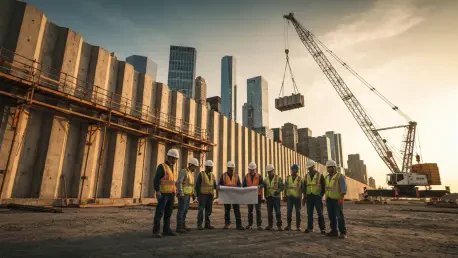
The plan to shield one of Manhattan’s most vulnerable and valuable districts from future deluges is being built not only with advanced engineering but on the foundation of a strategic partnership. The $1.7 billion effort is secured by a comprehensive Project Labor Agreement (PLA) with the Building and Construction Trades Council of Greater New York, ensuring that the massive undertaking is guided by established standards for wages, safety, and workforce development from its very first day.
This arrangement elevates the labor contract from a standard operational detail to a core component of the project’s strategy. The central premise is that the long-term success of critical climate infrastructure depends not just on the quality of the materials but on the skill, stability, and fair treatment of the workforce constructing it. The handshake deal codifies a commitment that protecting New York City’s future requires investing in its present-day workers.
The Legacy of Sandy a City Forced to Rebuild and Rethink
The ghost of Superstorm Sandy continues to loom over New York City’s planning and development, serving as the powerful catalyst for its large-scale resiliency initiatives. The widespread devastation a decade ago exposed the city’s profound vulnerability to coastal storm surges, forcing a fundamental reassessment of its relationship with the water’s edge and triggering a multi-billion-dollar push toward proactive defense.
In this new reality, areas like Battery Park City, with their dense residential populations and proximity to the financial district, represent ground zero for this urgent effort. The immense public investment in coastal protection is therefore a response to the dual challenges facing the city: shoring up defenses against an existential climate threat while simultaneously stimulating economic activity and ensuring that the recovery from past disasters fuels future prosperity.
Deconstructing the Defense More Than Just a Seawall
The physical scope of the Battery Park City project is extensive, representing a fully integrated coastal protection system. The work involves the complete reconstruction of bulkheads, the installation of advanced stormwater management solutions to handle heavy rainfall, and a significant upgrade of public spaces and parklands along the waterfront. The primary engineering goal is to provide robust protection against 2.5 feet of projected sea level rise, a critical benchmark for the coming decades.
Beyond preventing flooding, the project’s design incorporates features to mitigate the urban heat island effect during extreme weather and prevent deep water ponding. However, the ultimate economic prize is the planned removal of Battery Park City from the Federal Emergency Management Agency’s (FEMA) flood zone. This re-designation would deliver a direct and lasting financial benefit to residents and property owners by eliminating the federal mandate to purchase costly flood insurance.
The strategic framework governing this construction is the Project Labor Agreement. The PLA codifies high standards for wages and workplace safety for the thousands of union jobs the project will support over its lifespan. It acts as a stabilizing force, ensuring a reliable supply of highly skilled labor while minimizing the risk of work stoppages on a project where delays could have significant consequences.
Moreover, the agreement extends its benefits beyond the immediate workforce to the broader community. The PLA includes specific provisions designed to expand contracting opportunities for Minority and Women-Owned Business Enterprises (MWBEs) and Service-Disabled Veteran-Owned Business Enterprises (SDVOBs). It also directly supports workforce development pipelines, such as the Helmets to Hardhats and Construction Skills programs, creating clear pathways to middle-class careers for a diverse pool of New Yorkers.
This undertaking is also a trailblazer for New York City in its use of a progressive design-build delivery model. This collaborative approach, which integrates the design and construction phases, is intended to streamline the complex, multi-faceted process. When combined with the PLA, this innovative model is positioned as a formula for ensuring a project of this scale and importance is completed with maximum efficiency and to the highest standards of quality.
The Voices of Support a Consensus on Building a Better City
Leadership involved with the project underscores the necessity of this structured approach. Raju Mann, President and CEO of the Battery Park City Authority (BPCA), has emphasized that a project of this magnitude requires the “highest standards of quality and efficiency,” a goal he believes the PLA and design-build model are uniquely positioned to deliver for what he termed a “massive undertaking.”
This sentiment is echoed by leaders in the city’s wider construction industry. Carlo Scissura, President and CEO of the New York Building Congress, lauded the city’s broader commitment to PLAs as a “big, bold” strategy essential for progress. He directly connected such agreements to achieving “faster projects, safer jobs and fairer wages,” framing them as a cornerstone of responsible public investment.
From the labor perspective, the value of these agreements is paramount. Gary LaBarbera, President of the Building and Construction Trades Council of Greater New York, reinforced that PLAs are “crucial” for guaranteeing that large-scale public works projects provide “fair and livable wages, safe work environments,” and accessible career paths into the middle class for the union tradespeople who build and maintain the city.
NYCs New Playbook Replicating the Model for a Resilient Future
The Battery Park City resiliency project is not intended to be a one-off success but is instead being framed as a prime example of a larger, city-wide strategy. It serves as a replicable blueprint for how New York can tackle the immense challenge of climate adaptation while simultaneously addressing long-standing goals related to labor equity and economic opportunity.
The commitment to this model is backed by substantial city investment. The current administration has announced plans to place over $7 billion in upcoming public construction work under the purview of similar Project Labor Agreements. This signals a clear strategic shift, making the marriage of major infrastructure projects and comprehensive labor standards a central pillar of the city’s capital program.
Ultimately, the initiative demonstrated a new playbook for urban development in an era of climate uncertainty. The strategic pairing of critical infrastructure with robust labor agreements established a framework where public investments yielded maximum economic, social, and protective returns. This approach ensured that building a more resilient city also meant building a more equitable one, setting a precedent for future projects across the five boroughs.