
Today we’re speaking with Luca Calaraili, a leading expert in industrial construction with deep insights into the U.S. manufacturing landscape. We’ll be exploring the fascinating paradox currently shaping the sector: a general slowdown in construction spending contrasted with a surge of multi-billion-dollar “mega-projects.” Our conversation will touch upon the powerful influence of federal incentives like the CHIPS Act, the strategic logic behind the formation of regional manufacturing hubs, and the immense complexities and risks involved in bringing these colossal factories to life. We will also delve into the unique construction demands of different high-tech industries, from semiconductors and EVs to the rapidly onshoring pharmaceutical sector.
After a peak in 2024, overall manufacturing construction spending has seen a decline. At the same time, companies like Micron and TSMC are committing to historic investments. What key factors separate these mega-projects from the broader trend, and what does this divergence signal for US manufacturing?
It’s a fascinating dichotomy that really tells two different stories about the state of American industry. On one hand, you see the broader market reacting to shifting economics; we saw over $32 billion in clean energy projects canceled in 2025 due to fluctuating incentives and policies. That’s the market responding to near-term uncertainty. But then you look at Micron, which is putting an astounding $200 billion on the table, or TSMC with its $100 billion plan. These aren’t just business decisions; they’re geopolitical and national security imperatives. These projects are anchored by massive, long-term federal policies like the CHIPS Act, which is designed to re-shore critical supply chains, particularly for semiconductors. This signals a strategic decoupling of the most essential high-tech manufacturing from the typical economic ebb and flow, creating a protected class of projects deemed too important to fail.
Federal incentives like the CHIPS Act are a clear driver for these projects, yet we see cases like Samsung’s investment and funding being adjusted downward. Could you walk us through the primary risks and complexities companies face when building their strategies around these large-scale government programs?
Absolutely. While the promise of federal funding is incredibly alluring, it’s far from a blank check, and the Samsung case is a perfect illustration. They initially planned a $44 billion investment and were slated to receive $6.4 billion in CHIPS funding. But when market realities forced them to scale back their plans to $37 billion, the government funding was proportionally cut to $4.7 billion. This highlights the primary risk: these funds are tied to concrete deliverables and investment levels. Any change in a company’s strategy, whether driven by market demand, as we saw when Samsung temporarily halted construction, or by internal financial decisions, can directly impact the government’s contribution. Companies are essentially entering into a high-stakes partnership with the government, and they must navigate a complex web of compliance, milestones, and political scrutiny, all while managing the immense logistical challenges of the build itself.
Stellantis is doubling down on its Midwest automotive hub, while Samsung and Texas Instruments are expanding the semiconductor corridor in the South and West. What are the critical strategic advantages of these regional hubs, and how do they shape the development of local supply chains and talent?
Creating these regional hubs is a masterclass in strategic industrial development. For a company like Stellantis, investing $13 billion to retool plants in Indiana, Michigan, and other Midwest states is about tapping into a century of automotive DNA. The skilled labor, the specialized suppliers, and the logistics networks are already there. They are revitalizing an existing ecosystem for the next generation of vehicles. In contrast, what’s happening with Samsung in Texas and Texas Instruments in Utah is about building a new, highly concentrated ecosystem from the ground up. By clustering these massive fabs, they create a powerful gravitational pull for smaller suppliers, R&D partners, and highly specialized engineers. This proximity breeds innovation, streamlines supply chains, and creates a deep, localized talent pool that becomes a competitive advantage in itself, making the region a global magnet for semiconductor investment.
Projects like Rivian’s in Georgia are proceeding after delays, while Samsung’s Texas plant experienced a construction halt due to market demand. Based on your experience, what are the most common but unexpected hurdles that can threaten the timeline and budget of a multi-billion-dollar factory build?
The most common hurdles are often the ones that seem obvious in hindsight. Market volatility is a huge one; Samsung pausing construction because of a dip in demand is a prime example of how global economics can reach right down to a specific construction site in Texas. Political shifts are another major factor. Rivian is pushing forward with its $5 billion plant, but it had to navigate changing incentive landscapes, which can be a nerve-wracking process. Beyond these macro issues, the sheer logistical complexity is a constant battle. Sourcing specialized long-lead equipment for a semiconductor fab, securing thousands of skilled trade workers in a tight labor market, or even unexpected geological conditions on a 9-million-square-foot site can create cascading delays and budget overruns that no one fully anticipated in the initial project plan.
Lilly is embarking on what’s been called the largest pharmaceutical investment in U.S. history. What unique forces are driving this massive onshoring of drug manufacturing, and how do the construction and regulatory needs of these facilities differ from those of a semiconductor or EV plant?
Lilly’s $27 billion investment in new U.S. facilities is a direct response to a fundamental shift in thinking about supply chain security for critical medicines. The pandemic laid bare the vulnerabilities of relying on overseas manufacturing for essential drugs. This onshoring movement is driven by a national imperative to control our own pharmaceutical destiny. The construction needs are on another level entirely. While a semiconductor fab requires an incredibly clean environment, a pharmaceutical plant, especially one for active ingredients like Lilly’s new Alabama facility, demands absolute sterility and containment. The regulatory burden is immense, with every pipe, valve, and airflow system subject to intense FDA scrutiny and validation. The timelines reflect this, with plants often taking five years to complete because the construction process is intertwined with a rigorous, unyielding qualification and approval process that simply doesn’t exist in the same way for cars or computer chips.
With companies like Rivian and Tesla committing to massive EV and battery plants, how is the construction industry adapting its methods, materials, and workforce training to meet the highly specialized demands of these advanced facilities, especially with such aggressive production timelines?
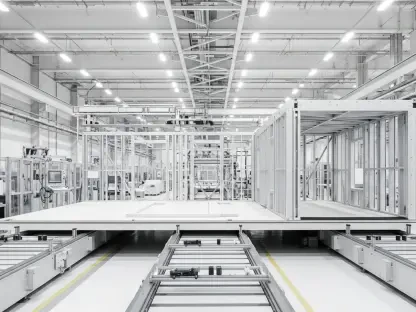
The rise of the gigafactory is forcing a real evolution in industrial construction. To meet the aggressive timelines—like Rivian aiming to produce 400,000 vehicles annually by 2028 from a plant that hasn’t even ramped up construction yet—we have to build smarter and faster. This means a heavy reliance on prefabrication and modular construction, where large sections of the plant are built off-site and then assembled like massive Lego blocks. Materials are also changing, with a focus on sustainable and high-performance concrete and steel to support the heavy robotics and assembly lines. Most importantly, workforce training is shifting. It’s no longer just about traditional trades; it’s about training electricians to handle the massive power infrastructure these plants require and teaching pipefitters to install the complex cooling and chemical delivery systems essential for battery production.
What is your forecast for the U.S. high-tech manufacturing construction sector beyond 2026?
Looking beyond 2026, I believe we’ll see this dual-track trend continue. The broader manufacturing construction market may remain volatile, subject to interest rates and general economic health. However, the mega-project boom in strategic sectors like semiconductors, pharmaceuticals, and EVs is just the beginning. The success of these first-wave projects, funded by initiatives like the CHIPS Act, will be critical. If companies like Micron and Rivian successfully hit their hiring targets—creating the promised 90,000 and 7,500 jobs, respectively—and begin ramping up domestic production, it will validate the entire onshoring strategy. This will almost certainly trigger a second wave of investment, not just in new fabs and factories, but in the entire ecosystem of suppliers and R&D facilities that support them. The future of this sector is less about broad growth and more about targeted, strategic, and government-backed industrial fortification.