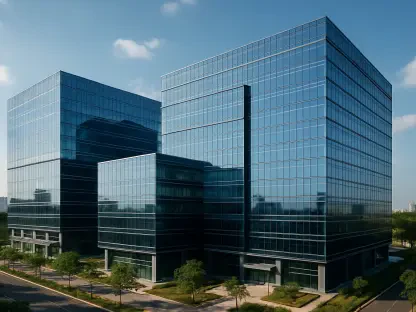

Rising from a historic north-side neighborhood, a massive, technologically advanced federal campus now stands as a permanent fixture on the St. Louis skyline, representing the single largest federal investment in the city’s history. The completion of the National Geospatial-Intelligence Agency’s new headquarters is more than a construction milestone; it is a transformative event that poses a fundamental question for the region: What does the future hold for a city now anchored by a $1.7 billion nexus of national security and high-tech innovation? This development signals a new chapter, prompting an examination of its profound economic, social, and strategic implications for the entire metropolitan area.
Beyond the Barricades Why a Federal Campus Is a Game Changer
The sheer scale of the Next NGA West project invites speculation about its impact far beyond its secure fences. While the campus itself is a restricted federal installation, its presence acts as a powerful economic and symbolic anchor. The central question is how this monumental investment will reshape the city’s trajectory, influencing everything from local business development and workforce training to St. Louis’s national reputation as a center for technological excellence. The answer lies in the strategic opportunities it creates for the community that surrounds it.
For the residents and businesses of St. Louis, the new headquarters is not just a workplace for thousands of federal employees but a catalyst for change. The ripple effects are anticipated to be extensive, touching adjacent neighborhoods and the broader regional economy. The challenge and opportunity for the city is to harness this momentum, ensuring that the benefits of this federal commitment are distributed widely and contribute to sustainable, long-term growth for everyone.
Anchoring the Gateway City The NGA’s Deep Rooted History
The National Geospatial-Intelligence Agency (NGA) is a critical component of the U.S. defense and intelligence communities, tasked with providing mapping and analytical intelligence to support national security, military operations, and disaster relief efforts. Its mission relies on analyzing imagery and geospatial information to deliver decisive advantages to policymakers, warfighters, and first responders, making it a cornerstone of modern intelligence gathering.
This new campus solidifies a relationship that has spanned over 70 years. The NGA has long been a major employer in St. Louis, with a local workforce of more than 3,000 personnel. The decision to build its next-generation headquarters in the city, replacing its aging facility south of downtown, was a deliberate reaffirmation of its commitment. This move cements the NGA’s legacy while modernizing its capabilities for decades to come.
Deconstructing the Impact The Tangible and Intangible Benefits
The most immediate and quantifiable benefit of the NGA campus was the immense economic injection from its construction. The $1.7 billion design-build project, managed by a joint venture of McCarthy Building Cos. and HITT Construction, created a surge in skilled labor demand and investment. Beyond the initial build, the retention of thousands of stable, high-wage federal jobs provides a consistent economic bedrock for the region, securing a vital employment base.
Equally important are the intangible benefits that position St. Louis for future growth. The 97-acre campus, with its 700,000-square-foot main office and state-of-the-art support facilities, is a landmark of innovation. Built to the highest security and sustainability standards under the oversight of the U.S. Army Corps of Engineers, it serves as a powerful symbol of federal confidence in the city. This project fosters a burgeoning geospatial-tech corridor, attracting contractors, startups, and specialized talent eager to be part of this growing ecosystem.
Voices from the Project Collaboration as the Cornerstone
The successful completion of such a complex undertaking was rooted in a deep, multi-year partnership. Project leaders have consistently highlighted the crucial collaboration between federal agencies, the design-build team, and local community stakeholders as the key to navigating the project from its initial environmental impact statement to its final delivery. This synergy ensured the project met its stringent technical and security requirements while remaining responsive to regional needs.
Josh Gaghen of McCarthy emphasized that the project’s success was a testament to this collaborative spirit. The massive scale—spanning 97 acres and representing a multi-billion-dollar investment—required a unified vision. This partnership not only constructed a facility but also built a foundation of trust and cooperation between the federal government and the St. Louis community, setting a precedent for future large-scale developments.
Capitalizing on the Momentum A Roadmap for St. Louis
For local businesses and entrepreneurs, the NGA campus presents a clear opportunity. Aligning services with the needs of the facility and its thousands of employees—from housing and hospitality to technical support and supply chain logistics—can create new revenue streams. The key is to strategically position offerings to cater to the emerging geospatial hub and its highly skilled workforce. This proactive approach can help local enterprises thrive in the shadow of this federal giant.
The project also provides a career roadmap for the regional workforce. With the NGA as an anchor, demand for skills in geospatial analysis, data science, and related tech fields is set to grow. Local universities and community colleges are becoming critical pipelines, offering training and degree programs tailored to these industries. For community and civic leaders, the task is to leverage the NGA’s presence to attract further investment, revitalize adjacent neighborhoods, and actively market St. Louis as a national center for technology and defense.
The NGA’s new headquarters was more than a construction project; it was a foundational investment that reshaped the city’s economic landscape. The collaboration between federal, private, and local entities established a successful model for future development, and the resulting innovation hub became a significant driver of regional growth. This monumental undertaking solidified St. Louis’s role as a critical center for national security and technology, leaving a lasting legacy of opportunity and progress.