
The US construction industry is grappling with a formidable challenge as project budgets swell under the weight of escalating material costs. A significant 3.2% year-over-year increase in nonresidential construction input prices by the end of 2025 has sent a clear signal: this is not a fleeting market fluctuation. The primary driver behind this inflationary pressure is a series of aggressive trade tariffs that have fundamentally altered the cost structure of essential building materials. This article delves into the direct and indirect consequences of these trade policies, analyzing how they have created a new economic reality for contractors, developers, and clients alike. We will explore the specific materials most affected, the ripple effects cascading through the supply chain, and the strategic adaptations required to navigate this high-cost environment.
A History of Volatility and the New Tariff Reality
The construction sector is no stranger to price volatility, having recently weathered the severe supply chain disruptions of the post-pandemic era. However, the current wave of inflation is different. While previous price hikes were largely driven by logistical bottlenecks and surging demand, the cost escalations seen throughout 2025 are a direct consequence of deliberate trade policy. Economists from leading industry groups have identified these tariffs as the principal cause. This context is crucial because it shifts the problem from a temporary supply-side issue to a more entrenched, policy-driven market condition that is less likely to self-correct without a change in government strategy.
Deconstructing the Impact of Trade Policy on Construction
The Direct Hit: Steel and Aluminum Prices Skyrocket
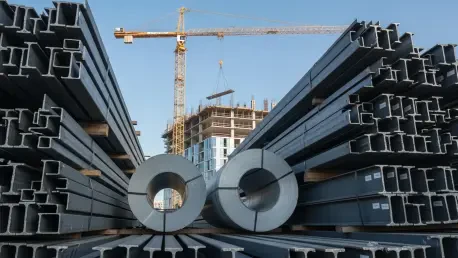
The most immediate and dramatic impact of the 2025 tariffs has been on metals. With new 50% tariffs imposed on foreign steel and aluminum, domestic producers have been able to raise their prices without fear of being undercut by imports. The data from the Producer Price Index is stark: the cost of aluminum mill shapes surged an astonishing 30.5% between December 2024 and December 2025, the largest annual jump since early 2022. Similarly, steel mill products climbed 17% over the same period. Industry economists directly attribute this acceleration to the trade policies, noting that the price index for aluminum has climbed consistently every month since the tariffs were implemented, creating severe budget challenges for projects reliant on these foundational materials.
The Ripple Effect: How Tariffs Permeate the Entire Supply Chain
The inflationary pressure from tariffs does not stop at raw materials. It cascades through the entire construction ecosystem, affecting a wide range of manufactured goods. The price of copper wire and cable, for instance, jumped 22% year-over-year in 2025, with economists warning that costs are likely to continue their upward trajectory into 2026. Furthermore, the machinery and equipment vital to every job site have become more expensive. With steel and aluminum as key components, the cost of construction equipment rose 5.6% over the last 12 months of 2025—the largest increase for this category in two years. This demonstrates how tariffs on basic materials ultimately inflate the capital expenditure costs for contractors, squeezing margins from multiple directions.
A Divergent Market: Contractor Sentiment and Sector-Specific Realities
Despite the grim cost data, the industry’s response is not uniformly pessimistic. An industry survey revealed that nearly seven in ten member contractors expect their profit margins to remain stable or even grow in the first half of 2026, suggesting many are successfully passing on increased costs in a high-demand market. This points to a bifurcation in the industry. While overall construction demand may be softening, specific sectors like data center construction are booming, creating pockets of resilience. This trend is mirrored in material prices, where commodities less exposed to international trade, such as asphalt and crushed stone, have remained relatively stable. This complex landscape shows that while tariffs are a universal headwind, their ultimate impact can vary based on a company’s market segment and pricing power.
Forecasting the Future: A Persistent inflationary Environment
Industry experts are in consensus: the tariff-driven cost pressures are not a temporary anomaly but are now firmly embedded in the market. Leading economists project that as long as the current trade policies remain in place, construction costs will continue their upward climb into 2026. This outlook forces the industry to plan for a sustained period of high material costs, shifting the focus from short-term mitigation to long-term strategic adaptation. The key variable moving forward will be federal trade policy, as any continuation, expansion, or reduction of tariffs will have a direct and immediate impact on the construction sector’s bottom line.
Strategic Imperatives for Navigating Higher Costs
The analysis presents clear takeaways for industry stakeholders. Contractors and developers can no longer rely on historical cost data for accurate bidding and must incorporate forward-looking pricing models that account for tariff-related volatility. To mitigate risk, professionals should consider several actionable strategies. These include locking in material prices with suppliers early in the project lifecycle, incorporating price escalation clauses into contracts to share risk with clients, and actively exploring alternative or domestically sourced materials where feasible. Furthermore, investing in technology and prefabrication methods that reduce material waste and on-site labor can help offset some of the inflationary pressures.
Redefining the Bottom Line in a New Era of Trade
The surge in US construction costs is a direct and powerful illustration of how macroeconomic trade policy translates into tangible economic pain on the ground. The tariffs of 2025 have not only driven up the prices of key materials like steel and aluminum but have also triggered a chain reaction that has inflated the cost of everything from copper wire to heavy machinery. This policy-driven inflation has reshaped the financial landscape of the industry, creating a challenging new normal. For the construction sector to thrive, it must move beyond simply absorbing these costs and instead adopt proactive, strategic approaches to procurement, contracting, and project management, recognizing that in today’s interconnected world, a trade proclamation can be as impactful as a blueprint.