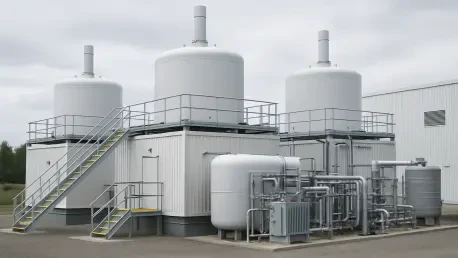

As the global community intensifies its search for reliable, carbon-free energy sources to combat climate change and meet escalating power demands, a transformative nuclear technology is rapidly moving from the drawing board to the deployment stage. Small Modular Reactors (SMRs) are emerging as a pivotal solution, promising a safer, more flexible, and economically viable alternative to traditional large-scale nuclear plants. This analysis examines the burgeoning trend of SMRs, exploring the intricate market dynamics, real-world applications, expert insights, and the future landscape of this promising energy frontier.
The Rise of SMRs: Market Dynamics and Adoption
Market Growth and Investment Trends
A powerful wave of government and private sector investment is accelerating the development of SMRs worldwide, with dozens of innovative designs now advancing toward commercialization across North America, Europe, and Asia. This surge in capital reflects a growing consensus that next-generation nuclear technology is essential for a stable and clean energy grid. The renewed commitment from established industry giants further validates this trend.
This financial momentum is creating tangible value and signaling renewed market confidence in the nuclear sector. Major engineering firms like Fluor, for instance, are strategically re-engaging with nuclear energy after a period of market uncertainty. The successful monetization of long-term investments, such as Fluor’s sale of NuScale Power shares for an impressive $1.35 billion, underscores the significant financial activity and inherent value being unlocked in the SMR space. Such transactions highlight that SMRs are not just an environmental solution but also a compelling financial opportunity.
Looking ahead, industry reports consistently project exponential growth for the SMR market over the next decade. This expansion is primarily driven by global decarbonization mandates and the urgent need for dispatchable, baseload power to complement the intermittency of renewable sources like wind and solar. SMRs are uniquely positioned to provide this reliable energy foundation, ensuring grid stability as the world transitions away from fossil fuels.
Real-World Applications and Key Projects
The transition of SMR technology from theoretical concept to practical application is well underway, marked by significant international projects that showcase its global viability. Fluor’s advanced SMR development in Romania serves as a prime example of this progress, demonstrating robust international collaboration and a firm commitment to deploying next-generation nuclear energy to meet European climate goals.
To support this new fleet of reactors, the entire nuclear ecosystem is expanding accordingly. This includes critical upstream and downstream infrastructure, ensuring a resilient and secure supply chain. The recent initiation of early engineering work for a major uranium enrichment plant expansion in Ohio is a clear indicator of this trend, as the industry prepares the necessary fuel cycle capacity to power the forthcoming SMRs.
Furthermore, the versatility of SMRs extends their potential impact far beyond conventional electricity generation. These reactors are being engineered for a diverse range of applications, including powering remote communities and industrial sites, providing high-temperature process heat for heavy industries like steel and cement manufacturing, producing clean hydrogen, and desalinating water. This adaptability significantly broadens the role of nuclear power in the global energy matrix.
Expert Perspectives: Voices from the Industry
Industry leaders are observing a distinct shift in market sentiment, with client confidence rebounding after a period of widespread hesitation. According to Fluor CEO Jim Breuer, the uncertainty driven by past trade policy debates and cost escalations is now subsiding. This renewed optimism is evidenced by a notable increase in front-end engineering work and advanced negotiations on major projects, leading to expectations that new energy sector awards will be “significantly higher” this year.
In response to this changing landscape, experts note a clear strategic pivot among major corporations aiming to capitalize on the global energy transition. Companies are diversifying their portfolios to align with high-growth, clean-energy sectors. Fluor’s strategy to re-enter the gas-fired power market while simultaneously expanding its nuclear portfolio exemplifies this broader industry movement toward a more balanced and forward-looking energy mix.
However, financial analysts maintain a pragmatic view, balancing long-term potential with immediate performance metrics. Andrew Wittman, a senior research analyst at Baird, emphasizes that the market remains keenly focused on near-term indicators such as new awards figures. While the strategic positioning for SMRs is viewed positively, short-term financial results continue to heavily influence market perception. This dynamic illustrates the critical need for companies to manage current performance while investing in the technologies that will define the future.
The Future Trajectory: Opportunities and Hurdles
Technological innovation is poised to dramatically enhance the efficiency and cost-effectiveness of SMR deployment. The integration of artificial intelligence across the entire project lifecycle—from initial planning and design to complex execution and supply chain management—promises to optimize processes and mitigate risks. Moreover, the shift toward factory-based manufacturing and assembly of reactor components will streamline construction, improve quality control, and shorten project timelines.
Despite their considerable advantages, including enhanced safety features, smaller land footprints, and greater grid flexibility, SMRs face significant hurdles. The industry must navigate complex and often lengthy regulatory and licensing processes, which vary by country. Overcoming public perception challenges, ensuring robust and permanent solutions for nuclear waste management, and scaling up supply chains to meet projected global demand remain critical for widespread adoption.
The successful deployment of SMRs at scale holds the potential to fundamentally reshape global energy markets. For many nations, it offers a credible path toward energy independence and security. By providing a stable and resilient power source for critical infrastructure and data centers, SMRs can bolster economic stability. Ultimately, they represent a vital and indispensable tool in the global effort to achieve ambitious net-zero emissions targets and secure a sustainable energy future.
Conclusion: The Dawn of a New Nuclear Era
The trend toward Small Modular Reactors is now firmly established, supported by a confluence of rising investment, tangible international projects, and strategic realignment from key industry players. While the sector navigates short-term financial scrutiny from markets and confronts long-term regulatory and logistical challenges, the forward momentum is unmistakable and continues to build.
SMRs are no longer a distant, conceptual technology but an active and rapidly evolving component of the global energy transition. As the underlying designs mature, supply chains develop, and the first wave of projects moves steadily toward operation, this trend is poised to define a new, more flexible, and accessible era for nuclear power, playing an indispensable role in the collective pursuit of a secure and sustainable energy future.