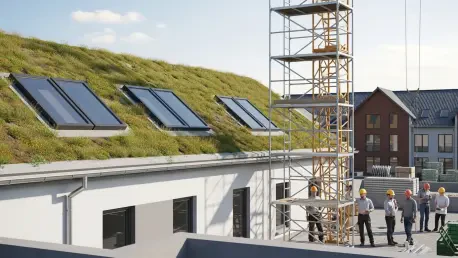

In the landscape of modern urban renewal, the transformation of vacant industrial plots into high-performance residential communities represents the gold standard for city planning. Luca Calaraili, an authority in architectural design and innovative construction, brings a wealth of expertise to this conversation, particularly regarding the integration of sustainability and social equity in housing. Our discussion centers on the Westmead Road project in Carshalton, a former timber yard that is now the site of an ambitious four-story development designed to provide 34 social rent units. Through this lens, we explore how technical precision and community-focused design can reshape the future of urban living.
Transforming a former industrial site into a four-story development with 34 social rent units presents specific design challenges. How do you balance the needs of larger families and wheelchair users in a dense layout, and what architectural features ensure these homes remain both accessible and functional for diverse tenants?
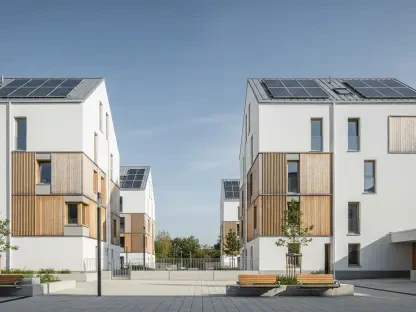
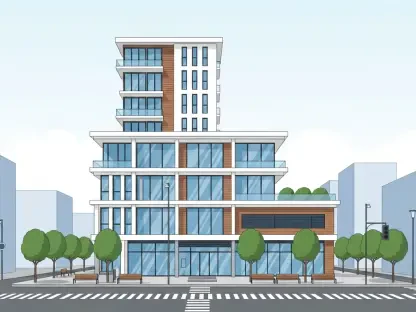
Designing for density on a former timber yard requires a surgical approach to the layout to ensure that every square foot serves a purpose. We are delivering a mix of flats and maisonettes, including 10 three-bedroom properties, which means we have to prioritize vertical accessibility and wide circulation paths from the ground up. By incorporating a landscaped courtyard and a dedicated children’s play area, we create communal breathing room that offsets the density of the four-story structure. For wheelchair users, the inclusion of specifically adapted units ensures that mobility is never an afterthought, while private gardens provide a necessary outdoor connection for larger families. These features aren’t just amenities; they are the architectural backbone that makes a social rent project feel like a permanent, dignified home.
Adopting Passivhaus standards and green roofs can drastically reduce carbon emissions and household utility costs. What technical steps are required to meet these rigorous efficiency benchmarks during construction, and how do these features ultimately improve the local environment and the financial well-being of the residents?
Meeting Passivhaus standards is a rigorous technical undertaking that starts with achieving an airtight building envelope and extreme thermal insulation to minimize heat loss. On the Westmead Road site, this means precision in every joint and seal to ensure the 34 units function as a cohesive, energy-efficient system. We are also installing a green roof, which acts as a natural insulator and a tool for boosting biodiversity in an otherwise paved urban environment. For the residents, these technical choices translate directly into a dramatic reduction in fuel costs, providing long-term financial relief and protecting them from energy price volatility. It is incredibly rewarding to see how high-level engineering can solve both environmental crises and the very personal challenge of household affordability.
Large-scale housing projects often aim to boost the local economy through dedicated training and apprenticeship programs. Could you describe the process for integrating these educational opportunities into the construction schedule and explain how such initiatives help build a sustainable workforce within the local community?
Integrating training into a live construction schedule requires a partnership mindset, where the site becomes a classroom as much as a workplace. We work closely with the council and our contracting partners to identify specific phases of the build, from the initial groundbreaking to the final fit-out, where apprentices can gain hands-on experience under master tradespeople. This isn’t just about filling temporary jobs; it’s about providing the local workforce with transferable skills that will last long after the 2028 completion date. By investing in people at 71–75 Westmead Road, we are ensuring that the local community isn’t just watching a building rise from the sidelines, but is actually the engine driving its completion.
Delivering hundreds of new council homes by 2028 requires massive logistical coordination and strategic planning. What are the most significant hurdles when scaling up production to this level, and how do you manage partnerships to ensure that high-quality housing is delivered on such an ambitious timeline?
The primary hurdle in scaling to 600 or even 1,300 homes is maintaining a consistent standard of quality across multiple sites while navigating the complexities of urban land acquisition. To manage this, we rely on deep-rooted collaborations, such as the partnership with the London Borough of Sutton and experienced contractors like Bugler Developments. We utilize the momentum from successful previous schemes to streamline our supply chains and communication protocols, ensuring that every stakeholder is aligned on the 2028 targets. This strategic coordination allows us to move diggers onto a vacant site with a clear, multi-year roadmap, minimizing delays and ensuring that the final “handover” meets the high expectations of the future tenants.
Reclaiming vacant land for a project scheduled for completion in 2028 involves a complex, multi-year workflow. What are the key construction milestones for the site over the next year, and how do you ensure the new structures and landscaping seamlessly blend with the existing character of the neighborhood?
Over the next twelve months, the site will transition from the initial groundbreaking and excavation phase to the visible rise of the four-story structural frame. We are hyper-focused on site preparation and foundational work right now, which is the most critical period for ensuring the long-term stability of the Passivhaus features. To blend the development into Carshalton’s existing fabric, we are implementing street improvements and architectural finishes that mirror the local character. The goal is for the finished project to feel as though it was always meant to be there, with the green roof and landscaped areas serving as a bridge between the new housing and the surrounding neighborhood.
What is your forecast for the future of social housing development in high-density urban areas?
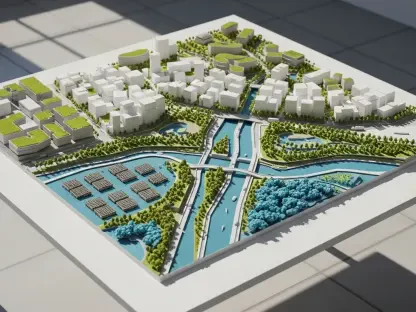
I believe we are entering an era where social housing will lead the way in technical innovation, rather than following the private sector. In the coming years, I expect to see a surge in “net-zero” council developments that prioritize the health and financial stability of tenants through modular construction and advanced energy systems. We will see more councils taking an aggressive approach to land acquisition—similar to the purchase of the Westmead site in 2025—to reclaim underutilized urban space for the public good. Ultimately, the future of housing in dense cities depends on our ability to prove that high-density living can be both sustainable and deeply humane, creating a blueprint for resilient communities across the globe.