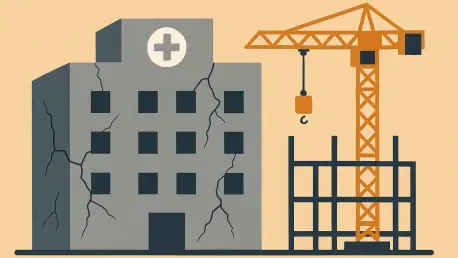

The promise of modern, safe medical facilities for some of the UK’s most vulnerable communities is now receding further into the future, as critical hospital rebuilds are officially confirmed to miss their original 2030 deadline. A recent analysis has laid bare the significant delays plaguing the government’s New Hospitals Program, revealing that seven priority hospitals constructed with deteriorating concrete will not be completed until at least 2032. This setback raises urgent questions about patient safety, the rising costs of maintaining crumbling buildings, and the feasibility of the government’s long-term infrastructure goals.
The Stark Reality of an Ailing Infrastructure
Across several NHS trusts, the daily reality of healthcare delivery occurs under ceilings held up by steel and timber props, a stark visual metaphor for a system under immense strain. These temporary supports are not just precautionary; they are essential structural interventions preventing the collapse of roofs made from reinforced autoclaved aerated concrete (RAAC), a material now known to be dangerously fragile. The situation has forced some hospitals to close entire wards and clinical areas, disrupting patient services and creating a constant atmosphere of risk for staff and patients alike.
This precarious environment is the direct result of decades-old construction materials reaching the end of their functional lives. The stopgap measures, while necessary for immediate safety, are unsustainable solutions to a systemic problem. The ongoing presence of these props in active hospital environments underscores the critical nature of the rebuilds, transforming the abstract issue of infrastructure policy into a tangible, daily hazard within places intended for healing.
A Crumbling Promise to Replace Unsafe Concrete
The core of the crisis lies with RAAC, a lightweight concrete material used in construction from the 1950s to the 1990s, which has a limited lifespan and is prone to sudden failure. Its widespread presence in NHS buildings prompted an ambitious government commitment to rebuild the most affected hospitals as part of a nationwide initiative. The initial promise was clear: deliver new, safe, and modern facilities to replace these deteriorating structures and safeguard the continuity of care.
This pledge was part of a larger, overarching goal to eradicate all RAAC from the NHS estate by 2035. However, the failure to meet the first major milestone for the seven highest-priority sites casts a long shadow over the entire program. The delays signal a disconnect between political ambition and practical execution, leaving hospital trusts to manage the growing risks of a material that experts have repeatedly warned is a ticking time bomb.
From an Ambitious Goal to a Staggering Delay
What was once heralded as a landmark infrastructure project has now become a case study in overpromising and under-delivering. The National Audit Office (NAO) report confirms that the 2030 target was unrealistic from the start, a conclusion now shared by auditors and medical leaders. For hospitals like Torbay, Kettering, and Musgrove Park, the new completion timelines extend nine to ten years beyond their initial projections, pushing their much-needed upgrades into the next decade.
In response to these setbacks, the program was reset in January of last year on what officials describe as a “more realistic” footing. Despite this reassessment, the NAO warns that even these revised schedules are under significant pressure due to condensed construction timelines and logistical hurdles. The breakdown of the original plan highlights a failure to adequately scope the complexity and cost of replacing such critical public infrastructure, leading to a cascade of delays that have tangible consequences.
Expert Warnings Versus Official Reassurances
The widening gap between the government’s official position and the assessments of independent experts has become a central feature of this ongoing issue. While the Department of Health and Social Care insists it has a sustainable and deliverable plan, auditors and professional bodies have voiced persistent concerns. The NAO’s findings validate long-standing warnings that the initial timeline was not grounded in the practical realities of large-scale construction and procurement.
This divergence in views creates a challenging landscape for both the public and the healthcare professionals working within these hospitals. On one hand, there are official reassurances that the situation is under control and that new facilities are being delivered as quickly as possible. On the other, there is a steady drumbeat of expert analysis pointing to persistent risks, tight schedules, and the potential for further slippage, leaving many to question whether the revised deadlines are any more achievable than the first.
The Steep Price of Postponement
The cost of these delays cannot be measured in time alone; it carries a significant financial and human price. While waiting for their new facilities, the seven affected hospitals are projected to spend over half a billion pounds on maintenance and safety measures just to keep their current buildings operational. These are funds that, as organizations like the Royal College of Surgeons of England have noted, are desperately needed elsewhere.
This diversion of resources represents a critical trade-off. Money spent patching up aging structures is money that cannot be invested in new operating rooms, advanced diagnostic equipment, or additional clinical staff. Ultimately, the postponement of these rebuilds forces the NHS to choose between maintaining basic structural safety and advancing patient care, a compromise that became increasingly untenable as the crisis deepened. The true cost was borne by patients and staff, who navigated a healthcare environment where resources were continually redirected from frontline services toward managing infrastructural decay.