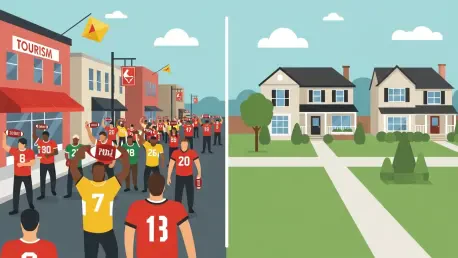

The arrival of a major sporting event like the NFL Draft is often seen as a purely economic windfall for a host city, but in Pittsburgh, this powerful catalyst is exposing deep-seated tensions within its evolving hospitality landscape. As the city prepares for the massive influx of visitors, an unprecedented boom in the short-term rental (STR) market is being met with a growing chorus of concern from residential communities. This surge in demand and supply is not just a temporary economic phenomenon; it has become the focal point of a critical debate about regulation, community integrity, and the long-term character of the city’s neighborhoods. The draft is forcing Pittsburgh to confront a crucial question: how can it embrace a golden opportunity for growth without sacrificing the quality of life that its residents cherish? The answer may lie in a new set of rules designed to balance the interests of hosts, guests, and the communities that accommodate them.
A Market Transformed
The transformation of Pittsburgh’s STR market ahead of the April 23-25 draft has been nothing short of explosive, a shift that AirDNA’s director of economics, Bram Gallagher, describes as “pretty profound.” Analysis conducted more than two months before the event already revealed a monumental surge in activity, with booking levels for the draft period quadrupling compared to the same dates in the previous year. This early wave of demand is highly atypical for the STR industry, where travelers usually book just four to six weeks in advance. By late January, the market for late April was already 50% occupied, a staggering increase from the 12% booking rate observed at the same point a year prior. Gallagher confidently predicts that this figure will climb to 90% by the time the draft kicks off, achieving a level of market saturation rarely seen outside of unique global events like the Super Bowl or the 2024 solar eclipse path, underscoring the immense economic gravity of the draft.
This unprecedented demand is being met by a remarkably elastic and responsive increase in supply from property owners eager to capitalize on the opportunity. In early 2024, Pittsburgh’s STR inventory consisted of approximately 3,100 available properties. By the end of that year, the number of listings had already grown by 15%, a figure that likely underrepresents the total number of available rental spaces, as many properties contain multiple distinct units. Gallagher notes that this supply could expand even further as the event approaches. With average nightly rental rates climbing well beyond the standard $200, the financial incentive for more homeowners to enter the market becomes increasingly compelling. As Gallagher colorfully puts it, residents might soon realize, “I could take a vacation in Maui for the same price somebody is willing to pay to stay in my house in Pittsburgh,” suggesting that without regulatory intervention, the market will continue to swell to meet the historic demand.
Neighborhoods on Edge
While the economic indicators point to a flourishing market, the rapid and often unregulated expansion of STRs has generated significant friction within Pittsburgh’s residential neighborhoods. Community leaders across the city articulate a consistent and growing concern: the problem is not with individual homeowners renting out a spare room, but with commercially operated, often remotely managed properties that disrupt the fabric of local life. Ellen Dibiase of the Friendship Community Group and Richard Swartz of the Bloomfield-Garfield Corporation both highlight a critical lack of accountability. When problems arise—from minor nuisances like trash being put out on the wrong day and attracting pests, to major disturbances like large, unruly parties—residents discover they have no local or responsive contact person to address the situation. Property managers are frequently based out-of-state and are unreachable, leaving frustrated neighbors with no remedy short of involving law enforcement.
This breakdown in communication channels severely erodes the social cohesion of a community, where direct neighbor-to-neighbor dialogue has traditionally been the first and most effective step in resolving issues. The frustration is compounded by the daunting and often futile process of navigating the official reporting systems of platforms like Airbnb. Jacky Kaiser, president of the South Side Community Council, recounted a frustrating three-hour wait on the phone just to speak with a call center representative to report a house party with underage attendees. While Airbnb claims that party allegations are rare, affecting fewer than 0.06% of reservations in 2024, Kaiser suggests this low figure may be a direct result of a reporting process so cumbersome that many residents simply give up. These anxieties were intensified by a shooting on January 1 outside an Airbnb, an event that has energized Pittsburgh City Council’s efforts to implement a comprehensive regulatory framework.
Crafting a New Framework
In response to the escalating community tensions, Pittsburgh City Council is actively developing legislation aimed at addressing these accountability gaps directly and creating a more balanced STR ecosystem. The core of the proposed regulations is a licensing requirement for all STR owners and operators. To obtain a license, hosts would need to disclose detailed property information, demonstrate they are current on all taxes, and, most critically, provide the name and contact information for a responsible party located within a 25-mile radius of the property. This provision is specifically designed to solve the problem of absentee landlords, ensuring that when an issue arises, there is a local individual who can be held accountable and can respond in a timely manner. This measure seeks to restore a sense of local oversight that residents feel has been lost with the proliferation of commercially run STRs.
Beyond establishing accountability, the proposed legal framework would also introduce clear operating standards to protect neighborhood quality of life and ensure guest safety. The regulations would set a limit on rental periods, capping stays at a maximum of 28 consecutive days, which helps distinguish short-term rentals from traditional long-term housing. Furthermore, the legislation would create mechanisms for official property inspections, giving the city the authority to verify that STRs are safe and compliant with local codes. To ensure these rules have teeth, the city would also be empowered to suspend licenses and issue significant fines for violations. Together, these measures represent a comprehensive attempt to manage the booming STR market, providing the city with the necessary tools to enforce standards and mediate the relationship between the visitor economy and residential communities.
The Aftermath: Boom or Bubble?
The central question that lingered was whether the NFL Draft would permanently alter Pittsburgh’s STR market or simply create a temporary economic bubble. Expert analysis of other major events provided several possible outcomes. Events like the Paris Olympics or major concert tours often generated massive but short-lived spikes in bookings that did not lead to long-term changes in market dynamics. In contrast, when Phoenix hosted the Super Bowl in 2023, the event seemed to contribute to an enduring boost in STR activity, which Gallagher speculated may have occurred because visitors enjoyed the city and were encouraged to return for future visits. The draft itself had a mixed history, with the 2024 event in Detroit failing to create a lasting impact on rental rates, while the draft in the smaller city of Green Bay followed a pattern of a sharp spike followed by a return to a slower, pre-existing growth trend.
Regarding the proposed regulations, Gallagher believed that a balanced approach would not necessarily have stifled the market’s growth. He pointed to New York City’s highly restrictive rules as an example of a policy that effectively pushed STR activity into neighboring New Jersey, but he viewed more moderate measures like registration, licensing, and inspections as sensible parts of a healthy regulatory environment. He suggested that such requirements, which typically involve a modest fee and some administrative paperwork, would likely not have had a significant negative impact on what he ultimately characterized as an “exciting” and predominantly “mom-and-pop” industry. The goal of the regulations was seen not as an obstacle to growth but as a necessary step to ensure that the growth was sustainable and beneficial for the entire city.