
Research suggests that the physical layout of a city directly impacts the survival and connectivity of its residents during periods of intense social or environmental stress. In the heart of Montreal’s Olympic Park, a new installation titled Espace Solaire is putting this theory to the test by transforming a once-underutilized concrete expanse into a vibrant hub for community interaction. Developed by the studio Aire Commune in partnership with Sunbird Énergie, this site serves as Quebec’s first outdoor public space powered entirely by solar energy. By combining renewable power generation with thoughtful architectural design, the project seeks to establish a resilient “third place”—a sanctuary outside the home and workplace where residents can congregate without the pressure of commercial consumption. This initiative addresses the modern urban challenge of social isolation, offering a welcoming alternative to the hostile architecture often found in contemporary city centers today.
The Sociological Foundation: Bridging Physical and Social Networks
The theoretical backbone of Espace Solaire is rooted in the concept of social infrastructure, a term popularized by sociologist Eric Klinenberg to describe the physical places that shape human interaction. Unlike traditional infrastructure, such as power grids or highways, social infrastructure includes the libraries, parks, and plazas that allow neighbors to form meaningful bonds. Historical data from events like the 1995 Chicago heatwave reveals that neighborhoods with robust social networks and accessible public gathering spots experienced significantly lower mortality rates compared to those lacking such features. Espace Solaire operates on the premise that a well-designed park bench or a shaded canopy can do more than provide comfort; it can actually save lives by fostering “weak ties.” These casual, repeated interactions among residents build a foundation of trust and mutual recognition that becomes vital during emergencies, ensuring that community members are more likely to check on one another.
By focusing on these “soft” systems, Aire Commune is challenging the standard priority list of urban planning, which often overlooks the psychological impact of shared spaces. The Espace Solaire installation demonstrates how intentional design can act as a catalyst for social cohesion in an era where digital connectivity frequently replaces physical presence. By providing a reliable and attractive location for residents to converge, the project helps to rebuild the civic fabric that has been frayed by years of rapid urbanization and privatized public zones. This approach aligns with the philosophy of creating “palaces for the people,” where high-quality architectural design is made available to every citizen regardless of socioeconomic status. Such spaces empower individuals to reclaim ownership of their neighborhoods, turning sterile transit zones into thriving environments that support mental well-being and strengthen the collective resilience of the surrounding urban population.
Modular Engineering: Merging Aesthetics with Renewable Energy
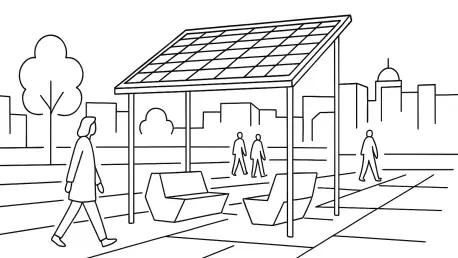
The physical manifestation of this sociological vision is a repeatable yellow steel module that provides a striking visual contrast to the surrounding concrete of the Olympic Park. This choice of vibrant color and industrial material serves a dual purpose: it creates a recognizable brand for the space while ensuring durability against Montreal’s varied climate. Atop each modular unit sits a sophisticated canopy of solar panels, which generates sufficient energy to power the site’s lighting, Wi-Fi, and charging stations. This self-contained energy system allows the installation to operate independently of the municipal power grid, making it an ideal model for decentralized urban infrastructure. The design carefully balances technical requirements with human comfort, utilizing sturdy concrete bases for stability and warm wooden slats for seating surfaces. This combination of materials invites passersby to linger, transforming a high-tech solar generator into a tactile and approachable piece of public furniture.
Functionality is further enhanced by the modularity of the seating arrangements, which are configured to support a wide range of social dynamics. For example, large picnic tables with integrated benches facilitate group meetings and communal dining, while smaller, square-shaped benches are positioned to allow for more private conversations or solitary reflection. This variety acknowledges that the success of a public space depends on its ability to offer choices to its users, a principle long advocated by urban observers like William H. Whyte. By providing both sun and shade, as well as a choice between social immersion and quietude, Espace Solaire ensures that it remains inclusive to different demographic groups. The inclusion of clear signage provides the “software” for the user experience, guiding visitors through the simple process of connecting to the free Wi-Fi and utilizing the power outlets, thereby removing any barriers to entry for those unfamiliar with the technology.
Strengthening Urban Resilience: Future Insights for Global Development
City planners and architects who examined the success of Espace Solaire identified several actionable strategies for future urban development. The project demonstrated that scalable, modular interventions were far more effective at reclaiming underutilized spaces than traditional, monolithic construction projects. By prioritizing the deployment of self-sustaining energy units, municipalities found a way to reduce their carbon footprint while simultaneously providing essential social services to residents. Decision-makers learned that the integration of solar technology with ergonomic design was not merely an aesthetic choice, but a necessary step toward building more resilient neighborhoods. These observations suggested that the future of city planning resided in the ability to create flexible, multi-functional spaces that adapted to the changing needs of the population. Moving forward, the focus shifted toward decentralized infrastructure that empowered local communities and provided a safety net during times of crisis.
The broader implication of this initiative was the realization that social infrastructure required the same level of investment and intentionality as roads or telecommunications networks. Urban leaders across the globe adopted similar modular templates to transform “hostile” environments into welcoming community hubs, thereby reducing social isolation and improving overall public health. This shift in perspective encouraged a more holistic approach to urban design, where the “soft” systems of a city were treated as critical assets for survival and prosperity. The legacy of Espace Solaire resided in its ability to prove that small-scale, thoughtful design could yield massive social returns. By fostering “weak ties” and providing equitable access to digital resources, cities cultivated a more engaged and connected citizenry. Ultimately, the project served as a definitive guide for how modern metropolises could bridge the gap between technology and humanity to create a more inclusive and resilient urban future.