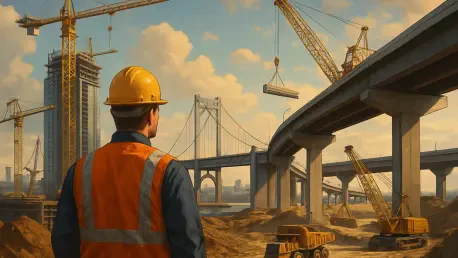

The United States construction industry finds itself at a pivotal juncture, where the broad currents of economic uncertainty are being met and masterfully redirected by a concentrated, powerful wave of megaprojects that will ultimately define the sector’s performance. While overarching economic headwinds, persistent labor cost pressures, and policy ambiguities create challenges across many segments, the industry’s overall health is anchored by this powerful and focused surge of large-scale development. An analysis of prevailing conditions reveals that a few select sectors—namely data centers, public infrastructure, and advanced manufacturing—provide a critical foundation for activity, offsetting stagnation elsewhere. This market analysis explores the five key trends shaping this dynamic landscape, demonstrating that success for construction firms is not determined by a universally rising tide, but by their strategic ability to secure a foothold in these specific, high-growth domains.
From Post Pandemic Volatility to a New Era of Federal Investment
To understand the current forecast, it is essential to recognize the forces that have shaped the present environment. The years following the pandemic were marked by unprecedented supply chain disruptions and dramatic material cost shocks that tested the resilience of the entire industry. As these pressures began to normalize, new drivers emerged in the form of landmark federal legislation. The Infrastructure Investment and Jobs Act (IIJA) and the Inflation Reduction Act (IRA) unlocked historic levels of funding, fundamentally redirecting capital toward public works, clean energy, and domestic manufacturing.
This massive infusion of federal support created a robust pipeline of large-scale projects, establishing the very foundation upon which the megaproject-driven market is being built. This strategic redirection of capital has created a bifurcated market, where federally-backed and technologically critical sectors thrive, while other privately funded segments face a more cautious investment climate. The long-term effects of this legislation are now fully materializing, creating a landscape where the scale and complexity of projects are reaching new heights.
The Pillars of Construction Activity
The Unstoppable Demand for Data Centers and Public Works
The data center construction boom continues its unrelenting pace, fueled by an insatiable demand for cloud computing and the explosive growth of artificial intelligence. This trend is a central component of a historic infrastructure cycle, driving an aggressive pace of development, particularly in markets where essential power and infrastructure are already established. Extremely low vacancy rates reinforce this outlook, signaling a clear runway for continued activity and providing strong indicators for ongoing investment in new builds.
However, this growth is not without significant hurdles. The primary constraint tempering this boom is the availability of power. The current project pipeline is nearly three times larger than it was just a few years ago, and the grid’s capacity to support it is a critical bottleneck. This challenge is compounded by land scarcity, complex permitting processes, and long lead times for specialized electrical equipment, creating a high-stakes environment for builders. Similarly, public infrastructure construction remains a pillar of strength through much of the year, buttressed by funds already appropriated through the IIJA. Major capital improvement programs at airports, seaports, and on roads and bridges are fully funded and moving forward. The primary risk to this momentum will materialize late in the year, as the IIJA’s authorization expires in the third quarter. Any legislative delay in its reauthorization could significantly slow the pace of new project awards and intensify competition. This late-year uncertainty, coupled with the mid-year sunset of several IRA clean energy incentives, creates a tale of two halves for the public sector.
Reindustrialization Matures The Shifting Landscape of Manufacturing
While broad investment in new manufacturing growth has leveled off, overall spending in the sector remains at historic highs, sustained by the continuation of previously announced megaprojects. The initial wave of investment, particularly in areas like electric vehicle plants, has cooled in the face of rising costs. However, this does not signal a retreat from the broader reindustrialization trend. Instead, the composition of the megaproject pipeline is evolving. Sectors such as semiconductors, defense, and biomanufacturing are actively expanding, picking up the slack from recalibrating industries.
These large-scale projects face many of the same power and land constraints as data centers, but with an even greater emphasis on the challenge of securing a sufficient skilled labor force. This reality is changing how projects are delivered. The industry is maturing beyond massive, one-and-done megaprojects and shifting toward a more measured approach focused on campus expansions and the development of supporting ecosystems. This strategic adaptation reflects a more pragmatic response to persistent labor and cost pressures, ensuring that the reindustrialization wave continues in a more sustainable fashion. The focus has shifted from speed to strategic, long-term development that fosters regional hubs of innovation and production.
Economic Realities Stabilizing Costs and the Slow Thaw of Interest Rates
The broader economic environment provides a complex backdrop for these sector-specific trends. A strong consensus points to a period of relative stability for material costs, with modest inflation of 2% to 4%. This predictability is a welcome change from recent volatility, though key variables remain. Prices for steel and aluminum are expected to stay elevated due to tariffs, which represent the largest unknown. To mitigate this risk, contractors are increasingly building escalation clauses into contracts and prioritizing domestic sourcing. The most significant price volatility is expected in electrical equipment, directly linked to demand from grid upgrades and the data center boom.
Meanwhile, there is general anticipation that interest rates are lower, but the positive effects on construction materialize with a considerable lag. Residential construction is expected to be the first sector to benefit from lower borrowing costs. For other areas, the rebound will be slower. A modest rebound for commercial and manufacturing construction will unfold throughout the year. The primary benefit of easing rates is the opportunity to restart longer-term projects that were stalled by financing uncertainty, particularly smaller, private industrial projects that are highly sensitive to the cost of capital.
Beyond the Blueprint Technology Labor and the Next Wave of Innovation
Looking ahead, the dominance of complex megaprojects is accelerating key industry shifts. The intense demand for specialized skills required for data centers and semiconductor fabs places an even greater premium on a limited pool of qualified craft workers, making workforce development and retention a top strategic priority. This labor crunch, in turn, drives greater adoption of productivity-enhancing technologies.
Innovations in prefabrication, modular construction, and project management software become less of a luxury and more of a necessity for delivering these massive projects on time and on budget. The convergence of these trends suggests a future where the most successful firms are not just builders, but highly sophisticated integrators of technology, supply chain management, and specialized human capital. The ability to manage complex logistics and integrate digital workflows from design to completion is rapidly becoming a critical differentiator in a competitive market.
Positioning for Profit Key Strategies for Construction Leaders
For construction firms aiming to thrive, a proactive and strategic approach is essential. The first imperative is specialization; developing deep expertise in high-growth niches like data centers, biomanufacturing, or critical infrastructure is crucial for capturing a share of the most robust project pipelines. Generalist approaches are proving less effective in a market dominated by highly technical and complex builds.
Secondly, firms must build resilience into their operations by strengthening supply chain relationships to navigate tariff uncertainties and securing materials well in advance. Thirdly, investing in technology and workforce training is no longer optional. Adopting digital tools to improve efficiency and implementing robust training programs to upskill labor will be a key competitive differentiator. Finally, mastering the complexities of long-term project financing and risk management is vital for capitalizing on opportunities as the interest rate environment slowly improves. Firms that can effectively manage these variables are best positioned for sustained profitability.
The Final Word Anchored by Scale Challenged by Complexity
The analysis of the US construction industry this year revealed a clear narrative: it was a year defined and sustained by the sheer scale of a few dominant sectors. The immense capital that flowed into data centers, infrastructure, and advanced manufacturing provided a powerful anchor, which ensured high levels of activity even as other segments of the market navigated economic uncertainty. However, this growth was not without its challenges. Success hinged on the industry’s ability to overcome significant constraints related to power, skilled labor, and legislative policy. For firms that were strategically positioned with the right expertise and operational agility, the year represented a period of immense opportunity. For the rest, it was a year of fierce competition in a much more challenging landscape.