
Luca Calarailli is a distinguished expert in construction management and architectural design, with a career defined by leading complex, large-scale infrastructure projects across the globe. His expertise lies in merging traditional engineering principles with cutting-edge technology, particularly in the rapid restoration of massive sports venues following environmental disasters. Having played a central role in high-stakes recovery efforts, such as the $60 million roof replacement of Tropicana Field after Hurricane Milton, Luca offers a unique perspective on global logistics, structural resilience, and the intricate coordination required to bridge the gap between 30-year-old designs and modern 3D scanning techniques.
The following discussion explores the logistical feat of mobilizing international teams and materials to repair catastrophic damage under tight deadlines. We delve into the complexities of air-freighting hundreds of thousands of square feet of specialized fiberglass across three continents, the technical challenges of matching new materials to aging cable systems, and the strategic decisions involved in upgrading a facility while a new stadium looms on the horizon.
When a major sports venue suffers catastrophic structural damage, how do you mobilize a response team within 48 hours, and what are the primary safety and assessment priorities during the first 72 hours on-site?
The immediate aftermath of a disaster like Hurricane Milton requires a rapid, decisive mobilization that feels more like a military operation than a standard construction start. Within the first 48 hours, we are on the phone with city officials and local stakeholders to establish a command center, and by 72 hours, our specialized teams are physically on-site to witness the devastation firsthand. Walking into a stadium where the roof has been torn away is a visceral experience; it often looks like an atomic bomb went off, with debris scattered across the stands and the internal structure exposed to the elements. Our priority in those first three days is the “damage assessment” phase, specifically verifying if the core geometry of the roof remained intact despite the massive uplift forces. We immediately deploy safety protocols to secure the perimeter and use high-resolution imaging to ensure the 30-year-old cable system hasn’t suffered a catastrophic failure that could lead to further collapse.
Coordinating a $60 million roof replacement involving German materials and manufacturing in China requires intense logistics. What are the specific challenges of air-freighting 400,000 square feet of fiberglass fabric, and how do you manage quality control across three different continents?
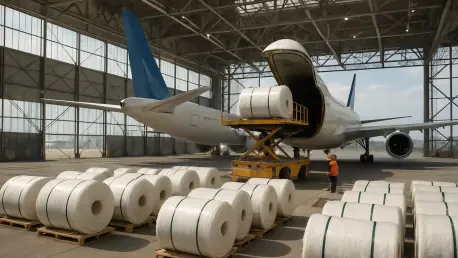
Managing a project that spans three continents is an exercise in extreme logistical precision, especially when you are racing against a fixed opening day. We sourced 400,000 square feet of specialized fiberglass fabric coated in polytetrafluoroethylene (PTFE) from Verseidag-Indutex GmbH in Germany, which then had to be air-freighted to China for the highly specialized sewing process. The sheer volume of material is staggering, and air-freighting such a heavy, delicate cargo requires a massive coordination of cargo planes to move 360-foot long panels across the globe without delay. To maintain quality control, we rely on a rigorous chain of custody and expert oversight at each node, ensuring that the German-manufactured material meets the exact specifications required for the arduous assembly in China before it finally arrives in Florida. This global relay race is the only way to meet a timeline that sees us placing the roof between August and November to be ready for a spring first pitch.
To match a new canopy to a 30-year-old cable system, engineers often rely on both archival blueprints and modern 3D scans. How do you reconcile original drawings with current drone survey data to ensure the new panels fit the existing geometry?
Reconciling the “generational gap” in engineering is one of the most intellectually stimulating parts of a project like this. We were incredibly fortunate to find the original engineered drawings from the 1990s still on-site, which provided the foundational logic for how the stadium was first built. However, buildings settle and move over three decades, so we cannot rely on paper alone; we use drones to conduct exhaustive 3D scans of the existing cable system geometry to see how it sits today. We then overlay this modern point-cloud data onto the digitized archival blueprints to identify any deviations, allowing the fabricators in China to sew the new panels with sub-inch precision. This marriage of historical records and 21st-century scanning ensures that when the massive panels are lifted into place, they align perfectly with the legacy tension system.
Modern stadium roofs are now expected to withstand hurricane-force winds of 165 miles per hour. Beyond using PTFE-coated fiberglass, what structural reinforcements or specialized installation techniques are necessary to ensure the fabric remains secure during extreme weather events?
Ensuring a roof can withstand 165 mile-per-hour winds requires more than just high-strength material; it’s about the mechanical integrity of the entire system. We utilize PTFE-coated fiberglass not just for its durability, but for its ability to maintain tension under extreme pressure without tearing or deforming. During the installation process, which we executed between August and November 2025, each panel is mechanically fastened and tensioned to the existing cable network using specialized hardware designed to distribute wind loads evenly across the structure. The secret lies in the “sewing” and reinforcement of the 360-foot panels, creating a drum-tight surface that deflects the wind rather than catching it like a sail. It’s a painstaking process of securing thousands of linear feet of fabric to ensure that the stadium remains a safe haven even in the face of future Category 5 storms.
With a tight installation window between August and November, construction teams must balance structural repairs with interior upgrades like new hospitality spaces. How do you manage the workflow to ensure water damage restoration doesn’t interfere with the high-altitude work of placing massive roof panels?
Managing concurrent work streams in a stadium environment is like conducting a vertical symphony where the “ceiling” is 200 feet in the air. While the heavy lifting of the roof panels is happening above, we have separate crews working below on water damage restoration and interior upgrades, such as installing brand-new bars and hospitality amenities. To prevent these teams from tripping over each other, we utilize a tiered scheduling system where high-altitude work is zoned off to protect the workers on the ground from any potential falling hazards. Interestingly, the restoration work actually allows us to make the stadium “the best it’s looked in 30 years,” because we aren’t just fixing what broke; we are modernizing the fan experience simultaneously. By the time we received Major League Baseball approval, we had successfully synchronized the completion of the roof with the interior aesthetic improvements.
Investing tens of millions in a facility that may only be used for a few more seasons presents a unique cost-benefit scenario. What are the operational trade-offs when performing major renovations on a “bridge” stadium while a new multibillion-dollar ballpark is simultaneously being planned?
This is a classic dilemma in sports infrastructure: how much do you invest in a “bridge” facility when a new $2.3 billion ballpark is on the horizon for 2029? The $60 million investment in the current roof was not just a luxury; it was a contractual and operational necessity to keep the team playing in their home city until the new stadium is shovel-ready. The trade-off involves prioritizing structural integrity and essential fan comfort over long-term architectural overhauls that wouldn’t see a return on investment. We focus our budget on the critical path—the roof and water remediation—while adding strategic upgrades like new bars that provide immediate value for the remaining seasons. It’s a delicate balance of spending enough to maintain a Major League standard without over-capitalizing on a structure that has a looming expiration date.
What is your forecast for the future of resilient sports architecture in hurricane-prone regions?
The future of sports architecture in storm-prone areas will shift toward “adaptive resilience,” where structures are designed to be either indestructible or intelligently sacrificial. We will see an increase in the use of advanced composites like the PTFE-fiberglass we used at the Trop, but with even smarter sensor integration to monitor cable tension in real-time during a storm. Furthermore, as we see with the plans for the new $2.3 billion stadium, future designs will likely move away from vast, single-point-of-failure fabric roofs in favor of more rigid, modular systems or retractable designs that can be “tucked away” to minimize wind profile. Ultimately, the industry will move toward buildings that aren’t just shelters, but active pieces of infrastructure that can bounce back from a “direct hit” within weeks rather than years, ensuring the continuity of the community’s cultural life.