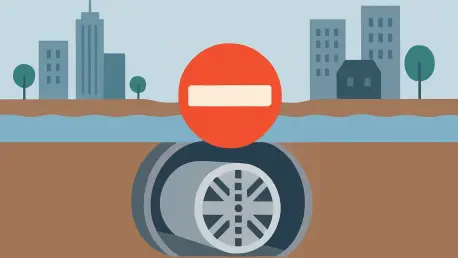

A project designed to secure the economic future of the entire Northeast Corridor now finds itself bogged down in a legal quagmire, its massive machinery silenced by a political standoff. The Hudson Tunnel Project, a cornerstone of the nation’s infrastructure and a vital $16 billion link, has been brought to a sudden halt. A high-stakes legal and financial showdown between the Gateway Development Commission (GDC) and the Trump administration has frozen federal funding, thrusting the project’s future into uncertainty. This timeline will trace the key events in this escalating conflict, from the initial funding suspension to the ensuing court battles. The standoff is not merely a contractual dispute; it represents a critical juncture where administrative policy clashes with tangible progress, leaving nearly a thousand workers jobless and jeopardizing a project of national importance.
The Unfolding Crisis: A Timeline of Events
Fall 2025 – Funding Freeze and Initial Challenge
The conflict ignited last fall when the Trump administration’s Department of Transportation (DOT) began questioning the legality of the Disadvantaged Business Enterprise (DBE) program. This program establishes workforce goals for women and minorities on federally funded projects. Using this challenge as justification, the DOT suspended its financial contributions. The decisive blow came on September 30, 2025, when the department withheld a contractually obligated payment of over $205 million, effectively cutting off the project’s primary financial lifeline and setting the stage for the crisis to come.
October 2025 – January 2026 – Running on Fumes
Despite the federal freeze, the GDC managed to keep construction moving for four crucial months. By leveraging its financial reserves and a dedicated line of credit, the commission pushed forward in an attempt to maintain momentum and meet critical deadlines. However, these temporary measures were never going to be a sustainable solution for a multi-billion-dollar undertaking. By late January, these financial resources were completely depleted, bringing the colossal project to the brink of collapse and forcing the GDC’s hand.
February 2026 – Construction Halts and Legal Action
With its funds exhausted and no federal money in sight, the GDC was forced to halt all construction progress on February 6. The shutdown had immediate and severe consequences, resulting in layoffs for nearly 1,000 workers who suddenly found themselves without a job. In response to what it deemed an illegal withholding of funds, the GDC fired back, filing a breach-of-contract lawsuit against the Trump administration on February 2. The states of New York and New Jersey, key partners in the project, quickly filed a separate lawsuit, escalating the legal pressure on the administration.
Mid-February 2026 – A Courtroom Showdown
The legal battle quickly saw a pivotal development. On February 6, a federal judge in New York sided with the GDC, issuing an order for the DOT to resume funding immediately. However, this victory was short-lived. The administration filed an appeal just two days later, on February 8, challenging the decision and further delaying the release of desperately needed funds. In a subsequent ruling, the court gave the government a firm deadline of Thursday to resume the payments as the appeal process continues, leaving stakeholders anxiously awaiting the outcome.
Key Turning Points and Overarching Tensions
The most significant turning points in this crisis were the administration’s initial decision to weaponize a policy dispute to halt funding and the judiciary’s swift intervention to order its reinstatement. This created a tense standoff, pitting the executive branch against state project leaders and the courts. The overarching theme is the vulnerability of critical infrastructure to political maneuvering, where a disagreement over a single program can derail a project with vast economic implications. The immediate future hangs on the administration’s compliance with the court order. Any further delay threatens to create an insurmountable gap in the project timeline, jeopardizing key 2026 milestones like the award of major contracts and the start of tunnel boring operations.
Deeper Implications and Unseen Costs
This conflict highlights the inherent risks in large-scale public projects that rely heavily on federal-state partnerships. With federal money accounting for 70% of the budget, its suspension proves crippling. Project stakeholders remain hopeful but cautious, emphasizing that a prolonged delay will have consequences far beyond the immediate layoffs. An often-overlooked aspect is the substantial cost of the shutdown itself. The “patch work” required to secure massive, open construction sites and demobilize heavy equipment is projected to cost an additional $15 million to $20 million per month. This is money spent not on progress, but on mitigating the public safety risks created by an idle work site, adding a costly and unproductive chapter to the project’s history.