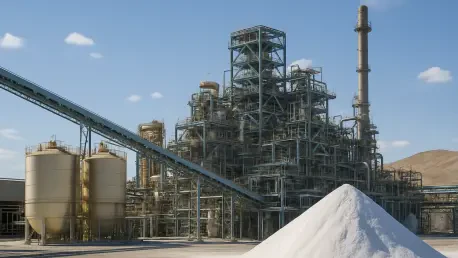

The global chemical landscape is currently witnessing a significant realignment as Kazakhstan transitions from a traditional importer to a dominant producer within the Central Asian industrial sector. This shift is punctuated by the recent launch of a massive soda ash production facility in the Zhambyl region, representing a total investment expected to exceed $2 billion across its development stages. Managed by Qazaq Soda LLP, a subsidiary of the Turkish COREX Group, in collaboration with Chinese general contractor CAMCE, the project marks a pivotal moment for the national economy. By leveraging vast domestic mineral resources, the plant is designed to end the country’s dependence on foreign soda ash, which is an indispensable raw material for glass manufacturing, metallurgy, and chemical processing. This strategic move not only secures the domestic supply chain but also positions the nation as a competitive exporter on the international stage, fundamentally changing the regional trade dynamics.
Strategic Infrastructure: The Engineering Behind the Expansion
The technical execution of this massive facility relies on an integrated EPC model where the Kazakh firm BI-Industrial serves as the primary contractor for critical infrastructure. Spanning a vast territory in the Zhambyl region, the site includes specialized facilities such as a 25-hectare solid waste storage area and an expansive 800-hectare evaporation pond. The construction team also completed a sophisticated limestone crushing complex and a comprehensive railway network to facilitate the movement of raw materials and finished goods. Choosing this specific location was a calculated decision driven by its proximity to high-grade limestone and salt deposits, which are the primary inputs for soda ash production. By streamlining the logistics between extraction and processing, the project achieves significant cost efficiencies while reducing the carbon footprint associated with long-distance transportation. This infrastructure serves as a blueprint for future industrial zones, showcasing how localized resources can drive large-scale development.
Beyond the mechanical and structural components, the project incorporates advanced environmental technologies to ensure long-term industrial sustainability and compliance with modern ecological standards. Engineers have implemented high-performance geomembranes for waste isolation, preventing any potential soil or groundwater contamination from the plant’s chemical processes. Additionally, modern emission control systems have been integrated into the production line to mitigate the impact of industrial gases, reflecting a commitment to greener manufacturing practices. This environmental focus is not merely a regulatory necessity but a core component of the project’s strategy to attract international investors who prioritize sustainable operations. As the facility scales its operations, these protective measures will be vital in maintaining the balance between industrial growth and regional environmental health. The integration of such high-tech solutions demonstrates a clear departure from older, more polluting industrial models, setting a new benchmark for the chemical industry in Eurasia while ensuring the facility remains operational for decades.
Economic Impact: Employment and Market Self-Sufficiency
The launch of the initial phase in September, which delivered an annual capacity of 500,000 tonnes, immediately impacted the local labor market and established a foundation for future expansions toward 3 million tonnes. During the construction phase, the project utilized over 300 personnel, predominantly local residents, while the operational plant created permanent roles for more than 380 specialized technicians. Policymakers and industry leaders prioritized the establishment of secondary manufacturing hubs nearby to utilize the soda ash in the production of finished glass and detergents. This approach maximized the value-added benefits within the domestic economy rather than simply exporting raw chemical products. Furthermore, investment in vocational training programs for the Zhambyl region was identified as a critical step to ensure a steady pipeline of skilled workers for the planned expansion phases. By focusing on these integrated economic strategies, the region successfully transformed an ambitious industrial vision into a sustainable reality that addressed both import dependency and local unemployment.