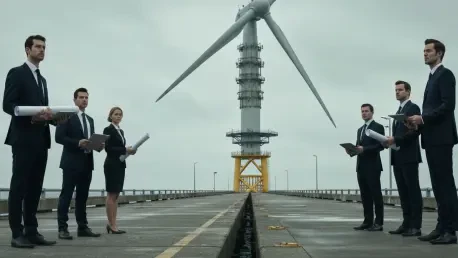

In a directive that sent shockwaves through the global energy market, the burgeoning American offshore wind industry was brought to an abrupt and total standstill by a single executive order, igniting a high-stakes battle over national security, economic stability, and the future of renewable power. The Trump administration’s sweeping stop-work order, issued in December, effectively paralyzed every major offshore wind project under construction in federal waters. This sudden halt has created an unprecedented clash, pitting the immense power of the federal government against the formidable corporate interests of international energy developers.
The conflict’s significance extends far beyond a simple regulatory dispute. With billions of dollars in private investment now jeopardized and thousands of jobs hanging in the balance, the shutdown represents a critical juncture for U.S. energy policy. It calls into question the nation’s ability to meet its renewable energy targets and maintain its credibility as a stable market for large-scale infrastructure investment. This article delves into the core of the controversy, investigating whether the administration’s stated national security concerns are a legitimate basis for such drastic action or merely a convenient pretext for a broader political agenda aimed at undermining the clean energy transition.
The Core of the Conflict: Justifications, Rebuttals, and the Battle for Regulatory Ground
Examining the Administration’s Two-Pronged Rationale
The official justification for the ban hinges on a two-pronged national security argument. Interior Secretary Doug Burgum announced the pause was a necessary precaution against the “rapid evolution of the relevant adversary technologies.” This vague warning was substantiated by references to recently completed, classified Department of Defense reports that allegedly identified new and pressing national security threats posed by the offshore wind projects. This narrative frames the administration’s action as a prudent and necessary response to emerging dangers that previous reviews could not have anticipated.
In stark contrast to this sober security-focused reasoning, Secretary Burgum’s public communications on social media painted a very different picture. In a post on X, he dismissed the combined output of all five affected wind farms as inferior to a single natural gas pipeline, labeling the technology as “expensive, unreliable,” and “heavily subsidized.” This messaging, which aligns with long-standing political critiques of renewable energy, introduces a significant contradiction. It raises the critical question of whether the administration is operating from a coherent policy position based on classified intelligence or is strategically using the specter of national security to achieve a political goal of halting renewable energy development.
The Industry’s Counter-Narrative: A History of Comprehensive Security Vetting
Offshore wind developers forcefully rebut the administration’s claims, arguing that national security considerations were not only considered but were exhaustively vetted and resolved through established regulatory channels long before the ban. They contend that the official rationale ignores a years-long history of collaboration and review with the very agencies now being cited as the source of concern. This counter-narrative repositions the stop-work order not as a proactive security measure, but as a disruptive and unnecessary intervention in a well-managed process.
The developers’ legal filings provide specific evidence to support their position. They highlight the comprehensive project reviews already completed by the Bureau of Ocean Energy Management (BOEM), the Department of Defense (DOD), and the U.S. Coast Guard—agencies that scrutinized every aspect of the projects at each regulatory stage. The most compelling piece of evidence is a formal mitigation agreement signed between Revolution Wind and the U.S. Air Force in November 2025. This legally binding accord was explicitly designed to address security risks and mitigate any potential adverse effects on military radar and operations, directly contradicting the administration’s assertion that new, unaddressed threats required a complete shutdown.
Quantifying the Disruption: From Financial Peril to Widespread Project Paralysis
The economic fallout from the stop-work order was both immediate and severe. Court filings from Ørsted, a partner in the Revolution Wind project, estimate the company is incurring catastrophic losses of at least $1.44 million for each day the construction halt remains in effect. This figure underscores the immense financial pressure on developers, a situation compounded by past disruptions. Equinor, developer of the Empire Wind project, had previously absorbed an estimated $200 million in delay-related costs from a more targeted stop-work order just months earlier, highlighting the financial fragility of these multi-billion-dollar undertakings.
The shutdown’s impact extends across the entire U.S. East Coast, paralyzing five flagship projects that form the backbone of the nation’s offshore wind ambitions. The affected developments include the 2.6-GW Coastal Virginia Offshore Wind, the 800-MW Vineyard Wind 1, the 700-MW Revolution Wind, the 2-GW Empire Wind 1 & 2, and the 924-MW Sunrise Wind. This collective paralysis not only threatens the financial viability of individual companies but also jeopardizes the entire domestic supply chain, from manufacturing facilities to port operations. The move risks signaling to global investors that the U.S. is an unpredictable and high-risk market, potentially derailing long-term investment in American clean energy infrastructure.
The Legal Gauntlet: Challenging the Order as Arbitrary and Capricious
In response to the order, Ørsted and Equinor have mounted a robust legal challenge, arguing that the administration’s directive is an “arbitrary and capricious change in position.” This legal standard is used to contest federal agency actions that lack a rational basis or sufficient explanation, particularly when they reverse a long-standing policy or decision. The developers assert that the government abruptly abandoned years of regulatory approvals without acknowledging the “significant reliance interests” of companies that have already invested billions of dollars based on those approvals.
Furthermore, the legal complaints directly challenge the scope of the administration’s executive authority over federally leased waters. Developers contend that their lease agreements with the government are not subject to “unfettered discretion” and imply an expectation of regulatory stability. Their filings point to clauses stipulating that “advance notice” will typically be given before any suspension is required. By issuing a sudden, blanket stop-work order, the administration has arguably breached the terms of these agreements. This legal battle has therefore become a crucial test of the balance of power between the executive branch and the private entities operating under federal leases.
Strategic Implications: Navigating the Intersection of Politics, Security, and Energy Investment
The evidence presented by wind developers, including prior multi-agency security reviews and a formal mitigation agreement with the Air Force, severely weakens the administration’s official security rationale. The conflicting political messaging further suggests that the ban may be rooted in ideology rather than new intelligence. This situation reveals a critical vulnerability for the energy sector: the intersection of high-stakes infrastructure projects with political volatility. The conflict underscores that even with comprehensive regulatory and security clearances, projects can be derailed by sudden shifts in the political landscape.
For industry stakeholders, this episode offers crucial insights. The most vital takeaway is the need to secure legally binding mitigation agreements that explicitly address and resolve potential security concerns, creating a powerful legal shield against future challenges. Furthermore, companies must now integrate political risk assessment into their core business strategy, preparing for unpredictable executive actions with the same rigor they apply to market or technical risks. Meticulous documentation of every regulatory approval, security clearance, and inter-agency agreement has become the most effective defense against sudden, and poorly justified, government interventions.
The Verdict on the Ban: A Defining Moment for America’s Energy Future
Ultimately, the evidence suggests that the sweeping offshore wind ban was driven more by long-standing political opposition to renewable energy than by the emergence of new, unmanageable national security threats. The administration’s actions, contradicted by a history of prior security vetting and its own public messaging, have sent a powerful and damaging signal to the global investment community. The resulting legal and financial turmoil has cast a chilling effect over the industry, threatening the nation’s ability to achieve its clean energy goals and combat climate change.
This conflict has pushed the United States to a critical crossroads. The outcome will set a precedent for how the nation handles the complex interplay of politics, security, and private investment in major infrastructure projects for years to come. The central question that remains is whether this confrontation will embolden further political interference in energy development, or if it will instead force the creation of a more resilient, transparent, and predictable regulatory framework that can withstand the shifting tides of politics and secure America’s energy future.