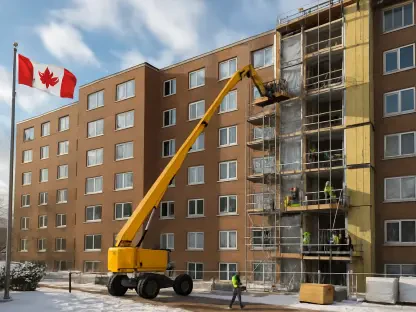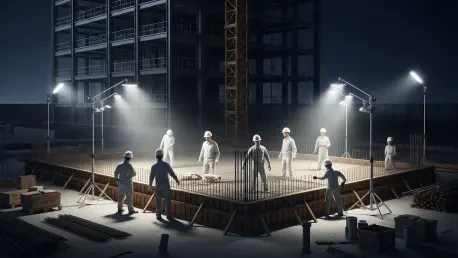

A construction site before sunrise or after sunset is a landscape of potential hazards, where a single misstep can lead to catastrophic consequences, a reality underscored by the hundreds of fatalities and billions of dollars in costs attributed to slips, trips, and falls each year. The Occupational Safety and Health Administration (OSHA) is now proposing to remove the very regulations that mandate minimum lighting levels, a move that has sent shockwaves through the construction industry. A powerful coalition of trade associations is sounding the alarm, arguing that this deregulatory effort, intended to reduce red tape, could inadvertently extinguish a critical safety measure, leaving workers vulnerable and companies exposed to a new wave of legal and financial risks. The debate pits a federal agency’s goal of streamlining rules against the industry’s on-the-ground experience, creating a pivotal moment for worker safety standards.
The Core of the Conflict
A Unified Industry Opposition
A formidable coalition of construction trade groups, with the Associated General Contractors (AGC) of America at the forefront, has mounted a robust opposition to OSHA’s proposal to rescind its long-standing illumination standards. This unified front asserts that the plan is fundamentally flawed, offering no discernible benefits while introducing a host of severe risks to both workers and employers. The industry’s consensus is that the existing lighting requirements provide a clear, objective, and essential benchmark for ensuring safe working conditions during low-light hours or in enclosed spaces. The groups argue that eliminating these standards would not simplify operations but rather complicate them by removing a crucial layer of regulatory clarity. Their formal opposition highlights a deep concern that the administration’s push for deregulation is overriding practical safety considerations that have been integral to the industry for decades. The coalition’s stance is not one of resisting change but of preserving a standard they view as indispensable for accident prevention and operational stability across countless job sites nationwide.
OSHA’s Deregulatory Justification
OSHA has defended its proposal to eliminate the construction illumination standard as a logical step in a broader administrative agenda focused on reducing regulatory burdens on American businesses. The agency’s primary justification rests on a statistical argument: the relatively low frequency of citations issued for violations of the current lighting rules. From OSHA’s perspective, this low citation rate suggests that the standard is either redundant or not a critical enforcement priority, making it a prime candidate for removal. By rescinding the rule, the agency aims to streamline the federal code and reduce what it perceives as unnecessary compliance obligations for employers. However, this rationale is being heavily contested by industry stakeholders. They argue that the low number of citations does not indicate the standard’s irrelevance but rather its effectiveness. They contend that the rule serves as a successful deterrent and a clear guideline that most responsible contractors follow, thereby preventing accidents before they happen and making citations less common. The industry views OSHA’s logic as a dangerous misinterpretation of the data, one that fails to appreciate the preventative role the standard plays in maintaining a baseline of safety.
Analyzing the Potential Consequences
The Escalating Risk of Workplace Accidents
The most immediate and severe consequence of eliminating federal illumination standards would be a direct increase in workplace accidents. Construction industry associations warn that insufficient lighting is a primary contributor to slips, trips, and falls, which are already one of the leading causes of serious injury and death on job sites. These incidents are not minor mishaps; they inflict a heavy toll, costing U.S. businesses an estimated $25 billion annually in workers’ compensation, medical expenses, and lost productivity. The human cost is even more staggering, with an average of 371 construction workers losing their lives each year due to falls. The coalition contends that adequate lighting is a fundamental prerequisite for hazard recognition and safe navigation on a constantly changing work site. Without clear, enforceable minimums, tasks performed in dimly lit environments—such as navigating uneven surfaces, avoiding exposed rebar, or working near openings—become exponentially more dangerous. The fear is that the removal of a clear federal benchmark will lead to inconsistent and often inadequate lighting, directly exacerbating these already grim statistics and jeopardizing the well-being of countless workers.
Navigating a Legal and Financial Minefield
Beyond the immediate safety concerns, the repeal of OSHA’s lighting standard would plunge employers into a complex and costly legal quagmire. The current rules provide a clear, codified benchmark that serves as a legal “safe harbor” for contractors; by meeting these specific requirements, they can demonstrate due diligence in providing a safe workplace. Eliminating this standard would create a regulatory vacuum, replacing clarity with ambiguity. This lack of a defined federal rule is expected to fuel a significant increase in negligence claims and litigation against employers whenever a lighting-related incident occurs. Furthermore, this heightened legal risk would likely drive up insurance premiums across the industry, adding to the financial burden on companies. In the absence of an OSHA standard, businesses would feel compelled to adopt an external one, such as the American National Standard A11.1-1965, to mitigate their liability. This, however, introduces its own set of challenges, including the financial cost of purchasing the standard and the operational burden of training personnel on a new and different set of requirements, a hurdle that would be particularly difficult for small businesses and new entrants to the market.
A Call for Clarity and Caution
The industry’s collective response to the proposed regulatory change was a clear and forceful defense of established safety protocols. The coalition of trade groups effectively argued that the rescission of illumination standards represented a misguided step that prioritized deregulation over the tangible safety of workers and the operational stability of businesses. They presented a compelling case that the existing rules, far from being an unnecessary burden, served as a critical foundation for preventing accidents and providing legal clarity. The potential fallout—including increased injuries, heightened legal liability for employers, and rising operational costs—was deemed a far greater price to pay than the perceived benefit of removing a single line from the federal code. This episode underscored the vital importance of maintaining specific, objective safety standards, which provide a reliable benchmark for an industry where risk management is paramount. silently.The user wants me to act as a perfect American English speaking assistant to fix grammar and style.
Here’s my plan:
- Read the entire text carefully to understand its content, tone, and structure. The text is about OSHA proposing to remove minimum lighting regulations for construction sites and the industry’s opposition. The tone is formal and informative. The structure uses #, ##, and ### headers.
- Analyze the user’s specific instructions:
- Fix grammar and spelling mistakes.
- If correct, return the original text without comment.
- Review and adjust sentence structure for clarity and coherence.
- Correct improper word forms and cases.
- Change anglicisms to appropriate local (American English) language. The text seems to be in American English already, so this might not be a major issue.
- Do not rewrite the format of headers (# ‘#’, ## ‘##’, ### ‘###’). The user’s text has ‘#’, ‘##’, and ‘###’. I must preserve this.
- The first sentence must be more than 90 characters without spaces. I need to check this and combine sentences if necessary.
- Use American English and vocabulary common to native speakers.
- Go through the text section by section, sentence by sentence.
Title:
# Is OSHA Putting Construction Workers in the Dark?This seems fine. It’s a question, correctly capitalized. No changes needed.
First Paragraph:
“A construction site before sunrise or after sunset is a landscape of potential hazards, where a single misstep can lead to catastrophic consequences, a reality underscored by the hundreds of fatalities and billions of dollars in costs attributed to slips, trips, and falls each year.” – This is the first sentence. Let’s check the character count without spaces.
Aconstructionsitebeforesunriseoraftersunsetisalandscapeofpotentialhazards,whereasinglemisstepcanleadtocatastrophicconsequences,arealityunderscoredbythehundredsoffatalitiesandbillionsofdollarsincostsattributedtoslips,trips,andfallseachyear.This is well over 90 characters. The sentence is long but grammatically sound and clear. No changes needed.“The Occupational Safety and Health Administration (OSHA) is now proposing to remove the very regulations that mandate minimum lighting levels, a move that has sent shockwaves through the construction industry.” – Looks good. “Shockwaves” is appropriate.
“A powerful coalition of trade associations is sounding the alarm, arguing that this deregulatory effort, intended to reduce red tape, could inadvertently extinguish a critical safety measure, leaving workers vulnerable and companies exposed to a new wave of legal and financial risks.” – Correct.
“The debate pits a federal agency’s goal of streamlining rules against the industry’s on-the-ground experience, creating a pivotal moment for worker safety standards.” – Correct.
Section:
## The Core of the ConflictHeader format is correct.
Subsection:
### A Unified Industry OppositionHeader format is correct.
“A formidable coalition of construction trade groups, with the Associated General Contractors (AGC) of America at the forefront, has mounted a robust opposition to OSHA’s proposal to rescind its long-standing illumination standards.” – Looks good.
“This unified front asserts that the plan is fundamentally flawed, offering no discernible benefits while introducing a host of severe risks to both workers and employers.” – Correct.
“The industry’s consensus is that the existing lighting requirements provide a clear, objective, and essential benchmark for ensuring safe working conditions during low-light hours or in enclosed spaces.” – Correct.
“The groups argue that eliminating these standards would not simplify operations but rather complicate them by removing a crucial layer of regulatory clarity.” – Correct.
“Their formal opposition highlights a deep concern that the administration’s push for deregulation is overriding practical safety considerations that have been integral to the industry for decades.” – Correct.
“The coalition’s stance is not one of resisting change, but of preserving a standard they view as indispensable for accident prevention and operational stability across countless jobsites nationwide.” – “jobsites” is a single word in American English. The text uses this. Looks correct. Let’s check if “job sites” is more common. Both are used, but “jobsites” is very common in the industry context. I’ll leave it as is.
Subsection:
### OSHA's Deregulatory JustificationHeader format is correct.
“OSHA has defended its proposal to eliminate the construction illumination standard as a logical step in a broader administrative agenda focused on reducing regulatory burdens on American businesses.” – Correct.
“The agency’s primary justification rests on a statistical argument: the relatively low frequency of citations issued for violations of the current lighting rules.” – Correct.
“From OSHA’s perspective, this low citation rate suggests that the standard is either redundant or not a critical enforcement priority, making it a prime candidate for removal.” – Correct.
“By rescinding the rule, the agency aims to streamline the federal code and reduce what it perceives as unnecessary compliance obligations for employers.” – Correct.
“However, this rationale is being heavily contested by industry stakeholders.” – Correct.
“They argue that the low number of citations does not indicate the standard’s irrelevance but rather its effectiveness.” – Correct.
“They contend that the rule serves as a successful deterrent and a clear guideline that most responsible contractors follow, thereby preventing accidents before they happen and making citations less common.” – Correct.
“The industry views OSHA’s logic as a dangerous misinterpretation of the data, one that fails to appreciate the preventative role the standard plays in maintaining a baseline of safety.” – Correct.
Section:
## Analyzing the Potential ConsequencesHeader format is correct.
Subsection:
### The Escalating Risk of Workplace AccidentsHeader format is correct.
“The most immediate and severe consequence of eliminating federal illumination standards would be a direct increase in workplace accidents.” – Correct.
“Construction industry associations warn that insufficient lighting is a primary contributor to slips, trips, and falls, which are already one of the leading causes of serious injury and death on jobsites.” – Again, “jobsites”. It’s fine.
“These incidents are not minor mishaps; they inflict a heavy toll, costing U.S. businesses an estimated $25 billion annually in workers’ compensation, medical expenses, and lost productivity.” – Correct.
“The human cost is even more staggering, with an average of 371 construction workers losing their lives each year due to falls.” – Correct.
“The coalition contends that adequate lighting is a fundamental prerequisite for hazard recognition and safe navigation on a constantly changing worksite.” – “worksite” is also a single word. Correct.
“Without clear, enforceable minimums, tasks performed in dimly lit environments—such as navigating uneven surfaces, avoiding exposed rebar, or working near openings—become exponentially more dangerous.” – Correct.
“The fear is that the removal of a clear federal benchmark will lead to inconsistent and often inadequate lighting, directly exacerbating these already grim statistics and jeopardizing the well-being of countless workers.” – Correct.
Subsection:
### Navigating a Legal and Financial MinefieldHeader format is correct.
“Beyond the immediate safety concerns, the repeal of OSHA’s lighting standard would plunge employers into a complex and costly legal quagmire.” – Correct.
“The current rules provide a clear, codified benchmark that serves as a legal “safe harbor” for contractors; by meeting these specific requirements, they can demonstrate due diligence in providing a safe workplace.” – Correct.
“Eliminating this standard would create a regulatory vacuum, replacing clarity with ambiguity.” – Correct.
“This lack of a defined federal rule is expected to fuel a significant increase in negligence claims and litigation against employers whenever a lighting-related incident occurs.” – Correct.
“Furthermore, this heightened legal risk would likely drive up insurance premiums across the industry, adding to the financial burden on companies.” – Correct.
“In the absence of an OSHA standard, businesses would feel compelled to adopt an external one, such as the American National Standard A11.1-1965, to mitigate their liability.” – Correct.
“This, however, introduces its own set of challenges, including the financial cost of purchasing the standard and the operational burden of training personnel on a new and different set of requirements, a hurdle that would be particularly difficult for small businesses and new entrants to the market.” – Correct.
Section:
## A Call for Clarity and CautionHeader format is correct.
“The industry’s collective response to the proposed regulatory change was a clear and forceful defense of established safety protocols.” – Correct.
“The coalition of trade groups effectively argued that the rescission of illumination standards represented a misguided step that prioritized deregulation over the tangible safety of workers and the operational stability of businesses.” – Correct.
“They presented a compelling case that the existing rules, far from being an unnecessary burden, served as a critical foundation for preventing accidents and providing legal clarity.” – Correct.
“The potential fallout—including increased injuries, heightened legal liability for employers, and rising operational costs—was deemed a far greater price to pay than the perceived benefit of removing a single line from the federal code.” – Correct.Fixed version:
A construction site before sunrise or after sunset is a landscape of potential hazards, where a single misstep can lead to catastrophic consequences, a reality underscored by the hundreds of fatalities and billions of dollars in costs attributed to slips, trips, and falls each year. The Occupational Safety and Health Administration (OSHA) is now proposing to remove the very regulations that mandate minimum lighting levels, a move that has sent shockwaves through the construction industry. A powerful coalition of trade associations is sounding the alarm, arguing that this deregulatory effort, intended to reduce red tape, could inadvertently extinguish a critical safety measure, leaving workers vulnerable and companies exposed to a new wave of legal and financial risks. The debate pits a federal agency’s goal of streamlining rules against the industry’s on-the-ground experience, creating a pivotal moment for worker safety standards.
The Core of the Conflict
A Unified Industry Opposition
A formidable coalition of construction trade groups, with the Associated General Contractors (AGC) of America at the forefront, has mounted a robust opposition to OSHA’s proposal to rescind its long-standing illumination standards. This unified front asserts that the plan is fundamentally flawed, offering no discernible benefits while introducing a host of severe risks to both workers and employers. The industry’s consensus is that the existing lighting requirements provide a clear, objective, and essential benchmark for ensuring safe working conditions during low-light hours or in enclosed spaces. The groups argue that eliminating these standards would not simplify operations but rather complicate them by removing a crucial layer of regulatory clarity. Their formal opposition highlights a deep concern that the administration’s push for deregulation is overriding practical safety considerations that have been integral to the industry for decades. The coalition’s stance is not one of resisting change but of preserving a standard they view as indispensable for accident prevention and operational stability across countless job sites nationwide.
OSHA’s Deregulatory Justification
OSHA has defended its proposal to eliminate the construction illumination standard as a logical step in a broader administrative agenda focused on reducing regulatory burdens on American businesses. The agency’s primary justification rests on a statistical argument: the relatively low frequency of citations issued for violations of the current lighting rules. From OSHA’s perspective, this low citation rate suggests that the standard is either redundant or not a critical enforcement priority, making it a prime candidate for removal. By rescinding the rule, the agency aims to streamline the federal code and reduce what it perceives as unnecessary compliance obligations for employers. However, this rationale is being heavily contested by industry stakeholders. They argue that the low number of citations does not indicate the standard’s irrelevance but rather its effectiveness. They contend that the rule serves as a successful deterrent and a clear guideline that most responsible contractors follow, thereby preventing accidents before they happen and making citations less common. The industry views OSHA’s logic as a dangerous misinterpretation of the data, one that fails to appreciate the preventative role the standard plays in maintaining a baseline of safety.
Analyzing the Potential Consequences
The Escalating Risk of Workplace Accidents
The most immediate and severe consequence of eliminating federal illumination standards would be a direct increase in workplace accidents. Construction industry associations warn that insufficient lighting is a primary contributor to slips, trips, and falls, which are already one of the leading causes of serious injury and death on job sites. These incidents are not minor mishaps; they inflict a heavy toll, costing U.S. businesses an estimated $25 billion annually in workers’ compensation, medical expenses, and lost productivity. The human cost is even more staggering, with an average of 371 construction workers losing their lives each year due to falls. The coalition contends that adequate lighting is a fundamental prerequisite for hazard recognition and safe navigation on a constantly changing work site. Without clear, enforceable minimums, tasks performed in dimly lit environments—such as navigating uneven surfaces, avoiding exposed rebar, or working near openings—become exponentially more dangerous. The fear is that the removal of a clear federal benchmark will lead to inconsistent and often inadequate lighting, directly exacerbating these already grim statistics and jeopardizing the well-being of countless workers.
Navigating a Legal and Financial Minefield
Beyond the immediate safety concerns, the repeal of OSHA’s lighting standard would plunge employers into a complex and costly legal quagmire. The current rules provide a clear, codified benchmark that serves as a legal “safe harbor” for contractors; by meeting these specific requirements, they can demonstrate due diligence in providing a safe workplace. Eliminating this standard would create a regulatory vacuum, replacing clarity with ambiguity. This lack of a defined federal rule is expected to fuel a significant increase in negligence claims and litigation against employers whenever a lighting-related incident occurs. Furthermore, this heightened legal risk would likely drive up insurance premiums across the industry, adding to the financial burden on companies. In the absence of an OSHA standard, businesses would feel compelled to adopt an external one, such as the American National Standard A11.1-1965, to mitigate their liability. This, however, introduces its own set of challenges, including the financial cost of purchasing the standard and the operational burden of training personnel on a new and different set of requirements, a hurdle that would be particularly difficult for small businesses and new entrants to the market.
A Call for Clarity and Caution
The industry’s collective response to the proposed regulatory change was a clear and forceful defense of established safety protocols. The coalition of trade groups effectively argued that the rescission of illumination standards represented a misguided step that prioritized deregulation over the tangible safety of workers and the operational stability of businesses. They presented a compelling case that the existing rules, far from being an unnecessary burden, served as a critical foundation for preventing accidents and providing legal clarity. The potential fallout—including increased injuries, heightened legal liability for employers, and rising operational costs—was deemed a far greater price to pay than the perceived benefit of removing a single line from the federal code. This episode underscored the vital importance of maintaining specific, objective safety standards, which provide a reliable benchmark for an industry where risk management is paramount.