
A cursory glance at the latest nonresidential construction planning data might suggest a market tapping the brakes, but this surface-level cooling masks an unprecedented and highly concentrated surge of activity in key sectors. The Dodge Momentum Index (DMI), a reliable forward-looking indicator for construction spending, registered a 1.1% decline in November 2025, marking its second consecutive month of contraction. This dip was a composite of a fractional 0.1% slip in commercial planning and a more pronounced 3.4% drop within the institutional sector. While this might signal caution to some observers, the underlying data reveals a more complex and vigorous reality. The year-over-year figures tell a dramatically different story, one of explosive growth driven by a wave of megaprojects so large they are reshaping the industry’s landscape. The quiet slowdown in some areas is being completely overshadowed by a roaring engine of development in others, creating a dual-speed market that defies simple categorization and points toward a fundamental shift in where investment capital is flowing.
Analyzing the Current Market Dynamics
A Tale of Two Sectors
The recent dip in the Dodge Momentum Index reveals a significant divergence between the commercial and institutional construction planning pipelines. The commercial segment experienced only a marginal decline, with stability in office and retail planning helping to offset pronounced weakness in the warehouse and hotel subsectors. This suggests that while the logistics and hospitality boom may be tempering, core commercial real estate planning remains resilient. In stark contrast, the institutional sector saw a more substantial 3.4% pullback. This downturn was broadly distributed across most categories, including education and public buildings, which had previously shown considerable strength. The slowdown followed a period of robust activity, indicating a potential normalization phase for the sector. However, one notable exception was the positive momentum observed in planning for religious-related construction, an outlier that highlights the niche-driven nature of the current market. This bifurcation underscores that a single headline number fails to capture the intricate push-and-pull forces at play within the nonresidential construction sphere.
The granular details of the sector-specific performance provide critical context for understanding the broader market trends. The weakening in warehouse planning, for instance, may reflect a market catching its breath after years of supercharged growth fueled by the e-commerce explosion, while the dip in hotel projects could be linked to shifting travel patterns and higher financing costs. On the institutional side, the widespread slowdown after a period of high activity is not entirely unexpected. Many public and private institutions may now be moving from the planning phase into execution, or they may be reassessing large capital expenditures in light of persistent macroeconomic uncertainties. The resilience in office and retail planning, though modest, is particularly noteworthy, as it defies long-standing narratives of decline in these areas. It could signal a nascent recovery or a shift toward repurposing and modernizing existing spaces rather than new ground-up construction, reflecting a more cautious yet adaptive approach from developers and investors in these traditional segments.
The Bigger Picture Year over Year
Despite the slight month-over-month decline, the year-over-year metrics for construction planning paint a picture of extraordinary strength and expansion. The Dodge Momentum Index in November 2025 stood a remarkable 50% higher than it did in November 2024, a testament to the powerful undercurrents driving the market forward. This massive annual increase indicates that the pipeline for future construction spending is significantly more robust than it was just twelve months ago. Furthermore, the year-to-date average for the DMI is a full 36% above the same period in the previous year, confirming that the recent monthly dips are minor fluctuations within a much larger and more powerful upward trend. This sustained, high-level growth suggests that the foundational drivers of construction demand remain exceptionally strong, capable of absorbing short-term volatility. The sheer scale of this annual expansion points away from a broad, evenly distributed recovery and toward a more concentrated boom powered by specific, high-value industry segments that are fundamentally altering the market’s composition.
This impressive annual growth is not merely a statistical anomaly; it reflects a profound shift in the scale and nature of projects entering the planning stages. The immense year-over-year jump in the DMI is almost entirely attributable to an influx of megaprojects, particularly within the technology and healthcare industries. These are not typical commercial or institutional buildings; they are vast, capital-intensive facilities like data centers and advanced medical campuses that carry valuations orders of magnitude greater than traditional projects. This concentration of value in a few key areas explains the paradox of a cooling headline number coexisting with a historic annual boom. While planning for smaller, more conventional projects may be decelerating due to economic pressures, the sheer financial weight of these megaprojects is elevating the entire index. This dynamic creates a market that is simultaneously slowing in breadth but accelerating in depth, a structural change that has significant implications for supply chains, labor markets, and regional economic development for years to come.
The Driving Forces and Future Outlook
Megaprojects Fueling the Engine
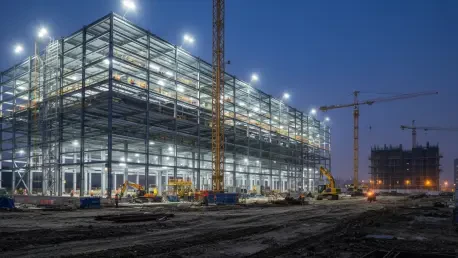
The engine behind the nonresidential construction boom is being fueled almost exclusively by a surge in high-value megaprojects, with the data center industry leading the charge. The impact of the technology sector’s insatiable demand for data infrastructure is so profound that it single-handedly reshapes the commercial planning landscape. According to the data, without the massive influx of data center projects, the year-over-year growth in the commercial DMI would have been a respectable 36%. However, with these projects included, that figure skyrockets to an astonishing 57%. This highlights the immense capital being deployed to build out the physical backbone of the digital economy. Illustrating this trend, the largest commercial projects to enter planning in November included the $406 million Novva Mesa data center in Arizona and the $317 million Compass data center in Illinois. On the institutional side, while the boom is less concentrated, large-scale projects are also making a significant impact, such as a $425 million school renovation in Michigan and a $250 million government complex in Virginia.
The proliferation of these enormous projects signals a deeper economic transformation where investment in digital and social infrastructure is taking precedence. Data centers have become the modern-day factories, essential for everything from cloud computing and artificial intelligence to streaming services and corporate data storage. Their construction is complex, expensive, and critical, driving a specialized and highly lucrative segment of the construction market. Similarly, major investments in healthcare and education reflect long-term societal priorities and demographic shifts. The scale of these projects creates a powerful ripple effect, boosting demand for specialized labor, advanced materials, and sophisticated engineering services. While the broader market for smaller nonresidential projects may face headwinds, this top tier of megaprojects provides a solid and growing foundation of activity, ensuring that the overall construction pipeline remains exceptionally well-capitalized and active, even if the growth is not evenly distributed across all sectors.
Navigating Near Term Headwinds
Looking ahead, the forecast for the nonresidential construction sector presents a dual narrative of focused strength amid broader challenges. Projections indicate that the market will continue to strengthen into 2027, but this growth is expected to be led almost exclusively by the sustained momentum in data center and healthcare projects. These two sectors are poised to remain the primary drivers of activity, buoyed by deep-seated technological and demographic trends that are largely insulated from cyclical economic downturns. However, this optimistic outlook for key segments is tempered by a more cautious consensus view for the rest of the nonresidential market. Many other sectors are expected to grapple with softer demand in the coming year as businesses and institutions navigate a landscape of economic uncertainty. This anticipated weakness in areas outside of technology and healthcare suggests that the market’s reliance on a few high-performing sectors will likely intensify before it broadens.
The primary obstacles on the horizon are macroeconomic risks, with inflationary cost pressures representing the most significant and persistent threat. Rising costs for materials, labor, and financing can erode project viability, causing delays or cancellations, particularly for developments with tighter margins. As these pressures continue to mount, the overall pace of planning across the board is likely to decelerate from the torrid pace seen over the past year. This environment creates a challenging calculus for developers and investors in sectors like retail, hospitality, and general office construction, where demand is more sensitive to consumer spending and corporate budgets. In essence, while the headline-grabbing megaprojects in data and healthcare will continue to propel the industry forward, the broader market is bracing for a period of adjustment. The challenge for the industry will be to manage the near-term headwinds affecting the majority of projects while capitalizing on the historic boom occurring at the top end of the market.
A Sector Redefined by Digital Demand
The analysis of the nonresidential construction market revealed a landscape in profound transition. What initially appeared as a slight cooling in planning activity was, upon closer inspection, a clear signal of a structural realignment. The data demonstrated that the industry’s trajectory was no longer dictated by broad, cyclical trends but was instead being powerfully shaped by the specific, immense demands of the digital economy. The outsized influence of data center construction fundamentally altered the growth narrative, creating a market that was simultaneously contracting in some traditional areas while experiencing historic expansion in others. This divergence underscored a pivotal moment where the construction of physical infrastructure for digital services became the primary engine of growth, overshadowing more conventional commercial and institutional development and setting a new course for the industry’s future.