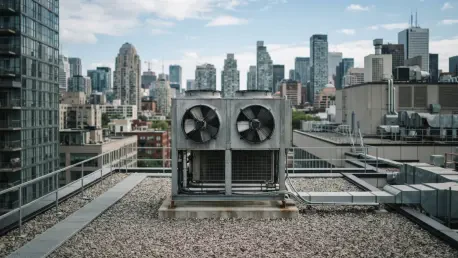

Engineering consultants must now navigate the complex trade-offs between the embodied carbon of new equipment and the long-term operational savings generated by high-efficiency systems. As the global community pushes toward the goal of net-zero emissions by 2050, the built environment has become a primary battleground for decarbonization efforts. Currently, buildings account for roughly one-quarter of the nation’s total carbon emissions, a statistic that underscores the urgent need for a total shift in how mechanical systems are conceived and implemented. It is no longer sufficient to treat Heating, Ventilation, and Air Conditioning (HVAC) as a series of isolated components selected purely for their cost or individual efficiency ratings. Instead, a holistic design philosophy is required to ensure that every choice supports a wider environmental strategy. This transition is becoming increasingly critical as the industry faces projections that buildings will become the single largest source of carbon emissions within the next decade if current trends remain unaddressed.
Integrated Design: The Shift Toward Whole-Life Carbon Philosophy
The evolution of mechanical design requires moving beyond the peak performance of isolated units to consider the broader implications of whole-life carbon impacts. This integrated approach demands that engineers evaluate how every design decision—from refrigerant selection to system scalability—affects a building’s total footprint over its entire lifecycle. By carefully analyzing the trade-offs between embodied carbon, which is intrinsically linked to the manufacturing and installation of equipment, and operational carbon generated during daily use, consultants can achieve practical decarbonization. This balance is necessary to avoid introducing unnecessary mechanical complexity that might lead to maintenance issues or shortened equipment lifespans. As climate patterns become more volatile, the focus must remain on creating systems that are as durable as they are efficient, ensuring that the carbon invested in their production yields maximum environmental returns over decades of operation.
Innovation in the field of climate control is now measured by how well technologies perform under real-world constraints rather than in controlled laboratory settings. This transition fundamentally changes the nature of the consultant’s role, requiring a much deeper understanding of how mechanical systems interact with a building’s unique envelope and insulation properties. The goal is to create reliable, workable designs that maintain high indoor air quality and occupant comfort while simultaneously raising the minimum standards for environmental performance. Moreover, the rise of high-density urban living necessitates advanced ventilation solutions that can filter pollutants without consuming excessive energy. By integrating these needs into the initial design phase, engineers can ensure that buildings remain habitable and efficient even as external temperatures fluctuate more dramatically. This proactive stance is essential for meeting both regulatory mandates and the physical demands of modern cities.
Technological Drivers: Efficiency Through Variable Refrigerant Flow
Variable Refrigerant Flow (VRF) technology serves as a cornerstone for modernizing large-scale climate control in commercial and residential developments alike. Recent advancements in these systems have yielded significant improvements in cooling seasonal efficiency and the Seasonal Coefficient of Performance (SCOP), directly reducing both operational carbon and long-term running costs. These gains allow building owners to meet tightening energy mandates while ensuring that mechanical systems remain flexible enough to adapt to varying occupancy levels and external weather conditions. Furthermore, modern VRF systems utilize sophisticated control algorithms to optimize energy distribution throughout a structure, heating one zone while cooling another with minimal wasted energy. This level of precision is vital for large, multi-use facilities where heating and cooling demands can vary wildly from room to room, ensuring that comfort is maintained without the excessive carbon footprint associated with older, less intelligent technologies.
Beyond mere energy savings, the transition to lower Global Warming Potential (GWP) refrigerants, such as R32, is a vital component of sustainable VRF design. By reducing the environmental impact of potential leaks and lowering the embodied carbon of the refrigerant charge itself, these systems provide a greener alternative without requiring a total reinvention of building layouts. This design continuity is essential for the industry, as it facilitates a smoother and more cost-effective transition to higher sustainability standards for both new builds and complex retrofits of historic structures. Engineering firms are increasingly prioritizing these systems because they offer a familiar installation path while delivering the rigorous performance metrics required by modern green building certifications. As the regulatory landscape continues to phase out high-GWP gases, adopting these advanced VRF solutions represents a strategic move to future-proof assets against environmental legislation and rising operational costs.
Strategic Implementation: Practical Steps for Building Decarbonization
Heat pump technology has become the primary successor to traditional gas-fired heating, yet its success depends on overcoming specific site and temperature constraints. The latest generation of air source heat pumps utilizes natural refrigerants like R290, which is a propane-based solution boasting a negligible GWP. This innovation virtually eliminates the carbon risks associated with synthetic refrigerant gases, providing a future-proof solution for commercial and industrial applications that were previously difficult to decarbonize. By moving toward natural refrigerants, the industry can bypass the cycle of transitioning between different synthetic blends, offering a more stable and environmentally benign long-term option. This shift is particularly important for large organizations looking to hit aggressive corporate social responsibility targets. The implementation of such systems signals a commitment to using the most advanced, low-impact technology available today while ensuring that heating systems remain reliable.
The transition toward a fully decarbonized built environment relies on the strategic integration of technology, design, and long-term operational planning. Successful projects demonstrate that achieving net-zero targets is not merely about replacing one machine with another, but about rethinking the entire thermal dynamic of a structure. Engineering consultants who prioritize whole-life carbon assessments are able to provide clients with a clear roadmap for reducing emissions while simultaneously lowering energy expenditures. This comprehensive approach ensures that the buildings of the late 2020s are prepared for the climate challenges of the following decades. To maintain this momentum, stakeholders must invest in workforce training and digital monitoring tools that track real-world performance against design intent. By focusing on high-temperature heat pumps and low-GWP VRF systems, the industry can successfully bridge the gap between ambition and reality, turning theoretical decarbonization goals into functional, high-performing assets.