
The skyline of every major American city currently stands as a testament to engineering prowess, yet the financial scaffolding supporting these structures is trembling under the weight of aggressive new trade policies. As the calendar turned to the early months of the current year, developers and contractors found themselves navigating a landscape where the cost of progress is being recalibrated by shifting international relations and domestic fiscal priorities. These changes are not merely localized concerns for the building trades; they represent a fundamental shift in the feasibility of urban expansion and industrial modernization. Monitoring the nuances of material inflation has transitioned from a routine accounting task to a critical strategic necessity for stakeholders across the economic spectrum.
Understanding the current trajectory of material costs requires a close look at the data defining this fiscal climate. This analysis explores the statistical evidence behind the recent price surges, the specific influence of import tariffs on essential commodities, and the expert perspectives shaping industry reactions. Furthermore, it examines the legislative pathways that could offer a semblance of stability in a market defined by volatility. By dissecting these layers, one can better understand the forces dictating the health of the construction sector through the remainder of the decade.
Examining the Surge in Construction Input Prices
Statistical Evidence of Escalating Material Costs
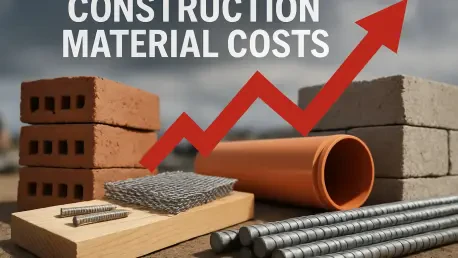
Recent data from the U.S. Bureau of Labor Statistics revealed a significant disruption in price stability, noting a 0.7% monthly jump in construction material costs during January. While a sub-one-percent increase might appear modest in isolation, the cumulative effect contributed to a 2.3% year-over-year rise in overall construction expenses. The nonresidential sector bore the brunt of this escalation, witnessing a 2.9% increase over the same period. This trend highlighted a growing disparity between different segments of the industry, as commercial and industrial projects faced sharper financial hurdles than residential developments.
The most alarming figure for developers was the annualized inflation rate for commercial projects, which hit a blistering 7.1% at the start of the year. Such a rapid acceleration suggests that the underlying cost structures for large-scale infrastructure and office spaces are under intense pressure. This surge forced many firms to reconsider their bidding strategies, as the margins that seemed safe a few months ago were quickly eroded by the rising cost of inputs. Consequently, the industry is seeing a shift toward more cautious project timelines to account for these budgetary uncertainties.
Real-World Supply Chain Disruptions and Market Reactions
The primary catalyst for these rising costs was the implementation of high tariffs on essential imports, particularly copper wire, cable, iron, and steel. These materials form the backbone of modern infrastructure, and the added duties created an immediate bottleneck for projects relying on global supply chains. For specialized facilities like data centers and manufacturing plants, the cost of industrial control equipment also saw a sharp uptick. These specialized components are often difficult to source domestically on short notice, leaving contractors with few alternatives but to absorb the higher prices or pass them on to clients.
Domestic suppliers frequently mirrored these tariff-driven price hikes, a phenomenon noted by the Associated General Contractors of America (AGC). Even when materials were produced within the country, the lack of lower-priced international competition allowed local manufacturers to raise their rates in tandem with the cost of imports. This ripple effect suggests that trade policies aimed at protecting domestic industry can inadvertently create a high-price floor for the entire market. As a result, the cost of a steel beam or a spool of copper wire became a moving target, complicating the financial planning of even the most experienced project managers.
Industry Perspectives on Economic Volatility
Anirban Basu, the Chief Economist for the Associated Builders and Contractors (ABC), provided a nuanced view of this January spike, questioning whether it signaled a long-term crisis or a temporary adjustment. He observed that much of the annual increase actually occurred in late 2025, while prices remained relatively flat during the final quarter of that year. From this perspective, the sudden jump at the beginning of the year could be interpreted as a market correction following a period of artificial calm. However, the persistence of these higher levels will depend heavily on broader economic factors.
The role of energy stability remains a crucial factor in mitigating these upward pressures. Experts suggested that as long as fuel and energy prices remain consistent, the construction industry might avoid a full-scale inflationary spiral. Since the production and transportation of heavy materials like concrete and steel are energy-intensive, any volatility in the global oil or gas markets would likely exacerbate the current situation. For now, the relative stability of the energy sector acted as a buffer, preventing material costs from climbing even higher than the current tariff-induced rates.
Jeffrey Shoaf, the CEO of the AGC, emphasized that the long-term solution lies in the expansion of domestic manufacturing capacity. He argued that the current reliance on expensive imports is a vulnerability that can only be neutralized by a robust domestic supply chain. By incentivizing the creation of new factories and processing plants within the United States, the industry could eventually insulate itself from the whims of international trade policy. This perspective shifts the focus from short-term cost management to a broader strategy of national industrial independence.
Future Outlook: Legislative Solutions and Market Evolution
Market stability is increasingly tied to federal certainty, specifically regarding the renewal of major infrastructure legislation. The upcoming debates over surface transportation and infrastructure bills are expected to provide a much-needed demand forecast for the industry. When contractors and manufacturers have a clear view of the government’s long-term spending plans, they are more likely to make the capital investments necessary to increase production. This predictability is essential for cooling the market and ensuring that supply can keep pace with the needs of a growing nation.
The likelihood of domestic manufacturers expanding their operations will be a defining trend in the coming years. If these companies can successfully scale up to meet the demand previously satisfied by imports, the inflationary pressure from tariffs should naturally subside. However, this transition is not without risks, as unexpected surges in market demand or a sudden shift in global energy prices could still disrupt the equilibrium. The industry must remain prepared for a period of transition where domestic supply is not yet fully capable of offsetting the loss of cheaper international goods.
Looking further ahead, the health of the construction sector will be dictated by the discipline of trade policies and the agility of contractors. If federal authorities prioritize a balanced approach that pairs tariffs with strong support for domestic growth, the industry could emerge more resilient. Conversely, a lack of coordination between trade and industrial policy could lead to sustained high costs that stifle development. Developers will need to maintain a high degree of flexibility in their procurement strategies to survive this era of trade-sensitive economics.
Conclusion: Balancing Policy and Production
The construction sector navigated a complex period where trade-induced inflation and domestic supply constraints intersected to redefine project budgets. Contractors found that staying competitive required a fundamental shift toward more sophisticated procurement strategies and a heavier reliance on domestic partnerships. The volatility observed at the start of the year served as a catalyst for firms to diversify their supply chains and explore new technologies, such as prefabricated components and advanced material tracking systems. These innovations offered a way to mitigate the rising costs of traditional raw materials like steel and copper.
Federal authorities played a pivotal role by signaling a commitment to long-term infrastructure investment, which provided the necessary confidence for private manufacturers to break ground on new production facilities. The industry successfully lobbied for streamlined permitting processes, allowing domestic supply to ramp up more quickly than in previous cycles. This proactive approach helped stabilize the market, as the increased availability of local resources eventually offset the financial burden of international tariffs. Moving forward, stakeholders prioritized data-driven decision-making to anticipate future shifts in trade policy.
Ultimately, the challenges of the current era demanded a higher level of coordination between private industry and public policy. Contractors who invested in digital tools to monitor real-time price fluctuations were better positioned to protect their margins and deliver projects on time. The industry learned that resilience was not just about weathering high costs but about actively shaping a more self-sufficient economic landscape. By focusing on domestic expansion and legislative certainty, the construction world established a more sustainable path for growth that was less vulnerable to global market shocks.