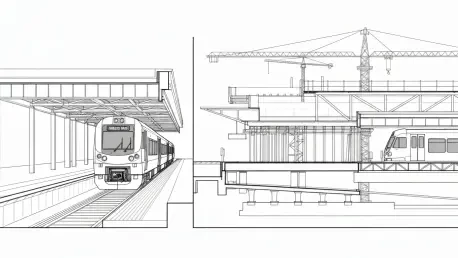

With Southern California’s public transit infrastructure facing unprecedented demand, we sit down with construction and design expert Luca Calaraili. His deep knowledge of large-scale infrastructure projects and passion for technological innovation provide a unique lens through which to view the challenges and opportunities of modernizing our transit systems. Today, we’re discussing a critical upgrade to the Metrolink system in Riverside County, exploring the intricacies of transforming a single-track terminus into a high-capacity hub, the strategic moves by contractors in a competitive market, and the financial choreography required to bring these complex projects to life.
The article notes this $24 million project aims to transform the Perris South station from a single-track terminus. Could you elaborate on the key construction phases for adding the second platform and 1,100 feet of track, and describe the biggest logistical challenge you anticipate?
Absolutely. A project like this is a multi-layered undertaking. The initial phase is all about groundwork—literally. This involves site preparation, grading, and relocating any underground utilities, which is often more complex than it sounds. Following that, you’ll see the core heavy civil work begin: laying the foundation for the new platform and meticulously installing over 1,100 feet of new track. The final phase is the “top-side” construction, which includes erecting the platform itself, installing canopies, and integrating all the electronic systems. The single biggest challenge, without a doubt, is performing this work adjacent to a live, operational railway. You can’t just shut down service for months. It demands an intricate ballet of scheduling, often confining the most disruptive work to overnight hours or weekends to ensure the safety of crews while minimizing impact on the nearly 2,100 weekday riders who rely on this line.
With ridership on the Perris Valley Line surging 22% year-over-year, how will adding a fourth layover track and new switching infrastructure specifically improve service reliability? Please share some metrics or an example of how this prevents a service bottleneck during peak hours.
This is the heart of the operational upgrade. A 22% ridership increase is a fantastic problem to have, but it puts immense strain on a single-track terminus. Think of the current setup as a one-lane dead-end street. If a train is delayed for any reason, it creates a traffic jam that cascades backward through the system. Adding the fourth layover track and new switching infrastructure transforms that dead-end into a dynamic, multi-lane staging area. During peak morning service, for example, instead of one train having to pull in, unload, load, and leave before the next can even approach, you can now have two trains at the station simultaneously. This allows for bidirectional service and creates critical redundancy. If one train has a mechanical issue, it can be shunted to a layover track without crippling the entire line. It’s about building resilience and flexibility directly into the physical infrastructure.
Granite recently completed the $22 million Moreno Valley/March Field station expansion. What specific lessons or innovations from that project will you apply to the Perris South upgrade, and how does this new contract advance Granite’s strategic goals in the Inland Empire rail market?
Continuity is a massive advantage in this industry. Coming directly off the $22 million Moreno Valley project, which is just 13 miles away, Granite brings a treasure trove of localized knowledge to Perris South. They’ve already established a successful working relationship with the Riverside County Transportation Commission, they understand the regional supply chains, and their crews are familiar with the specific demands of working on the Metrolink system. That prior experience drastically reduces the learning curve. For Granite, this $24 million contract isn’t just another project; it’s a strategic anchor. It solidifies their position as a dominant player in the Inland Empire’s burgeoning rail sector. By successfully delivering these back-to-back projects, they are building a powerful portfolio that demonstrates their expertise and reliability in this high-growth market.
This project is funded by sources like Measure A and a state grant. Can you walk us through how RCTC and Granite will coordinate to manage this budget and timeline, ensuring the project is delivered by the slated 2028 completion date without significant overruns?
Managing a publicly funded project with multiple revenue streams requires impeccable coordination and transparency. The foundation of this is a robust project management plan agreed upon by both RCTC and Granite from day one. This involves meticulous cost tracking, regular progress reports, and a proactive approach to risk management. They will hold frequent, collaborative meetings to address potential issues—whether it’s a supply chain delay for steel or an unexpected site condition—before they can escalate and impact the budget or the 2028 timeline. Having a client and contractor who have a recent history of success, as they do with the Moreno Valley project, builds a level of trust that is invaluable. This shared experience allows for more open communication and quicker problem-solving, which are the two most critical ingredients for keeping a complex project on schedule and on budget.
What is your forecast for regional commuter rail development in Southern California over the next decade, particularly in high-growth areas like Riverside County?
The future for commuter rail in this region is exceptionally bright and, frankly, essential. The Perris South project is a perfect example of the trend we’ll see accelerate over the next ten years. As communities in the Inland Empire continue to grow, the pressure on freeways like the I-215 will become untenable. Rail is the most effective and sustainable solution for moving large numbers of people. My forecast is a dual-pronged approach: first, a continued focus on “infill” capacity projects like this one—adding tracks, expanding stations, and improving layover facilities to squeeze more efficiency out of the existing network. Second, you’ll see serious planning for further system extensions. That 22% ridership surge is a powerful data point for policymakers; it proves there is a significant, unmet demand for reliable transit. Investing in rail isn’t a choice anymore; it’s a necessity for the economic and environmental health of Southern California.