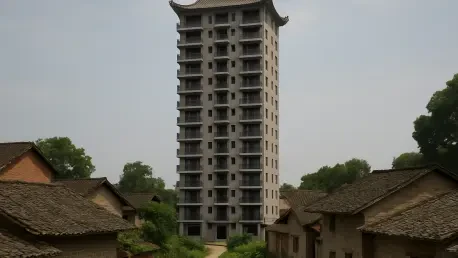

Rising abruptly from the modest architectural landscape of Zhuyuan village, a massive fifteen-story concrete tower stands as a striking testament to one family’s determination to remain physically and emotionally connected in an era of rapid urban sprawl. Approximately twenty households from the Zhou clan decided to reject the conventional path of building individual, separate homes by combining their inheritance and financial assets to construct a singular vertical compound. This project serves as a modern evolution of the traditional Chinese ancestral home, providing a centralized hub for more than one hundred relatives who might otherwise have been scattered across various provinces due to industrial demands. By centralizing their living space, the family has effectively bypassed the isolation often associated with modern apartment living while simultaneously maximizing the utility of their limited ancestral land allotment. The resulting structure represents a unique intersection of communal heritage and contemporary engineering, offering a potential blueprint for other extended families seeking to maintain their social fabric amidst the pressures of 21st-century geographic displacement.
Architectural Innovation: The Engineering of Vertical Unity
Structural Design: Engineering a Vertical Village
The physical design of the Zhou family tower represents a sophisticated departure from the rudimentary brick-and-mortar structures commonly found in rural Chinese settlements. Measuring fifteen stories in height, the building houses twenty-two identical apartments distributed across the second through the twelfth floors, with two distinct residential units occupying each level to ensure privacy for individual nuclear families. Integrating high-end amenities like a modern passenger elevator and an expansive underground parking facility, the structure offers a level of convenience typically reserved for premium urban developments. Interestingly, the family opted to omit professional property management services, choosing instead to rely on internal communal agreements to oversee maintenance and utility logistics. This self-governing approach requires a high degree of interpersonal trust, as the costs associated with elevator inspections and structural upkeep are shared among the relatives based on verbal contracts and long-standing ancestral ties that have historically governed village life.
Legislative Barriers: Navigating the Regulatory Landscape
Navigating the complex regulatory environment of rural construction presented a significant challenge for the Zhou clan, as local zoning laws generally restrict self-built residential structures to a maximum of six stories. By standing nearly three times that height, the tower occupies a unique and somewhat precarious legal space that reflects the tension between traditional land usage and modern density needs. The project was made possible only through the strategic consolidation of collective land rights, where multiple households agreed to forfeit individual footprints in favor of a single vertical plot. This maneuver allowed the family to preserve the surrounding agricultural and open space while providing sufficient housing for their expanding population. However, the presence of such a tall structure in a low-rise village has prompted local authorities to tighten oversight, ensuring that this particular skyscraper remains a rare exception rather than a precursor to widespread rural high-rise development in the coming years as building codes become more rigid.
Sociocultural Dynamics: Redefining Ancestral Proximity
Cultural Preservation: Sustaining Clan Identity Through Shared Spaces
Beyond its architectural significance, the Zhou tower serves as a vital anchor for social cohesion, mitigating the fragmenting effects of modern labor migration on the traditional Chinese family unit. While the building may appear quiet during the standard work week, it undergoes a dramatic transformation during significant cultural milestones such as the Lunar New Year or the Mid-Autumn Festival. During these periods, the vertical compound becomes a bustling hive of activity as younger relatives return from their professional lives in distant metropolitan centers to reunite with their elders. This shared living arrangement facilitates large-scale communal meals and multi-generational interactions that would be physically impossible in separate, disconnected households. By maintaining a permanent, high-capacity residence in their ancestral village, the Zhou family has created a sustainable model for preserving their heritage, ensuring that the bonds of kinship remain intact even as individual members pursue diverse career paths across the global economy.
Future Implications: Analyzing the Viability of Collaborative Residential Models
The completion and operation of the Zhou family tower provided a compelling case study for how localized, grassroots efforts could address the dual pressures of land scarcity and cultural erosion. Urban planners and sociologists observed that the project successfully leveraged private capital to create high-density housing that respected the social fabric of the rural community. It became clear that while the physical blueprint of a fifteen-story skyscraper might not be universally applicable due to evolving safety codes, the underlying principle of cooperative investment offered a viable path forward for other large clans. Policy discussions shifted toward creating legal frameworks that supported such collective residential models while maintaining engineering standards. Ultimately, the family’s initiative demonstrated that maintaining proximity through vertical integration was a practical solution for modernizing ancestral traditions. Stakeholders recognized that fostering these types of community-led developments required a balance between oversight and the organic needs of families.