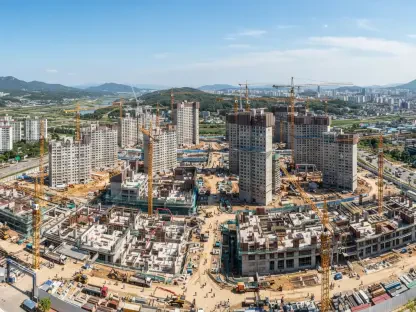

Construction costs have reached a critical threshold where projects that were once profitable have transformed into massive loss-generating endeavors. In the first seven months of the current year, the South Korean construction landscape has witnessed a staggering departure from historical norms, with more than 2,500 firms forced to cease operations permanently. This wave of insolvencies is not merely a localized issue but a systemic tremor shaking the very foundations of the national economy. While the Seoul metropolitan area historically acted as a buffer against such volatility, the current downturn has bypassed these traditional safeguards, striking regional provinces with unprecedented ferocity. The quarterly closure rate has surged to its highest level since the post-2012 era of financial instability, signaling a profound shift in market viability. As mid-sized general contractors begin to fail at rates previously reserved for smaller subcontractors, the industry faces a breakdown of the structural resilience that once defined South Korea’s rapid urban development.
Structural Fragility and the Ripple Effects of Insolvency
Regional Collapse: The Fall of Established Titans
The most visible evidence of this industry-wide decay is found in the collapse of established regional titans, most notably the court receivership filing of Taewang E&C. As a top-tier builder and a central pillar of the Daegu regional economy, Taewang’s sudden downfall has sent shockwaves through the local business community. The company’s inability to service its debts was the result of a lethal intersection between stalled presale proceeds and rapidly ballooning financing obligations. In a desperate attempt to avoid total liquidation, the firm resorted to offering physical goods and completed units as payment to creditors rather than liquid currency. This unconventional settlement method serves as a grim harbinger for dozens of other mid-sized firms currently struggling to maintain sufficient cash flow. For a company of Taewang’s stature to succumb so completely indicates that the protective barriers for established industry players have dissolved, leaving even the most respected regional builders exposed to the threat of immediate ruin.
Economic Chains: The Subcontractor Domino Effect
Beyond individual corporate failures, the broader regional economy is reeling from the rehabilitation proceedings of other prominent entities like Shindongah and Daejeo Construction. These collapses do not occur in a vacuum; they trigger a destructive domino effect that systematically dismantles the entire subcontracting ecosystem. When a primary contractor fails, hundreds of smaller partner firms—ranging from electrical specialists to masonry experts—are left with massive unpaid invoices and no clear path to recovery. These smaller enterprises typically lack the capital reserves necessary to survive extended payment delays or the total loss of a primary contract. Consequently, the industry is witnessing a vertical erosion that threatens to wipe out an entire generation of specialized labor and technical expertise. This loss of human capital is particularly damaging to the regional hubs of Daegu and Busan, where the construction sector has long been a primary source of employment and economic vitality for the local population.
Navigating the Financial Deadlock and Inventory Crisis
Toxic Inventory: The Crisis of Unsold Regional Units
At the center of the regional industry’s paralysis is the overwhelming accumulation of toxic inventory, consisting of tens of thousands of residential units that remain unsold despite completion. Recent data reveals that approximately 85 percent of these empty homes are concentrated in regional hubs outside the capital, creating a localized market glut that has effectively frozen new development. This oversupply suppresses property values and discourages potential investors, leaving builders with massive debt obligations and no mechanism for revenue generation. Furthermore, the traditional lifeline of Project Financing (PF) has effectively severed for regional projects. Financial institutions, wary of the rising delinquency rates and the stagnant housing market, have implemented rigorous loan screenings that lock provincial builders out of the credit market. This credit squeeze has created a vicious cycle where projects stall due to a lack of immediate funding, leading to site foreclosures and further eroding lender confidence in the sector’s long-term viability.
Credit Deadlock: The Breakdown of Project Financing
The breakdown of the financing market has transformed the regional construction slump into a deep-seated liquidity trap that standard market adjustments can no longer resolve. Most distressed project sites are located outside of the Seoul metropolitan region, where the gap between construction costs and final sales prices is the narrowest. As interest rates remain high and material costs show no signs of returning to pre-crisis levels, the financial feasibility of provincial housing projects has vanished. Without access to flexible credit lines or bridge loans, regional firms are unable to bridge the gap between project initiation and the realization of sales revenue. This financing deadlock has not only halted new construction but has also forced many developers to abandon partially completed sites, leaving urban landscapes scarred by skeletal structures and unpaid debts. The situation demands a radical rethinking of how credit is extended to regional developers, as the current risk-averse posture of major banks continues to accelerate the pace of corporate bankruptcies.
Policy Evaluation: Assessing Governmental Interventions
In response to the mounting casualties within the construction sector, the South Korean government introduced several strategic interventions, including specialized PF guarantees and the establishment of anchor REITs. These initiatives were designed to inject much-needed early-stage investment into struggling projects and provide a safety net for regional developers. However, the practical implementation of these programs has been uneven at best, with several key initiatives significantly underperforming their intended targets. For instance, the government-backed program to buy back unsold residential units acquired only a fraction of its goal during the current fiscal cycle. Critics argue that the criteria for such support remain too restrictive, often excluding the very firms that are most at risk of immediate collapse. The delay between policy announcement and actual capital injection has also been a major point of contention, as many firms failed while waiting for administrative hurdles to be cleared by regional financial oversight committees.
Strategic Recovery: Actions for Long-Term Stability
To stabilize the industry, policymakers moved to adopt more aggressive and flexible measures that focused on immediate liquidity restoration. Success was found when authorities narrowed the gap between executive orders and the actual disbursement of funds, allowing builders to cover payroll and material costs without delay. Experts recommended that the government ease the requirements for unit buybacks and expand the role of public-private investment partnerships to absorb excess regional inventory. Furthermore, the focus shifted toward diversifying the regional economy away from an over-reliance on residential development, encouraging a transition toward green infrastructure and smart city projects. By providing targeted tax incentives for firms that specialized in high-tech industrial construction, the administration sought to foster a more resilient and versatile labor force. Ultimately, the survival of the provincial construction landscape depended on balancing short-term debt relief with a long-term strategy to address the structural imbalances between the capital and the provinces.