
The construction of a single highway bridge often involves a high-stakes waiting game where engineers must rely on sacrificial samples to determine if a structure is strong enough to support the weight of thousands of vehicles. For decades, the industry has relied on the “cylinder break” method—a process that involves pouring concrete into small molds, letting them cure alongside the main structure, and then crushing them in a lab to estimate strength. This analog approach is inherently imprecise, often leading to costly delays or the unnecessary over-designing of concrete mixes to compensate for the lack of real-time data.
The End of Guesswork in American Road Construction
Modernizing the American landscape requires a departure from these traditional, destructive testing methods toward a more integrated digital approach. The emergence of “smart” concrete is transforming the job site by allowing the material to communicate its own structural integrity. By replacing estimations with hard data, crews can now make informed decisions about when to pull forms or open a road to traffic. This shift is not merely about convenience; it represents a fundamental change in how the US manages its vast network of physical assets.
The practical implications of this technology are profound for an industry plagued by thin margins and tight schedules. When a project sits idle waiting for a laboratory report, labor costs mount and traffic congestion worsens. Digital certainty allows for a more fluid construction timeline, ensuring that every hour on the clock is used effectively. As these sensors become more prevalent, the guesswork that has characterized concrete work for a century is finally being phased out in favor of a more scientific, data-driven standard.
The Trillion-Dollar Challenge: Modernizing US Transit
The pressure to deliver durable and cost-effective public works has intensified as the final phases of the Infrastructure Investment and Jobs Act continue to unfold. With massive investments flowing into highways, bridges, and airport runways, there is a heightened focus on ensuring that these projects provide a high return on investment. Historically, the uncertainty of concrete curing has led to the use of excessive cement, a practice that inflates budgets and significantly increases the carbon footprint of construction.
As the industry looks toward upcoming surface transportation reauthorization bills, the focus is shifting from simple expansion to long-term sustainability. Data-driven validation ensures that taxpayer dollars are directed toward infrastructure that is built to last. By using technology to verify strength in real-time, the government can demand higher quality and more efficient material usage. This pivot is essential for maintaining the nation’s competitiveness and ensuring that new transit systems are resilient enough to handle the demands of the coming decades.
REBEL Technology: A Real-Time Window into Concrete Strength
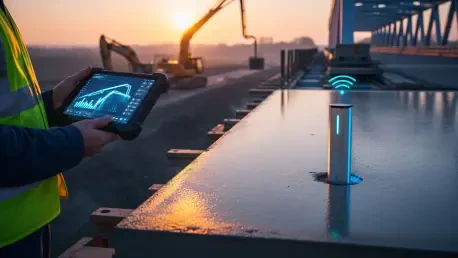
The Rebel system, a standout innovation developed at Purdue University and brought to market by Wavelogix, represents the cutting edge of this movement. These IoT-embedded sensors are placed directly into the concrete mix during the pour, where they begin monitoring temperature and structural development at a granular level. The sensors transmit this information wirelessly, providing project managers with a continuous stream of data that reflects the actual conditions of the concrete as it cures in place.
Since its launch, the technology has moved rapidly from a specialized university prototype to a widely used field tool, appearing in over 60 projects across 17 states. This growth has been supported by rigorous testing and collaboration with the Federal Highway Administration and several state Departments of Transportation, including those in Texas and California. By pinpointing the exact moment of readiness, contractors can reduce project timelines and optimize cement content, which simultaneously lowers material waste and carbon emissions.
Bridging the Gap: Engineering and Public Policy
The integration of IoT into infrastructure is increasingly viewed as a necessity rather than a luxury by both engineers and policymakers. Professor Luna Lu, the founder of Wavelogix, has spearheaded efforts to make these sensors a standard requirement for state-level projects. This push is supported by federal backing, including a significant grant from the National Science Foundation, which highlights the government’s desire to move away from reactive maintenance and toward proactive, sensor-informed asset management.
Establishing these technologies as the industry norm requires a collaborative effort to update outdated building codes and transportation specifications. When policy aligns with engineering capabilities, the result is a more efficient regulatory environment that encourages innovation. By proving the accuracy of sensor-based testing against traditional methods, advocates are clearing the path for a future where every major American road is equipped with the intelligence to monitor its own health from the moment it is poured.
Strategies: Implementing Smart Sensors in Infrastructure Projects
To fully realize the benefits of real-time sensing, state agencies and private contractors must focus on integrating sensor data into existing Project Management Information Systems. This transparency ensures that strength data is accessible to all stakeholders, from the engineers on the ground to the federal auditors overseeing the budget. Scaling the manufacturing of these devices is also a priority, as a robust supply chain is necessary to meet the high-volume demands of national highway reauthorizations.
Ultimately, the successful adoption of smart concrete sensors depended on a commitment to rigorous validation and the willingness to move beyond legacy practices. Stakeholders prioritized the creation of standardized protocols that allowed sensor data to be used as a legal record of structural integrity. These efforts paved the way for a more resilient and sustainable infrastructure network, ensuring that the next generation of American transit was built with the highest degree of precision and accountability.