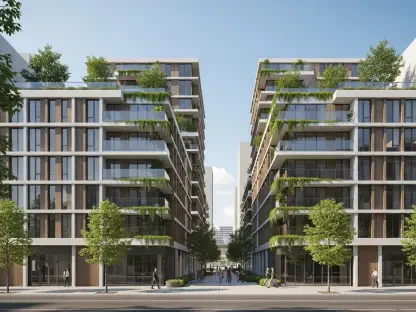

The current Australian property landscape is undergoing a profound transformation as institutional investors and government agencies collaborate to address the systemic shortage of rental accommodation through large-scale developments. At the heart of this shift is the recent commencement of a 435-unit build-to-rent project located at 87–131 Bell Street in Ivanhoe, Victoria, which represents one of the most significant applications of the federal government’s Housing Australia Future Fund to date. This specific initiative serves as a critical test case for whether centralized funding and corporate management can effectively stabilize a volatile market where traditional supply mechanisms have historically struggled to meet rising demand. By prioritizing high-density, professionally managed housing over individual speculative ownership, the project signals a departure from conventional Australian real estate norms. It highlights a strategic move toward long-term security for tenants who are increasingly being priced out of the traditional suburban dream.
Structural Innovations in Housing Finance
The Blended Capital Investment Model
The financial architecture supporting the Bell Street development illustrates a sophisticated blended capital strategy designed to mobilize private equity for the public good. This approach combines the resources of the Housing Australia Future Fund with significant institutional backing from major industry superannuation funds such as AustralianSuper and HESTA. By integrating government subsidies with large-scale private investment, the project overcomes the high entry barriers and interest rate sensitivities that often stall large-scale residential construction. This partnership model is particularly effective because it aligns the long-term investment horizons of superannuation funds with the stable, ongoing returns generated by rental income. Furthermore, the involvement of the Commonwealth Bank of Australia provides the necessary debt financing to bridge the gap between initial capital outlay and project delivery. This synergy ensures that developers can maintain project momentum regardless of market fluctuations.
Institutional investors are increasingly drawn to the build-to-rent sector as a defensive asset class that offers predictable cash flows and a degree of insulation from the volatility of the retail property market. For funds like AustralianSuper, which manages the retirement savings of millions of workers, participating in these projects provides a dual benefit of social impact and financial performance. The Bell Street initiative demonstrates how policy frameworks can incentivize these large entities to pivot away from commercial real estate and toward residential housing. By providing a clear pipeline of projects supported by federal guarantees, the government has successfully created an environment where institutional capital feels secure enough to commit for the long haul. This transition is crucial for scaling the housing supply, as it moves the burden of development away from smaller builders and toward well-capitalized organizations capable of seeing massive projects through to completion.
Public-Private Partnerships for Social Impact
The primary objective of this collaboration is to address the acute shortage of rental housing by providing a mix of one- and two-bedroom apartments across three towers rising up to 16 stories. A standout feature of the project is its commitment to affordability; more than 300 of the total 435 homes are designated as affordable housing. These units will be managed by the community housing provider Housing Choices Australia, ensuring long-term rental security and professional management for residents who might otherwise struggle in the private rental market. This management structure ensures that the properties are maintained to a high standard, providing tenants with a level of stability that is often missing from the fragmented private rental sector. By utilizing a specialized community housing provider, the project ensures that the social goals of the development are met without compromising the operational efficiency required for institutional investment.
This model reflects a growing trend where institutional investors seek stable, long-term returns while simultaneously addressing social challenges, such as the need for essential worker housing near major employment hubs. The collaboration between Assemble and the Melbourne-based Samma Property Group, with Hacer serving as the head contractor, highlights the necessity of expert coordination in the construction phase. By bringing together diverse specialists, the project can utilize economies of scale that are unavailable to smaller developers. This efficiency is passed on through the provision of high-quality amenities and professionalized service for the residents. As these partnerships become more common, they will likely redefine the relationship between public policy and private enterprise in the housing sector. The success of the Ivanhoe project will serve as a benchmark for future developments seeking to balance commercial profitability with the urgent need for inclusive urban design.
Strategic Urban Planning and Regional Growth
Proximity to Essential Employment Hubs
The strategic location of the Bell Street site is a critical component of its utility, as it is situated within walking distance of the Austin Hospital and the broader Heidelberg medical precinct. The development is specifically designed to provide housing for healthcare and community service professionals who need to live near their workplaces to maintain the city’s essential services. This aligns perfectly with the investment goals of HESTA, whose members often work in these sectors and frequently struggle to find affordable accommodation in well-connected areas. By placing high-density housing within reach of major employment centers, the project reduces commute times and improves the quality of life for frontline workers. This spatial planning approach acknowledges that housing affordability is not just about the cost of rent, but also about the proximity to job opportunities and social infrastructure. It represents a shift toward more holistic urban development.
Beyond the immediate benefits to residents, the concentration of essential workers in the Ivanhoe area supports the long-term resilience of the local healthcare system. When nurses, doctors, and support staff have access to secure housing nearby, hospital staffing becomes more reliable and the local economy benefits from increased domestic spending. The Samma Property Group has emphasized that the design of the towers will include communal spaces that foster a sense of community among these professionals, further enhancing the appeal of the development. This focus on the specific needs of a target demographic demonstrates a more nuanced approach to development than the one-size-fits-all model of the past. As urban centers continue to grow, the ability to house the workforce that sustains them will be a defining factor in their economic success. The Ivanhoe project effectively bridges the gap between urban planning and workforce requirements.
Expanding Density in the North-East Corridor
The Bell Street project is part of a broader trend of densification and housing growth in the Ivanhoe area, which has seen several major developments recently approved or commenced. Other notable initiatives include a 275-unit project by PDG on surplus government land and a 58-apartment seniors living proposal by Villa Maria Catholic Homes. Collectively, these initiatives represent a unified effort to accelerate housing delivery in Victoria’s north-east by utilizing land more efficiently. The move toward higher density in these established suburbs is necessary to accommodate the growing population without contributing to urban sprawl. With a projected completion date in mid-2028, the Bell Street project serves as a tangible test case for how government-backed funds can effectively crowd in institutional capital to provide secure, affordable, and well-located housing at scale. This momentum suggests that the local landscape is evolving rapidly.
The successful implementation of these projects required a coordinated effort between local councils, state planners, and private developers to ensure that the infrastructure could support the increased population. Policymakers focused on streamlining the approval process for developments that met strict affordability and sustainability criteria, which encouraged more companies to enter the build-to-rent space. This proactive stance on urban densification provided a roadmap for other regions facing similar housing pressures. By prioritizing projects that offered a high social return on investment, authorities were able to justify the transition toward more intensive land use in traditionally low-density areas. The shift in planning priority fostered a more competitive environment where quality and community impact became as important as the bottom line. As these buildings began to rise, they signaled a new era of urban living that favored accessibility and long-term residency over the transient nature of the legacy market.