
The rapid metamorphosis of global digital architecture has transformed the humble data center from a peripheral utility into the singular, high-performance engine driving the global intelligence economy. While traditional data centers were designed to prioritize storage and steady-state processing for web services, the modern infrastructure landscape has shifted toward massive, specialized environments optimized for the rigors of generative artificial intelligence. This evolution represents more than a simple hardware upgrade; it is a fundamental reimagining of how energy, space, and capital are deployed to sustain the computational demands of large-scale neural networks. The transition from general-purpose hyperscale computing to these bespoke AI environments has been driven by a necessity for unprecedented parallelism, forcing architects to discard legacy designs in favor of facilities that resemble supercomputers more than server farms.
This specialized shift emerged as a direct response to the bottlenecking of traditional Central Processing Unit (CPU) architectures when faced with the trillions of parameters inherent in modern language models. Standard data centers, which once managed diverse workloads across distributed virtual machines, proved inadequate for the concentrated bursts of power required for training and inference. In the current landscape, the infrastructure must act as a cohesive, low-latency fabric, where thousands of nodes operate as a single logical entity. This emergence marks the beginning of the “sovereign cloud” era, where the physical proximity of hardware and the efficiency of its interconnection have become the primary benchmarks of technological and economic power on the global stage.
Evolution of AI Infrastructure and the Global Data Center Boom
The genesis of modern AI infrastructure can be traced back to the realization that standard enterprise cloud environments lacked the necessary density for deep learning workloads. In the early stages of the current decade, hyperscalers began to pivot, recognizing that the era of general-purpose virtualization was giving way to a period defined by high-intensity arithmetic. This pivot triggered a global boom in construction, as developers scrambled to build facilities capable of supporting hundreds of megawatts of power. The core principle of this new era is the prioritization of throughput over sheer capacity, emphasizing the speed at which data can move between memory and processing cores rather than how much data can be archived on spinning disks.
As these environments evolved, the context of their deployment shifted from centralized public clouds to a more fragmented and competitive landscape. While the initial wave of development was led by a handful of technology giants, the current market features a diverse array of specialized operators and sovereign entities seeking to localize their intelligence-processing capabilities. This fragmentation has accelerated innovation in infrastructure design, leading to the development of facilities that are specifically engineered for the unique thermal and electrical profiles of generative AI. The resulting global boom is not merely an expansion of existing capacity but a complete replacement of the technological foundation upon which the digital economy rests.
Core Components and Architectural Features
Specialized Computing Clusters and GPU Integration
At the heart of any modern AI data center lies the specialized computing cluster, a high-density arrangement of Graphics Processing Units (GPUs) that serves as the primary engine for generative tasks. Unlike traditional servers, these clusters are designed to handle the massive parallelization required to calculate the weights and biases of neural networks simultaneously. The integration of high-bandwidth memory and proprietary interconnects allows these clusters to process datasets that would have been computationally impossible just a few years ago. Performance benchmarks for these systems are no longer measured in simple clock speeds but in petatflops and the efficiency of the data fabric that binds the individual accelerators together.
The collective functioning of these components hinges on the ability to minimize “tail latency,” or the delay caused by the slowest node in a cluster. To achieve the performance required for modern large language models, architects have implemented non-blocking network topologies that ensure data remains in a state of constant motion. This architectural sophistication allows the infrastructure to act as a unified processor, effectively blurring the lines between individual server blades. The result is a specialized hardware environment that is fundamentally distinct from the multi-tenant, shared-resource models of the past, providing a dedicated and uncompromising platform for the most resource-intensive applications in existence.
High-Density Power Systems and Advanced Cooling
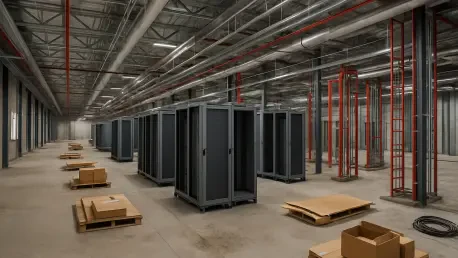
Supporting such intense computational power requires a radical departure from traditional electrical and thermal management strategies. AI data centers now routinely feature rack densities exceeding 100 kilowatts, a figure that would have caused a catastrophic failure in a standard enterprise facility. To manage this concentration of energy, operators have moved toward “bleeding edge” liquid cooling solutions, where coolant is circulated directly to the chip surface or through specialized heat exchangers within the rack. This transition to liquid-based thermal management is essential for maintaining the longevity of high-value hardware, as air cooling simply cannot move heat quickly enough to prevent thermal throttling in the latest generation of accelerators.
Beyond cooling, the technical aspects of power generation and distribution have become central to facility design. These data centers often require dedicated substations and, in some cases, on-site microgrids to ensure a stable and uninterruptible supply of electricity. Managing these massive thermal loads involves sophisticated software-defined power management systems that can predict spikes in demand and adjust cooling intensity in real-time. The significance of these systems cannot be overstated; they are the literal life-support systems for the digital brains they house. Without this advanced infrastructure, the hardware would be unable to reach its peak operational efficiency, rendering the entire investment commercially unviable.
Innovations in Financing and Asset Management
The financial underpinnings of AI infrastructure have undergone a transition as significant as the technology itself. As the capital requirements for these facilities climbed into the tens of billions of dollars, the traditional reliance on corporate balance sheets proved insufficient. This gap has been filled by a rapid shift toward private credit and more opaque debt markets, where institutional investors seek the stable, long-term returns associated with essential infrastructure. This movement has introduced a new layer of complexity to the sector, as massive private equity consortiums now exert considerable influence over the trajectory of technology development, often bypassing traditional public market oversight.
This new financing landscape is characterized by the rise of off-balance-sheet structures and asset-backed lending, where the GPUs themselves often serve as collateral for the loans. While this approach has unlocked the capital necessary for the current boom, it has also introduced a unique set of risks related to transparency and market concentration. The rise of these financing models reflects a broader trend toward the commoditization of compute, where infrastructure is treated more like a utility or a real estate asset than a traditional tech investment. However, the reliance on private debt markets means that the true systemic risk associated with these massive projects is often hidden from view, creating a potential point of failure for the broader financial ecosystem.
Real-World Applications and Sector Deployments
The deployment of massive AI campuses has direct implications across a variety of critical industries, including finance, healthcare, and insurance. In the financial sector, these facilities enable real-time risk assessment and high-frequency trading algorithms that can process global market shifts in microseconds. Healthcare providers utilize this specialized infrastructure to run complex simulations for drug discovery and personalized medicine, where the ability to process genomic data at scale can shave years off development timelines. These real-world applications demonstrate that the AI data center is not just a siloed technological achievement but a foundational tool that enhances the operational capabilities of diverse economic sectors.
Furthermore, the emergence of $20 billion “mega-campuses” has paved the way for the rise of third-party sovereign AI clouds. These facilities are designed to provide nations and large corporations with the computational independence they need to maintain data privacy while leveraging the power of generative models. For example, insurance companies now rely on these dedicated clusters to run sophisticated climate models and actuarial simulations that were previously too complex to execute. By providing a secure and high-performance environment for sensitive data, these facilities have become essential for organizations that require the benefits of AI without the risks associated with public cloud environments.
Critical Challenges and Systemic Risks
One of the most pressing challenges facing the sector is the “GPU debt treadmill,” a phenomenon where the rapid rate of technological obsolescence forces operators into a cycle of constant reinvestment. Because the functional lifecycle of high-performance hardware is significantly shorter than the lifespan of the buildings that house them, operators must constantly secure new financing to upgrade their chips. This creates a precarious situation where the value of the collateral can depreciate faster than the debt is repaid. This treadmill effect places immense pressure on cash flows and raises questions about the long-term sustainability of the current investment model, especially if the anticipated revenue from AI services fails to materialize at scale.
Logistical hurdles and supply chain vulnerabilities further complicate the stability of these systems. The concentration of high-value assets in single locations creates significant insurance capacity issues, as the potential loss from a single fire or natural disaster could reach into the tens of billions. Moreover, the global supply chain for specialized components remains fragile, and any disruption in the production of cooling systems or power regulators can stall multi-billion-dollar projects indefinitely. These risks are now coming under increased regulatory scrutiny, as governments begin to recognize that the failure of a major data center operator could have systemic implications for the global economy, similar to the collapse of a major financial institution.
Future Trajectory and Infrastructure Adaptation
Looking ahead, the industry is moving toward modular construction as a primary strategy for extending the lifespan of these facilities. By designing buildings that are hardware-agnostic and easily upgradable, operators can mitigate the risks of technological obsolescence. Modular designs allow for the hot-swapping of power modules and cooling arrays, ensuring that the physical shell remains relevant even as the interior components evolve. This shift toward adaptability is crucial for the long-term viability of the sector, as it allows for a more gradual and sustainable approach to infrastructure development.
The evolution of asset-backed securitization will also play a role in stabilizing the financing of these projects. As lenders become more comfortable with the residual value of AI hardware, new financial instruments will likely emerge that allow for more transparent and efficient risk distribution. The long-term impact of a resilient AI infrastructure will be a significant increase in global digital prosperity, as the cost of intelligence processing continues to drop. By creating a more stable and adaptable foundation, the industry can ensure that the benefits of artificial intelligence are not limited by the physical and financial constraints of the current generation of facilities.
Summary of Findings and Industry Outlook
The investigation into AI data center infrastructure revealed a sector characterized by a high-stakes balancing act between the need for rapid innovation and the necessity of financial stability. The review determined that the shift from general-purpose cloud computing to specialized AI environments was an essential response to the unique computational demands of the modern era. While the technical achievements in liquid cooling and GPU integration demonstrated remarkable progress, the findings also highlighted a growing disconnect between the lifespan of physical assets and the rapid depreciation of hardware. The industry successfully unlocked massive capital through private credit, yet this development introduced new layers of systemic risk that demanded more robust transparency.
Ultimately, the state of the technology appeared strong, provided that the current infrastructure could adapt to the pressures of the debt treadmill. The transition toward modular construction and more sophisticated risk management indicated a path forward that could overcome the hurdles of obsolescence. The review concluded that the transformative impact of these facilities on the global landscape was undeniable, setting the stage for a period where computational power would function as the primary currency of economic progress. The long-term health of the ecosystem depended on its ability to maintain this momentum without succumbing to the financial or logistical vulnerabilities that defined its early expansion.