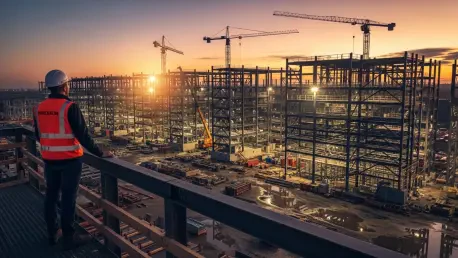

AI Boom Splits Fortunes in Construction Sector

AI Boom Splits Fortunes in Construction Sector

The U.S. construction industry appears stable on the surface, with project backlogs holding steady at a seemingly healthy 8.2 months. However, this topline figure conceals a turbulent reality: a stark and growing divide that is cleaving the sector in two. Fueled by an insatiable demand for computing power, the artificial intelligence frenzy has ignited an unprecedented boom in data center construction, creating a lopsided market where mega-firms are thriving while smaller contractors are being left behind. This article explores the forces driving this disparity, analyzes the data revealing the chasm between industry players, and examines the long-term implications for a sector being fundamentally reshaped by technological ambition.

From Bricks and Mortar to Silicon and Steel: The Industry’s Foundational Shift

For decades, the health of the construction sector was tethered to traditional economic drivers like housing starts, commercial real estate development, and public infrastructure spending. These segments created a relatively balanced ecosystem where firms of all sizes could find a foothold. The digital revolution began to alter this landscape, but the recent explosion in AI has accelerated the shift at a dizzying pace. The computational demands of AI models require vast, specialized, and enormously expensive data centers, transforming them from a niche IT concern into a dominant force in industrial construction. This new pillar of demand is unique in its scale and complexity, favoring only the largest, most capitalized firms and creating a market dynamic unfamiliar to the historically fragmented industry.

The Great Divide: A Chasm in Project Backlogs and Profitability

The Tale of Two Contractors: Giants Thrive While Small Firms Struggle

The most telling evidence of the market split lies in the contrasting fortunes of large and small contractors. Firms with annual revenues exceeding $100 million are reporting their highest project backlogs in five years, gorging on a pipeline of massive, high-value data center projects. Conversely, smaller contractors with less than $30 million in revenue are facing their lowest backlogs in years, as the momentum fails to trickle down. Industry economists note that the current construction momentum is almost exclusively confined to the data center segment. These billion-dollar projects require a level of capital, bonding capacity, and specialized expertise that effectively locks out smaller competitors, creating a clear class divide within the industry.

Data Centers as the Decisive Factor in Project Pipelines

The impact of this single segment is dramatically skewing the industry’s overall health metrics. A closer look at the numbers reveals the outsized influence of data center work. The 13% of industry association members contracted for a data center project reported an average backlog of approximately 11 months—nearly a full year of secured work. In stark contrast, contractors without any data center projects on their books had a much shorter backlog of just 7.8 months. This three-month gap highlights how a narrow but powerful construction category is inflating the industry-wide average, masking the precarious position of the vast majority of firms that are not participating in the AI-driven boom.

A Narrow Boom Masking Broader Industry Caution

Despite the record-breaking activity in one corner of the market, overall industry sentiment remains surprisingly subdued. While contractor confidence saw a minor uptick at the end of last year, it remains well below levels seen in previous periods of growth. This cautious outlook reflects the reality that the prosperity is not broad-based. For the 87% of contractors left outside the “AI party,” shrinking backlogs and fierce competition in traditional sectors are the dominant concerns. This muted confidence underscores the fact that a boom concentrated in a single, high-tech niche is not enough to lift the entire industry, creating an environment of uncertainty for most players.

Future Outlook: A Widening Chasm on the Horizon

The division between the haves and have-nots is poised to widen further through 2026 and beyond. The data center construction boom shows no signs of slowing, as hyperscalers like Amazon, Google, and Microsoft continue to push forward with massive development plans to support their AI ambitions. According to market analysts, historically low vacancy rates for data center capacity indicate a lengthy runway for additional projects. This sustained, high-value demand will continue to flow primarily to the industry’s largest players, cementing their dominant position and further stretching the gap between them and their smaller counterparts who compete in more traditional and less dynamic markets.

Navigating the Lopsided Market: Strategies for Survival and Growth

In this divided landscape, contractors must adopt new strategies to survive and thrive. For smaller firms, direct competition for mega-projects is not viable. Instead, they should focus on specialization in niche support services required by data centers, such as advanced electrical systems, high-capacity HVAC, or physical security installation. Forming strategic joint ventures can also provide a pathway to participate in larger projects. For the industry giants, the primary challenge will be managing resources and scaling their workforce to meet the relentless demand. Investing heavily in training, technology adoption, and supply chain management will be critical to maintaining their edge and delivering these complex projects on time and on budget.

Conclusion: The New Construction Reality Forged by AI

The AI boom has fundamentally altered the construction sector, creating a new paradigm where fortunes are made not in traditional markets but in building the infrastructure for the digital future. The story is no longer about a rising tide lifting all boats; it is one of mega-yachts being launched by a technological tsunami while smaller vessels navigate the choppy waters left in their wake. The industry’s health can no longer be judged by a single, monolithic metric. Moving forward, every firm—large and small—must critically assess its position in this new reality, recognizing that technology is no longer just a tool for building but is now the primary architect of the market itself.Fixed version:

A Lopsided Boom: How AI Is Reshaping the Construction Landscape

The U.S. construction industry appears stable on the surface, with project backlogs holding steady at a seemingly healthy 8.2 months. However, this topline figure conceals a turbulent reality: a stark and growing divide that is cleaving the sector in two. Fueled by an insatiable demand for computing power, the artificial intelligence frenzy has ignited an unprecedented boom in data center construction, creating a lopsided market where mega-firms are thriving while smaller contractors are being left behind. This article explores the forces driving this disparity, analyzes the data revealing the chasm between industry players, and examines the long-term implications for a sector being fundamentally reshaped by technological ambition.

From Bricks and Mortar to Silicon and Steel: The Industry’s Foundational Shift

For decades, the health of the construction sector was tethered to traditional economic drivers like housing starts, commercial real estate development, and public infrastructure spending. These segments created a relatively balanced ecosystem where firms of all sizes could find a foothold. The digital revolution began to alter this landscape, but the recent explosion in AI has accelerated the shift at a dizzying pace. The computational demands of AI models require vast, specialized, and enormously expensive data centers, transforming them from a niche IT concern into a dominant force in industrial construction. This new pillar of demand is unique in its scale and complexity, favoring only the largest, most capitalized firms and creating a market dynamic unfamiliar to the historically fragmented industry.

The Great Divide: A Chasm in Project Backlogs and Profitability

The Tale of Two Contractors: Giants Thrive While Small Firms Struggle

The most telling evidence of the market split lies in the contrasting fortunes of large and small contractors. Firms with annual revenues exceeding $100 million are reporting their highest project backlogs in five years, gorging on a pipeline of massive, high-value data center projects. Conversely, smaller contractors with less than $30 million in revenue are facing their lowest backlogs in years, as the momentum fails to trickle down. Industry economists note that the current construction momentum is almost exclusively confined to the data center segment. These billion-dollar projects require a level of capital, bonding capacity, and specialized expertise that effectively locks out smaller competitors, creating a clear class divide within the industry.

Data Centers as the Decisive Factor in Project Pipelines

The impact of this single segment is dramatically skewing the industry’s overall health metrics. A closer look at the numbers reveals the outsized influence of data center work. The 13% of industry association members contracted for a data center project reported an average backlog of approximately 11 months—nearly a full year of secured work. In stark contrast, contractors without any data center projects on their books had a much shorter backlog of just 7.8 months. This three-month gap highlights how a narrow but powerful construction category is inflating the industry-wide average, masking the precarious position of the vast majority of firms that are not participating in the AI-driven boom.

A Narrow Boom Masking Broader Industry Caution

Despite the record-breaking activity in one corner of the market, overall industry sentiment remains surprisingly subdued. While contractor confidence saw a minor uptick at the end of last year, it remains well below levels seen in previous periods of growth. This cautious outlook reflects the reality that the prosperity is not broad-based. For the 87% of contractors left outside the “AI party,” shrinking backlogs and fierce competition in traditional sectors are the dominant concerns. This muted confidence underscores the fact that a boom concentrated in a single, high-tech niche is not enough to lift the entire industry, creating an environment of uncertainty for most players.

Future Outlook: A Widening Chasm on the Horizon

The division between the haves and have-nots is poised to widen further through 2026 and beyond. The data center construction boom shows no signs of slowing, as hyperscalers like Amazon, Google, and Microsoft continue to push forward with massive development plans to support their AI ambitions. According to market analysts, historically low vacancy rates for data center capacity indicate a lengthy runway for additional projects. This sustained, high-value demand will continue to flow primarily to the industry’s largest players, cementing their dominant position and further stretching the gap between them and their smaller counterparts who compete in more traditional and less dynamic markets.

Navigating the Lopsided Market: Strategies for Survival and Growth

In this divided landscape, contractors must adopt new strategies to survive and thrive. For smaller firms, direct competition for mega-projects is not viable. Instead, they should focus on specialization in niche support services required by data centers, such as advanced electrical systems, high-capacity HVAC, or physical security installation. Forming strategic joint ventures can also provide a pathway to participate in larger projects. For the industry giants, the primary challenge will be managing resources and scaling their workforce to meet the relentless demand. Investing heavily in training, technology adoption, and supply chain management will be critical to maintaining their edge and delivering these complex projects on time and on budget.

Conclusion: The New Construction Reality Forged by AI

The AI boom has fundamentally altered the construction sector, creating a new paradigm where fortunes are made not in traditional markets but in building the infrastructure for the digital future. The story is no longer about a rising tide lifting all boats; it is one of mega-yachts being launched by a technological tsunami while smaller vessels navigate the choppy waters left in their wake. The industry’s health can no longer be judged by a single, monolithic metric. Moving forward, every firm—large and small—must critically assess its position in this new reality, recognizing that technology is no longer just a tool for building but is now the primary architect of the market itself.
Subscribe to our weekly news digest.

Join now and become a part of our fast-growing community.

Invalid Email Address
Thanks for Subscribing!
We'll be sending you our best soon!
Something went wrong, please try again later