
The United Arab Emirates real estate landscape is demonstrating a fascinating divergence as it moves into 2026, with two of its prominent emirates charting distinctly different courses driven by unique structural forces. While both Abu Dhabi and Ras Al Khaimah are buoyed by strong fundamentals, including significant growth in capital values and transaction volumes throughout 2025, their underlying market dynamics reveal a tale of two contrasting strategies. The capital, Abu Dhabi, is strategically transitioning into a supply-led cycle with a pronounced emphasis on affordability, responding to internal demographic pressures and a massive development pipeline. In stark contrast, the northern emirate of Ras Al Khaimah is in the throes of a powerful investment-heavy boom, characterized by rapid price appreciation that is now outpacing some of the nation’s most established luxury markets and setting new benchmarks for value. This schism highlights the maturing complexity of the UAE’s property sector.
Abu Dhabi’s Supply-Side Realignment
The residential market in the nation’s capital achieved remarkable capital growth in 2025, with property values rising 10.5% year-on-year by the third quarter, a new record for the emirate. This surge was primarily fueled by the villa segment, which saw values climb an impressive 12% annually as demand for freehold units accelerated among both residents and international investors. A profound shift in the market’s demand profile has also become evident, with off-plan sales now dominating the transactional landscape. These pre-construction deals accounted for a staggering 79% of all residential sales in the third quarter, reflecting a 118% year-on-year explosion in volume. This investor and end-user confidence in future projects signals a deep-seated belief in the long-term stability and growth potential of Abu Dhabi’s real estate sector. The focus on new developments is fundamentally reshaping market behavior, steering capital towards projects that are years away from completion.
This momentum, however, is occurring against the backdrop of a significant recalibration driven by the future supply pipeline. A critical factor influencing the market’s trajectory is the delayed delivery of new housing stock; by the end of Q3 2025, only 10% of the residential units expected for the year had been completed. With an estimated 33,000 new units scheduled for delivery by 2030, the market is poised to become far more influenced by volume and consumer choice. In anticipation of this influx, major developers are making a strategic pivot toward affordability. Aldar, a key player, is increasingly focusing on properties within the AED 500,000 to AED 3 million price range. This move is also motivated by sharp rental increases—apartments saw rents jump nearly 13% annually, while villas rose over 5%—which are compelling more long-term residents to transition from renting to owning, creating a sustainable new source of end-user demand.
Ras Al Khaimah’s Investment-Fueled Ascent
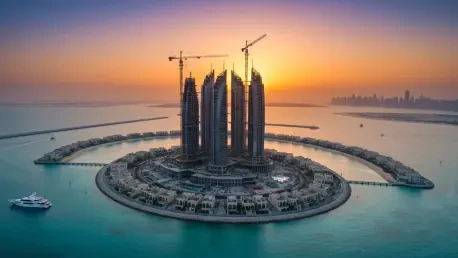
While Abu Dhabi recalibrates for a future of volume, Ras Al Khaimah is experiencing an unprecedented phase of rapid price appreciation fueled by robust investment and ambitious coastal developments. The emirate’s residential capital values soared by 15% year-on-year, a figure that surpasses growth in many other parts of the country. This upward trajectory is overwhelmingly driven by off-plan sales, which constituted an even greater share of transactions than in Abu Dhabi, at 84% of all residential deals recorded between January and September 2025. This amounted to over 4,100 units sold before construction was complete, underscoring the immense speculative and investment interest pouring into the northern emirate. The development of large-scale, master-planned coastal communities has been a primary catalyst, with apartment prices on the flagship Al Marjan Island surging by a remarkable 17% and other key areas posting similar double-digit gains.
The pricing momentum in Ras Al Khaimah now rivals, and in some cases surpasses, the most luxurious and established zones in Dubai. Since 2023, average apartment prices in the emirate have climbed nearly 40%, increasing from approximately AED 2,049 to AED 2,838 per square foot. This meteoric rise has been most pronounced on Al Marjan Island, the site of an upcoming integrated Wynn resort, where average values have now exceeded AED 3,070 per square foot. This figure remarkably places the district’s real estate values ahead of prime areas like Downtown Dubai and Palm Jumeirah on a per-square-foot basis. This rapid value accretion has transformed RAK from a secondary market into a primary destination for high-end real estate investment, making its top-tier properties more expensive than those in many major global cities and signaling a fundamental revaluation of its market position.
A Divergence of Market Destinies
The market dynamics of 2025 painted a clear picture of two emirates on divergent but equally compelling paths. Abu Dhabi’s real estate sector proactively shifted its focus toward sustainability and affordability, a strategic realignment shaped by the anticipation of a significant increase in housing supply and rising rental costs that pushed residents toward ownership. Its growth was managed and deliberate, aimed at fostering a stable, long-term end-user market. In contrast, Ras Al Khaimah’s trajectory was defined by an explosive, investment-led boom. The emirate successfully leveraged mega-projects and intense investor appetite to achieve unprecedented price growth, which re-categorized its market on both a national and global scale. These distinct strategies ultimately demonstrated the UAE property market’s growing sophistication, where different emirates successfully cultivated unique value propositions to attract different segments of buyers and investors.